Our Short List of 3

- Best for: hunters and birders who scan wide ground and rarely need more than 48x.
- Magnification: 16-48x
- Objective lens diameter: 65mm
- Field of view: 138-72 ft at 1,000 yards
- Eye relief: 20.3-18.3mm

- Best for: all-round use across birding, range work and scenery at the standard 20-60x range.
- Magnification: 20-60x
- Objective lens diameter: 80mm
- Model number: 52250
- Prism: BaK-4

- Best for: low-light glassing and detailed 60x work where brightness at full power matters.
- Magnification: 20-60x
- Objective lens diameter: 85mm
- Field of view: 108-60 ft at 1,000 yards
- Eye relief: 20.3-18.3mm
All 4 Picks at a Glance
| Product | Specs | Action |
|---|---|---|
| Vortex Diamondback HD 16-48×65 Angled |
| Check price on Amazon |
| Celestron Ultima 80 20-60×80 Angled |
| Check price on Amazon |
| Vortex Diamondback HD 20-60×85 Angled |
| Check price on Amazon |
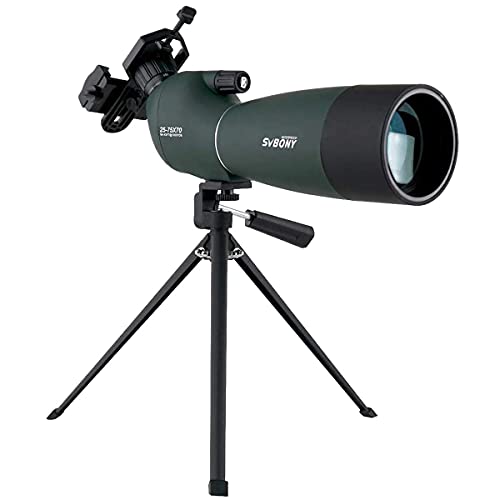 SVBONY SV28 25-75×70 |
| Check price on Amazon |
Key takeaways
- Compare spotting scope magnification from 16-48x to 25-75x and match zoom range, objective size and exit pupil to birding, hunting or range work.
Shopping by magnification looks simple until you compare two scopes side by side and the one with the bigger top number gives the dimmer, shakier picture. The real decision is not how high the zoom goes, but how much of the range stays bright and steady at the distances you actually watch, and how small the exit pupil shrinks when you push to maximum power on a grey morning.
That matters whether you are picking field marks off a distant shorebird, judging antler points across a basin, or reading bullet holes from a bench. The four scopes below were chosen from their Amazon listing titles and specification data to cover four distinct magnification bands, from a wide 16-48×65 up to a 25-75×70, so you can match a zoom range to your ground instead of buying the largest number on the box.
Quick Picks
As an Amazon Associate we earn from qualifying purchases.
| Product | Best for | Key spec from title |
|---|---|---|
| Vortex Diamondback HD 16-48×65 Angled | Wide scanning views | 16-48x zoom, 65mm objective |
| Celestron Ultima 80 20-60×80 Angled | All-round 20-60x use | 20-60x zoom, 80mm objective |
| Vortex Diamondback HD 20-60×85 Angled | Bright 60x viewing | 20-60x zoom, 85mm objective |
| SVBONY SV28 25-75×70 | Highest magnification | 25-75x zoom, 70mm objective |
How to Choose
Match the Zoom Range to Your Typical Distance
Begin with the distance you watch most often, not the farthest shot you can imagine. Birders working a marsh edge and shooters at a 100-yard bench live between 20x and 40x, where a 16-48x or 20-60x range spends its life. Western hunters and shorebird watchers who read detail at several hundred yards use the 45x to 60x band far more. A 25-75x scope only earns its keep when your subjects sit at the long end regularly, because its narrower low end makes finding the subject slower every single time you set up.
Check the Exit Pupil at Maximum Power
Exit pupil is the objective diameter divided by magnification, and it decides how bright the image feels at the top of the range. An 85mm scope at 60x delivers about 1.4mm, while a 65mm scope at 48x keeps roughly the same figure with less zoom on tap. Below about 2mm the view dims quickly in shade or at dusk, and small eye movements begin to black out the image. If you plan to use maximum power in low light, the objective size behind the zoom matters more than the zoom figure itself.
Weigh Field of View at the Low End
Field of view is quoted at 1,000 yards and it shrinks as magnification climbs, so the low-power figure tells you how fast you can find and follow a subject. A scope showing 138 feet at its lowest setting lets you sweep a ridgeline or a flock and settle on one bird without hunting around. A scope that begins at 25x may show barely 64 feet, which feels like looking through a tube when a bird moves. Check the low-end field of view before the top-end power; you will use it every session.
Plan Tripod Support for High Magnification
Every extra turn of the zoom ring multiplies shake along with size. At 20x a light travel tripod copes well enough, but at 60x or 75x the same legs turn a breeze into a swimming image, and heat shimmer over sun-warmed ground can cap useful magnification well below the number on the eyepiece. Budget for a stiff tripod and a smooth head as part of the scope choice, keep the center column low, and expect your clearest high-power views early and late in the day when the air sits still.
The 4 Best Options
Vortex Diamondback HD 16-48×65 Angled
- Best for: hunters and birders who scan wide ground and rarely need more than 48x.
- Magnification: 16-48x
- Objective lens diameter: 65mm
- Field of view: 138-72 ft at 1,000 yards
- Eye relief: 20.3-18.3mm
hunters and birders who scan wide ground and rarely need more than 48x.
the 24.6-foot class of close focus on bigger scopes does not apply here, but 16.4 feet still rules out butterfly-range viewing.
This is the pick for viewers who scan more than they zoom. The 16x low end shows 138 feet at 1,000 yards, the widest view in this group, so finding a hawk on a snag or a herd on a far slope takes seconds rather than a search pattern. The 48x ceiling still resolves antler points and leg bands at sensible ranges, and because the zoom stops earlier, the exit pupil stays near 1.4mm only at the very top instead of through the whole upper band. At 49.8 ounces it also suits hunters who carry a scope all day.
Celestron Ultima 80 20-60×80 Angled
- Best for: all-round use across birding, range work and scenery at the standard 20-60x range.
- Magnification: 20-60x
- Objective lens diameter: 80mm
- Model number: 52250
- Prism: BaK-4
all-round use across birding, range work and scenery at the standard 20-60x range.
the zoom eyepiece is fixed to the body, so there is no option to swap in a wide-angle eyepiece later.
The Ultima 80 covers the classic 20-60x band that most spotting scope buyers end up using, pairing it with an 80mm objective that keeps the exit pupil near 1.3mm at full power. It suits the viewer who splits time between a shooting bench, a hawk watch platform and a shoreline, and wants one scope that behaves predictably in all three places. The 45-degree angled body keeps your neck relaxed during long seated sessions, the multi-coated optics and BaK-4 prism hold contrast well for the class, and a soft carrying case comes in the box.
Vortex Diamondback HD 20-60×85 Angled
- Best for: low-light glassing and detailed 60x work where brightness at full power matters.
- Magnification: 20-60x
- Objective lens diameter: 85mm
- Field of view: 108-60 ft at 1,000 yards
- Eye relief: 20.3-18.3mm
low-light glassing and detailed 60x work where brightness at full power matters.
at 60.9 ounces plus a tripod, this is a vehicle or short-hike scope, not a backcountry carry.
Same 20-60x range as the Celestron, but the 85mm objective is the point. That extra glass lifts the exit pupil to 4.25mm at 20x and holds about 1.4mm at 60x, so the top of the zoom stays usable at dawn and dusk when smaller scopes fade. Shorebird watchers reading leg flags and hunters judging game in first light get the most from it. The helical focus collar adjusts quickly without snagging on brush, and the Arca-Swiss foot drops straight onto compatible tripod heads. You pay for the glass in weight, at 60.9 ounces.
SVBONY SV28 25-75×70
- Best for: fixed-position viewing where maximum magnification matters more than a wide view.
- Magnification: 25-75x
- Objective lens diameter: 70mm
- Field of view: 64-43 ft at 1,000 yards
- Close focus: 8m
fixed-position viewing where maximum magnification matters more than a wide view.
at 75x the exit pupil drops under 1mm, so the image dims and steadiness demands a solid tripod.
The SV28 is the answer when the question is purely how much magnification you can get. Its 25-75x zoom reaches past every other scope here, which helps when you are reading a target at the far end of a range or picking out a distant raptor from a fixed vantage point. The trade shows at the low end: 25x is the floor, and the field of view narrows to 64 feet at 1,000 yards, so locating a moving subject takes practice. The kit softens the learning curve with a tripod, a phone adapter and a carrying case in the box.
Which One Fits Your Situation
Scanning Open Country for Game
Pick the Diamondback HD 16-48×65. Glassing a basin means sweeping large areas at low power, and its 138-foot field of view at 16x covers ground faster than any 20x or 25x floor can. When something worth a closer look appears, 48x is enough to judge size and headgear at hunting distances, and the lighter body is easier to carry between vantage points all morning.
Reading Hits at the Range
Pick the Celestron Ultima 80 or the Diamondback HD 20-60×85. Bench work lives between 30x and 60x depending on distance and caliber, and both scopes put that band behind an 80mm or 85mm objective, which keeps small holes readable against bright paper. The angled bodies suit a seated position behind the scope, and neither asks you to pay for zoom range you will never use at the bench.
Watching Shorebirds and Waterfowl
Pick the Diamondback HD 20-60×85 for identification work at long range, where plumage detail and leg bands sit right at the edge of what 60x can resolve. Its brighter top end helps on overcast mornings over water. If your marsh work is closer and faster moving, drop to the 16-48×65 instead; the wider view keeps birds in frame as they shift along the shoreline.
Digiscoping From a Fixed Spot
Pick the SVBONY SV28. A phone adapter comes in the box, and the 25-75x range lets you fill the frame with a distant subject from a hide, a deck or a vehicle window mount. Keep expectations matched to the physics: shoot most of your images between 30x and 50x, where the image stays bright, and treat 75x as a fair-weather tool for still air and strong light.
Common Mistakes
- Buying by the top magnification number alone, then finding the image too dim and shaky to use at that setting.
- Mounting a 60x or 75x scope on a light photo tripod and blaming the optics for the swimming image.
- Ignoring exit pupil, then wondering why a smaller scope looks brighter at dusk despite a lower zoom figure.
- Judging a scope at midday in heat shimmer, when rising warm air caps useful magnification for every model.
- Choosing the largest objective for a backpack hunt, then leaving it behind because of the weight.
Frequently Asked Questions
What Magnification Is Best for Bird Watching?
Most birding happens between 20x and 45x. That band balances detail for identification with a field of view wide enough to follow movement and an exit pupil large enough for overcast light. A 20-60x scope covers it comfortably, while a 16-48x model suits closer work. Reserve 60x for calm air and distant, still subjects such as waders on a far shoreline.
Is 75x Magnification Actually Usable?
Yes, in the right conditions. At 75x you need a rigid tripod, still air and a subject that holds still, which is why scopes in that class suit ranges, hides and seawatching. In wind or midday heat shimmer the image breaks up well before 75x, and the exit pupil under 1mm makes the view dim. Think of it as a fair-weather ceiling, not an everyday setting.
Does a Bigger Objective Lens Make High Magnification Clearer?
It makes it brighter, which often reads as clearer. Magnification comes from the eyepiece, but the objective decides how much light reaches your eye at that power. An 85mm lens at 60x delivers an exit pupil near 1.4mm, while a 65mm lens at the same power drops toward 1.1mm and looks noticeably duller in shade. Glass quality still sets the sharpness limit.
What Tripod Does a 60x Scope Need?
Look for a tripod with stiff legs, a head that locks without drift, and enough height to keep the center column mostly down. Every bit of column extension adds wobble that 60x will show you. A scope foot that mounts directly to an Arca-Swiss head removes one flex point. If the image still swims, hang weight from the tripod hook and shield the setup from wind.