Our Short List of 3
All 3 Picks at a Glance
| Product | Specs | Action |
|---|---|---|
 BETAFPV BT2.0 450mAh 1S 30C LiPo Battery (4-Pack) | Check price on Amazon | |
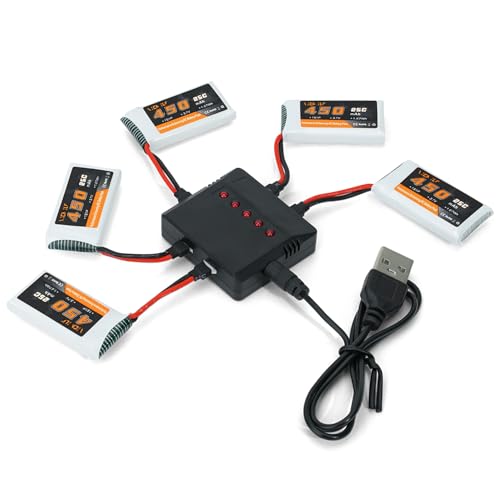 VICMILE 3.7V 450mAh 25C LiPo Drone Battery (5-Pack) | Check price on Amazon | |
 URGENEX 3.7V 450mAh 25C LiPo Drone Battery (5-Pack) | Check price on Amazon |
Key takeaways
- Find the best 1S 450 mAh battery for your tiny whoop or micro drone. Compare three proven packs, connectors, and charging tips before you buy.
A 1S 450 mAh battery sits at the sweet spot for tiny whoop drones and micro RC aircraft. It is light enough to keep a small quad nimble, yet it carries enough energy for useful flight sessions indoors and in calm outdoor air. Pilots flying 65 mm and 75 mm whoops, along with owners of small toy-grade quadcopters, reach for this size more than any other, because it balances flight time, weight, and punch in a way that smaller cells cannot match and larger cells spoil with extra mass.
The catch is that not every pack labeled 1S 450 mAh behaves the same way. Connector style, nominal voltage, discharge rating, and physical size all decide whether a battery slides into your drone and delivers steady power or sags the moment you punch the throttle. This guide compares three packs sold for this job, so you can match a battery to your aircraft instead of guessing.
As an Amazon Associate, we earn from qualifying purchases.
Quick Answer
For most 1S tiny whoop pilots, the BETAFPV BT2.0 450mAh pack is the strongest all-round choice, thanks to its durable BT2.0 connector and high-voltage cell. If you fly a small toy quad with a Molex plug, the VICMILE five-pack is the practical pick, while the URGENEX five-pack offers a similar Molex setup with its own included charger. Match the connector first, then the voltage.
How to Choose
Choosing a 1S 450 mAh battery starts with the connector, because nothing else matters if the plug does not fit. Tiny whoops built in the last few years commonly use one of three plugs: BT2.0, PH2.0, or Molex. BT2.0 is the modern standard on brushless whoops from makers such as BETAFPV, and it handles higher current with less voltage drop than the older PH2.0 design. PH2.0 remains common on many micro quads, including several EMAX Tinyhawk models and HappyModel aircraft. Molex plugs appear mostly on toy-grade drones from brands such as SYMA and Holy Stone, where the battery bay and lead are sized for that plug. Check your drone manual or look at the plug on the battery that came in the box before ordering anything. Adapters exist, but they add weight and a failure point on an aircraft where every gram counts.
Voltage is the next detail to get right. A standard 1S LiPo cell has a nominal voltage of 3.7 volts and charges to 4.20 volts. A high-voltage LiHV cell has a nominal voltage of 3.8 volts and charges to 4.35 volts. LiHV packs deliver a little more punch on aircraft tuned for them, but they only reach full performance on a charger with a LiHV mode. If your charger lacks a high-voltage mode, a standard 3.7 volt pack is the safer and simpler choice.
Discharge rating, printed as a C number, tells you how quickly a cell can deliver its stored energy. A 25C pack suits gentle cruising and toy drones with modest motors. A 30C pack adds headroom for quick climbs and light freestyle moves. Higher ratings such as 75C or 80C exist for racing whoops with powerful motors, and they hold voltage better during hard throttle bursts. For most indoor flying, a rating between 25C and 30C is plenty.
Physical size and weight matter as much as the electrical specs. A 1S 450 mAh cell typically measures around 60 mm long, 15 to 20 mm wide, and 7 to 8 mm thick, and weighs roughly 12 to 13 grams. Battery bays on tiny whoops are molded to tight tolerances, so a pack that is a few millimeters too wide can refuse to seat properly or shift in flight and change the center of gravity. Weigh your current pack if you can, and compare the listed dimensions of any replacement before buying. A heavier pack also changes how the quad handles: it flies a little longer in a straight line but turns more slowly and lands harder.
Pack quantity is a practical question. One battery gives most whoops only a few minutes in the air, so pilots usually buy four, five, or six at a time and rotate through them during a session. A set of four to six packs, used in rotation and stored at partial charge, is a sensible starting point for most pilots.
Charging and care deserve as much attention as the purchase itself. Always charge LiPo cells on a charger made for them, never leave a charging battery unattended, and stop using any cell that puffs, feels hot after normal use, or shows damaged leads. Store cells at roughly half charge when they will sit for more than a few days, and keep them in a fire-resistant bag away from flammable material. A damaged or swollen cell belongs in a proper battery recycling point, not in the trash and not in your drone.
Finally, think about the aircraft you actually fly. A brushless tiny whoop with a BT2.0 lead wants a BT2.0 high-voltage pack. A small toy quad with a Molex lead wants a standard-voltage Molex pack. Buying the wrong connector and hoping an adapter fixes it is the most common mistake in this category, and it is entirely avoidable with a thirty-second check of the plug on your existing battery.
BETAFPV BT2.0 450mAh 1S 30C LiPo Battery (4-Pack)
The BETAFPV BT2.0 450mAh pack is the reference battery for modern 1S brushless tiny whoops. It was designed around the BT2.0 connector, which uses solid pins instead of the folded crimp pins found on older PH2.0 plugs. That change sounds minor, but it is the reason this pack holds voltage better under load: the connection stays tight through vibration and repeated plug cycles, so the motors see steadier current during climbs and quick direction changes. Pilots moving from PH2.0 packs to BT2.0 packs often notice the difference most in the second half of a flight, when an older plug would start to sag.
Each cell is a high-voltage LiHV design with a nominal voltage of 3.8 volts and a full charge voltage of 4.35 volts. The 30C continuous discharge rating, with a higher burst rating for short peaks, is well matched to 65 mm and 75 mm whoops running small brushless motors. It is not the highest C rating on the market, and that is a deliberate trade: the cell stays light at around 12.7 grams while still delivering clean throttle response for indoor racing lines and freestyle practice.
Fit is another strength. At roughly 62 mm long, 15.5 mm wide, and 6.7 mm thick, the pack slides into the battery bays of the Meteor75, Cetus Pro, Cetus X, and similar 1S brushless whoops without forcing. The lead length is short, which keeps wiring tidy inside a small frame and avoids snagging a propeller. Four packs in the box is enough for a solid practice session when paired with a multi-port charger, and rotating four cells keeps any single cell from being hammered flight after flight.
This is also the pack to choose if you fly an EMAX Tinyhawk and are willing to convert its lead to BT2.0. Many Tinyhawk owners make that change because the connector upgrade improves consistency across their whole fleet, letting one battery type serve several aircraft. The conversion itself is simple soldering work, but it should only be attempted by someone comfortable with a soldering iron and LiPo safety.
Who Should Skip It
Skip this pack if your drone uses a PH2.0 or Molex plug and you do not want to change connectors, since the BT2.0 plug will not mate with those leads. Skip it as well if your charger has no LiHV mode, because you will not reach the full charge voltage that makes this cell worth choosing. Toy-grade quad owners should look at the Molex packs below instead.
VICMILE 3.7V 450mAh 25C LiPo Drone Battery (5-Pack)
The VICMILE five-pack is built for the other half of the 1S 450 mAh world: small toy-grade quadcopters with Molex plugs. Aircraft such as the SYMA Q11, Holy Stone HS170 series, and similar mini quads use a small white Molex connector and a battery bay sized for a slim rectangular cell. This pack matches that format exactly, measuring 37 mm by 20 mm by 8.1 mm and weighing about 12 grams, so it drops into those bays without trimming or forcing.
Electrically it is a standard-voltage cell: 3.7 volts nominal, charging to the usual 4.20 volt limit on any ordinary LiPo charger. That simplicity is a genuine advantage for casual pilots. There is no LiHV mode to remember, no special charger to buy, and no risk of selecting the wrong charge profile. The included 5-in-1 USB charger tops up all five cells at once from a USB port, which turns a short flying session into a longer one with almost no extra gear. For a pilot whose drone came with a single battery and a basic charger, this kit is the fastest way to multiply flight time.
The 25C discharge rating fits the intended aircraft. Toy quads draw modest current, and a 25C cell delivers it without strain or excess heat. Flight behavior stays predictable: steady lift, smooth throttle response, and a gentle power fade near the end of the charge that signals it is time to land, rather than a sudden cutoff.
Who Should Skip It
Skip this pack if your drone uses a BT2.0 or PH2.0 connector, because the Molex plug will not fit without an adapter. Skip it as well if you fly a brushless FPV whoop that demands high burst current, since the 25C rating and standard voltage are tuned for lighter-duty toy aircraft rather than racing quads.
URGENEX 3.7V 450mAh 25C LiPo Drone Battery (5-Pack)
The URGENEX five-pack covers the same ground as the VICMILE kit: a standard-voltage 1S 450 mAh cell with a Molex plug, sold as a ready-to-fly bundle with a 5-in-1 charger. It fits the same family of small quadcopters, including SYMA and Holy Stone models, and it follows the same slim dimensions of 37 mm by 20 mm by 8.1 mm at about 12 grams per cell. For pilots who already know their drone takes this format, it is a direct drop-in replacement set.
The practical difference between the two Molex kits comes down to availability and personal preference rather than a gap in specs. Both use 3.7 volt standard LiPo chemistry, both are rated at 25C, and both ship with a multi-port USB charger that handles five cells at once. URGENEX lists a cycle life of at least 500 charge cycles for these cells, which is a reasonable expectation for a well-cared-for LiPo in this class.
In the air, the behavior matches the format: smooth, predictable power for small toy quads, with a gentle taper near the end of the charge. The cells are light enough that they do not upset the balance of a small quad, and the Molex plug seats firmly without wobble. Owners of Holy Stone HS170, HS170G, and HS170C models, along with SYMA Q11 and similar aircraft, will find the fit familiar from the first flight.
The included charger is the same style of 5-in-1 USB board found in competing kits, and it is genuinely useful. Charging five cells at once from one USB port means a pilot can prepare a whole session the night before or top up between outings without a bench charger. Just remember that USB charging is slow compared with a dedicated hobby charger, so plan ahead rather than expecting a quick turnaround between flights.
Who Should Skip It
Skip this pack if your drone uses a BT2.0 or PH2.0 connector, or if you fly a brushless FPV whoop that needs higher discharge headroom and high-voltage cells. It is tuned for toy-grade quads, and forcing it into a racing role will only disappoint.
Who Should Skip It
A 1S 450 mAh battery is not the right purchase for every pilot. If your drone uses a 2S or 3S battery, this size will not power it at all, so check the cell count in your manual before ordering. If your aircraft is a larger 3-inch or 5-inch FPV quad, it needs far more capacity and voltage than a single 450 mAh cell can provide. Pilots who fly only camera drones from mainstream brands should also look elsewhere, because those aircraft use proprietary smart batteries rather than hobby LiPo cells.
Beginners who have never handled a LiPo should also pause and learn the basics first. These cells demand a proper charger, attention during charging, and storage at partial charge. That is not difficult to learn, but it is not optional either. Finally, anyone whose drone manual specifies a different capacity, such as 300 mAh or 550 mAh, should follow the manual: a larger cell may not fit the bay, and a smaller one may not deliver the flight time the aircraft was tuned for.
FAQ
What drone uses a 1S 450 mAh battery?
Tiny whoop drones and micro FPV quads are the main users, including 65 mm and 75 mm brushless whoops such as the BETAFPV Meteor75 and Cetus series, plus EMAX Tinyhawk models. Small toy quadcopters from SYMA and Holy Stone also use this size with a Molex plug. Always confirm the connector and battery bay size in your drone manual before ordering.
Can I use a 450 mAh battery in a drone that came with a 300 mAh battery?
Sometimes, but only if the dimensions and connector match and the extra weight stays within what the motors can lift. A 450 mAh cell is physically larger than most 300 mAh cells, so measure the battery bay first. If the pack fits and the plug matches, the larger cell usually gives longer flights, though the quad may feel slightly less agile.
Do I need a special charger for a LiHV 1S 450 mAh battery?
Yes, to get the full benefit. LiHV cells charge to 4.35 volts per cell, while standard LiPo chargers stop at 4.20 volts. A charger with a LiHV or high-voltage mode is needed to reach full charge. Standard 3.7 volt packs, such as the Molex kits in this guide, charge fine on any ordinary LiPo charger.
How long does a 1S 450 mAh battery last per flight?
Most tiny whoops fly for around three to five minutes on a full charge, depending on motor size, flying style, and wind. Gentle indoor cruising stretches flight time toward the upper end, while aggressive freestyle moves and outdoor wind shorten it. Carrying four or five packs and rotating them is the usual way pilots extend a session.
Final Verdict
The best 1S 450 mAh battery depends on the plug on your drone, and that single check narrows the field fast. For brushless tiny whoop pilots, the BETAFPV BT2.0 pack is the clearest pick: its solid-pin connector holds voltage under load, its high-voltage cell adds punch, and its size fits the whoops it was built for. For owners of small toy quadcopters with Molex plugs, the VICMILE and URGENEX five-packs are equally practical, each pairing five standard-voltage cells with a multi-port charger that keeps the flying going.
Product and ASIN Reference
| Product | ASIN |
|---|---|
| BETAFPV BT2.0 450mAh 1S 30C LiPo Battery (4-Pack) | B0CQR1MCRZ |
| VICMILE 3.7V 450mAh 25C LiPo Drone Battery (5-Pack) | B0C4NTP1YF |
| URGENEX 3.7V 450mAh 25C LiPo Drone Battery (5-Pack) | B0CQ71ZS1X |