Key takeaways
- Find the best oscillating sprinklers for rectangular lawns, comparing coverage area, nozzle counts, base types, and the controls that shape each spray pattern.
An oscillating sprinkler solves a specific problem that round-pattern sprinklers handle badly: most lawns are rectangles. A spray bar sweeps back and forth and lays water in a rectangular footprint, so the corners of a typical front or back yard get watered instead of being left dry while the middle of the lawn gets soaked and the driveway gets washed. The models below were chosen for that job, and they differ mainly in how much ground they cover, how their bases sit on the lawn, and how precisely their controls let you trim the pattern to your edges.


Every pick here is a true oscillating sprinkler with a moving spray bar. There are no impact heads, no rotary models, and no traveling sprinklers mixed in, because those water in different shapes and solve different problems. What changes from one pick to the next is coverage, build material, and the style of adjustment, so the right choice depends on the size and shape of your lawn and on how often you expect to move the sprinkler during a session.
Quick Picks
Our Short List of 3
All 4 Picks at a Glance
| Product | Specs | Action |
|---|---|---|
| Melnor 65154AMZ XT Turbo Oscillating Sprinkler | Check price on Amazon | |
| Dramm 15001 ColorStorm Oscillating Sprinkler | Check price on Amazon | |
 Melnor 65137AMZ MiniMax Turbo Oscillating Sprinkler on Step Spike | Check price on Amazon | |
 Melnor 65148AMZ TurboTek Oscillating Sprinkler | Check price on Amazon |
How to Choose an Oscillating Sprinkler
Match the stated coverage to one placement, not the whole yard
The coverage figure on the box is the largest rectangle the sprinkler can water from a single position at strong household pressure. Measure the section you actually plan to water in one placement, length times width, and pick a model whose stated coverage clears that number with room to spare. A long hose run, an uphill lawn, or a supply shared with another tap will shrink the real pattern, and a sprinkler working at the edge of its capacity leaves the far corners thin. Headroom also lets you use the range controls to pull the pattern in to your borders instead of stretching the spray to reach them.
Count the controls, not just the nozzles
Three adjustments matter on an oscillating sprinkler. Range control shortens or lengthens the sweep of the bar, width control narrows the fan from side to side, and flow control reduces the overall amount of water without changing the pattern shape. A model with all three can be tuned to a narrow side yard in the morning and a wide back lawn in the afternoon. A model with only range tabs is simpler and perfectly workable for one fixed patch, but you will move it more often if your lawn changes shape from one section to the next.
Decide how the base should sit
A weighted metal sled base stays where you put it and resists tipping when pressure surges, which suits flat, open lawns. A step spike anchors the head in soft ground and keeps a compact unit upright on gentle slopes and in garden beds, and it stores in far less space. Spike bases struggle in hard, dry, or rocky soil, while wide sled bases can rock on lumpy ground. Think about where the sprinkler will actually sit most weeks, not just where it would sit on the best part of the lawn.
Think about the water you have
Oscillating sprinklers run on the water passing through them, and the drive mechanism has to push the bar back and forth against that flow. Homes on well water or with gritty municipal supply benefit from a dirt-resistant drive and from nozzles that can be cleaned, because a single clogged jet leaves a dry stripe across the whole rectangle. Brass jets and clean-out plugs are worth attention if your water carries sediment, and a mesh filter washer at the inlet is worth keeping in place rather than discarding during setup.
The Picks
Melnor 65154AMZ XT Turbo Oscillating Sprinkler
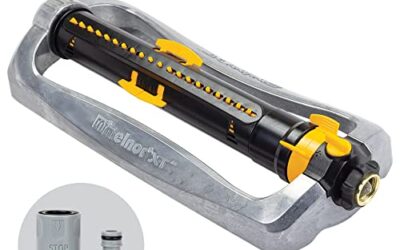
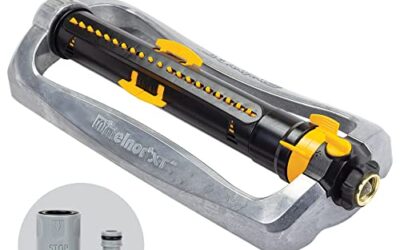
This is the wide-coverage option in the group, built around a metal sled base and a stated maximum of 4,500 square feet through 20 precision nozzles. The control set is the fullest here: a zoom control adjusts the overall watering area, and separate adjustments handle width and range, so the rectangle can be shrunk down for a patch of new seed or opened up for a full section of back lawn without moving the base. The listing also describes a dirt-resistant drive intended to keep the sweep smooth on well water, and the bundle includes Melnor’s QuickConnect adapter for faster hose changes.
Choose this one when a single placement needs to cover a large, straight-edged lawn and you want to shape the pattern from the sprinkler rather than by repositioning it. The trade-off is size and weight: the metal base that keeps it planted also makes it the bulkiest unit here to carry between zones and to store. It is covered by a limited lifetime warranty according to the listing, which suits a sprinkler expected to live outdoors season after season.
Dramm 15001 ColorStorm Oscillating Sprinkler
Dramm builds this model around materials rather than electronics-style controls: a heavy-duty metal body and base fitted with 18 brass nozzle jets. The stated coverage is up to 3,036 square feet, described as a rectangle of about 66 feet by 46 feet at the widest setting, and adjustment comes from a dial and tab that change the pattern and spray distance. A needle plug is included for clearing the brass jets, which matters because brass nozzles reward occasional cleaning with a very even fan of water.
This is the pick for a medium lawn and for anyone whose previous plastic sprinklers cracked, faded, or developed leaks at the fittings. The metal construction is heavier than the polymer models, at roughly two and a half pounds, and the adjustment system is less granular than the three-way controls on the XT Turbo, so fine shaping of the pattern takes a little more patience. In return you get the simplest, most serviceable design in the group, backed by a lifetime limited warranty.
Melnor 65137AMZ MiniMax Turbo Oscillating Sprinkler on Step Spike
The MiniMax takes the oscillating mechanism off the sled entirely and mounts it on a metal step spike that you push into the ground with a foot. Despite the compact head, the stated coverage reaches up to 4,000 square feet, and the controls are four-way: width, range, and flow, plus a head that rotates a full circle so you can aim the rectangle without pulling the spike out and starting again. The base is a flow-through design, which means a second sprinkler can be chained behind the first on the same hose run for long or awkward areas, pressure permitting.
Pick this model for irregular corners, planting beds, slopes where a sled would rock, and new lawn areas where you want the head up off the soil. It is also the easiest of the four to store, since there is no wide base to find shelf room for. The limits are in the ground itself: hard, dry, or stony soil makes the spike difficult to seat, and a spike unit can lean if the soil softens during a long watering. The listing shows a limited lifetime warranty and a dirt-resistant drive, the same drive family used in the larger Melnor models.
Melnor 65148AMZ TurboTek Oscillating Sprinkler
The TurboTek is the smaller, simpler end of the line: 16 precision nozzles, a stated coverage of up to 2,800 square feet, and sliding range adjusters that set how far the bar sweeps. The body is a reinforced polymer rather than metal, which keeps it light to move between a front lawn and a side strip, and the drive is Melnor’s InfinityDrive turbo motor, described as a sealed, dirt-resistant mechanism for smooth oscillation. The bundle includes the QuickConnect product adapter, and the listing rates the unit for a maximum pressure of 80 pounds per square inch.
This is the sensible pick for small to medium lawns, townhouse yards, and newly seeded patches where a gentle, contained rectangle matters more than maximum reach. You give up the width and zoom shaping of the XT Turbo and the reach of the other three, so a big lawn means more placements per session. In exchange, the simpler control set is quick to set, the lighter body is easy to carry and store, and the listing carries a seven-year limited warranty, the longest fixed-term coverage in this group.
Setting Up for an Even Pattern
Place the sprinkler on the flattest ground inside the area you want to water, then turn the water on partway and watch one full sweep before opening the tap fully. Adjust range first so the ends of the sweep land just inside your borders, then trim width so the fan does not reach paths, walls, or the street. If the pattern falls short at the far end, your pressure or flow is the limit, and shortening the hose run or removing a splitter usually recovers more distance than opening the controls further.
Overlap placements slightly when you move the sprinkler. The edges of an oscillating pattern receive less water than the middle, so shifting the unit by about half its pattern width between placements evens out the total. A few straight-sided cans or jars placed around the lawn during a timed session will show you how much water each zone actually received, and that simple check is more useful than guessing from how wet the surface looks.
Care That Keeps the Sweep Smooth
Most oscillating problems trace back to grit. Rinse the inlet filter washer at the start of the season and whenever the sweep slows, and run clean water through the bar before storage. On models with a clean-out plug or needle tool, clear any jet that throws a crooked stream rather than leaving a dry stripe to widen over the summer. Drain the sprinkler before freezing weather and store it out of direct sun; polymer bodies in particular age faster when they live on the lawn year-round. A sprinkler that stops mid-sweep usually needs cleaning or more flow, not replacement, so work through those two checks before giving up on it.
Which One Fits Your Lawn
For one large rectangle watered from a single spot, the Melnor XT Turbo 65154AMZ has the coverage and the control set to shape its pattern to your borders. For a medium lawn and a preference for metal and brass parts you can clean and keep for years, the Dramm ColorStorm is the durable choice. For corners, beds, slopes, and chained runs, the MiniMax on its step spike goes where sled bases cannot. For smaller lawns and new seed, the TurboTek covers modest ground with the simplest setup of the four. Match the stated coverage to the largest single section you water, keep some headroom for your real pressure, and any of these will water a rectangle more evenly than a round pattern ever will.
Disclosure: As an Amazon Associate, this site may earn from qualifying purchases made through links in this article, at no additional cost to you.