Key takeaways
- Compare the best water bottles for construction workers, from a PACKOUT-locking steel bottle to a hi-vis jug, with capacities, lids and jobsite specs.
Quick answer: For most construction workers, the Milwaukee PACKOUT 36 oz Insulated Bottle with Chug Lid is the best water bottle to buy, because its thicker 18/8 stainless steel body, leakproof chug lid and twist-to-lock PACKOUT base are designed for tool storage systems already on the truck. Crews who run through water fast should look at the 40 oz Thermos ICON, climbers who carry everything on their backs should look at the lightweight Hydro Flask Trail Series 32 oz, coffee drinkers get the tightest hot seal from the Zojirushi SM-VA60, and the Under Armour Playmaker Jug covers the budget hi-vis role.
As an Amazon Associate, we earn from qualifying purchases.
A water bottle that works in an office fails on a jobsite in predictable ways. It gets knocked off a tailgate onto concrete. It rides in a dusty gang box. It is opened with gloved hands, drunk from one-handed on a ladder, and expected to still pour cold water at three in the afternoon after sitting in a hot truck cab since six. The five bottles in this guide were chosen for that reality: steel bodies that tolerate drops, lids that seal against dust and can be worked with gloves on, capacities matched to how far the water cooler actually is, and insulation that survives a full shift in summer heat.
The lineup covers the main jobsite roles rather than five versions of the same bottle. There is a tool-system bottle that locks into PACKOUT storage, a big twist-and-pour classic in the lunchbox tradition, a featherweight bottle for roofers and tower hands who haul their own water up, a compact flip-top built for the morning coffee, and a foam-insulated jug in hi-vis yellow that hangs off the fence by the gate. Every pick is a current Amazon listing with a verified identifier, recorded in the reference table at the end.
Table of Contents
- How to Choose a Water Bottle for Construction Work
- Quick Comparison
- The 5 Best Water Bottles for Construction Workers
- Safety and Checks Before You Order
- Frequently Asked Questions
- Conclusion
How to Choose a Water Bottle for Construction Work
Start with the lid: gloves, dust and one hand
The lid decides whether a bottle works on site. You will open it wearing work gloves, often with one hand, and the drinking surface sits exposed to concrete dust, drywall dust and metal shavings all day. Chug caps with a covered spout are the jobsite default for a reason: the cap flips or twists open fast, the mouthpiece stays covered between drinks, and the flow is quick enough to matter during a short break. Flip-top lids with a positive lock, like the one on the Zojirushi in this guide, suit coffee and truck cabs because they cannot pop open in a bag or box. Traditional twist-and-pour stoppers, like the Thermos ICON design, pour without fully opening, which keeps dust out and heat in, but they are a two-handed operation and a poor match for drinking on the move.
Straw lids deserve a caution here. They are excellent in gyms and offices, but an exposed straw collects dust, and a straw that sits in a hot truck all day is the hardest drinking surface in this guide to keep clean. If your work is dusty, choose a lid that covers the part your mouth touches.
Capacity and the refill reality
Capacity should follow the distance to the refill point, not a number on a product page. On a commercial site with a water station on every floor, a 32 oz bottle refilled at breaks is plenty and keeps carry weight sane. On residential framing, roofing or site work where the cooler lives in the truck and the truck is a climb down and a walk away, 36 to 40 oz stretches each trip further. True half-gallon jugs exist for remote work, but remember that water weighs about 8.3 pounds per gallon before the bottle itself, so a half gallon is over four pounds of water alone; that is a cooler-side bottle, not a carry bottle.
Heat guidance from occupational safety sources is built around frequent drinking rather than heroic single loads: small amounts often, with total intake across a hot shift running well past a single bottle. The practical takeaway is that your bottle is one link in a chain that includes the site cooler, so buy for the longest gap between refills in your actual day.
Insulation: vacuum steel versus foam
Vacuum-insulated stainless steel is the standard for a reason. A double-wall bottle with the air removed keeps ice water cold through a summer shift and coffee hot through a winter morning, and the steel body doubles as the durability story. Published retention figures vary by maker and test method, so treat hour ratings as comparisons within a brand rather than laboratory truth across brands.
Foam-insulated plastic, like the Under Armour jug in this guide, is the budget alternative. It will not match steel on retention, but it is light, cheap to replace when it inevitably gets crushed or lost, and honest about its role: cold water for a few hours near the work area, not all-day performance in a hot cab. If your bottle lives in direct sun on a roof deck, steel earns its place; if it hangs on the fence by the laydown yard, foam is a rational buy.
Durability is wall thickness, base design and finish
All five picks here will dent eventually; the question is how the bottle handles it. Thicker steel walls resist the deep dents that crack vacuum seals, and a bottle that loses its vacuum still works, it just stops insulating. Powder-coated finishes grip better with gloves and hide scuffs, while bare steel shows every mark but never flakes. Bases matter more than marketing suggests: a non-slip base keeps a bottle upright on a vibrating saw table or a sloped truck bed, and a bottle that locks into a storage system, like the Milwaukee in this guide, removes the rolling-around-in-the-cab problem entirely.
Lids are the usual failure point, not bodies. Hinges, flip mechanisms and gaskets wear out before steel does, so check whether the maker sells replacement lids and gaskets for the model you choose, and treat a bottle with no spare-parts path as a shorter-lived purchase.
Carry, hooks and the cup-holder reality
How the bottle travels matters as much as how it insulates. A sturdy carry handle that fits gloved fingers, a fence hook for chain-link and scaffold, or a base that locks into tool storage all beat a smooth bottle that lives loose in the cab. One honest warning on cup holders: wide jobsite bottles are built for capacity, not for console cup holders. The Milwaukee in this guide measures about 3.93 inches across, which is wider than most truck cup holders, so measure yours before assuming any 36 or 40 oz bottle will ride in the console. Narrower bottles exist for that job; these five are chosen for the site first and the cab second.
Cleaning for dusty work
Jobsite bottles get dirty in ways kitchen bottles never do. Concrete dust works into lid threads, sugary drinks bake inside in the heat, and a bottle that cannot be scrubbed properly becomes a bottle nobody drinks from. Wide mouths that fit a bottle brush and ice cubes are worth real money here. Check the care line for each model: some steel bottles in this guide are dishwasher safe, others are hand wash only, and lid assemblies with small gaskets need a weekly rinse-and-dry routine to stay fresh. A seamless interior, like the Zojirushi design, removes the gasket seam where residue usually collects.
Quick Comparison
| Product | Capacity | Lid Type | Insulation | Best For |
|---|---|---|---|---|
| Milwaukee PACKOUT Insulated Bottle | 36 oz | Chug cap | Vacuum steel | Crews running PACKOUT storage |
| Thermos ICON Series Beverage Bottle | 40 oz | Twist-and-pour stopper | Vacuum steel | Big water and coffee volume |
| Hydro Flask Trail Series Wide Mouth | 32 oz | Flex Cap | Vacuum steel | Light carry at height |
| Zojirushi SM-VA60 Stainless Mug | 20.3 oz | One-touch flip | Vacuum steel | Morning coffee on site |
| Under Armour Playmaker Jug | 32 oz | Jug cap | Foam-insulated plastic | Budget hi-vis fence bottle |
The 5 Best Water Bottles for Construction Workers
1. Milwaukee PACKOUT 36 oz Insulated Bottle with Chug Lid — The Jobsite Native

Best for: Framers, electricians, plumbers and remodelers who already run Milwaukee PACKOUT storage and want a bottle that locks into the system instead of rolling around the cab.
Milwaukee built this bottle the way it builds tools, and the details show it. The body is 18/8 stainless steel with a thicker wall than typical drinkware, pitched by the maker as impact-resistant, and the base carries the twist-to-lock PACKOUT connectivity that clicks into PACKOUT boxes, organizers and mounting plates. On a truck or trailer already organized around that system, the bottle gets a fixed home, which solves the oldest jobsite bottle problem: it is always where you left it, upright, instead of under the seat.
The chug lid is the right lid for site work. It is leakproof, opens fast enough to use with gloves, pours a quick high-flow drink during a short break, and the whole bottle is dishwasher safe, which matters after a week of dust. At 36 oz it sits in the jobsite sweet spot: enough water to stretch between cooler trips on most sites without the carry weight of a half-gallon jug. Milwaukee rates it for all-day hot and cold retention, and the double-wall vacuum build supports using it as a coffee bottle in winter and an ice-water bottle in summer without swapping gear.
The honest trade-offs are size and system lock-in. At about 12.48 x 3.93 inches it is a wide bottle; published sources disagree on console cup-holder fit, and at that diameter the safe assumption is that most standard holders are too small. It also makes the most sense inside the PACKOUT ecosystem. If your truck runs a different storage system, the twist-lock base is just a wide base, and the Thermos below may be the simpler buy.
Specs
- Capacity: 36 oz (1.06 L)
- Material: 18/8 stainless steel, thicker impact-resistant wall
- Insulation: Double-wall vacuum; rated by the maker for all-day hot and cold retention
- Lid: Leakproof chug lid with carry handle
- Base: Twist-to-lock PACKOUT connectivity
- Dimensions: 12.48 x 3.93 in; about 1.8 lb
- Care: Dishwasher safe
- Tier: Premium
2. Thermos ICON Series Stainless Steel Beverage Bottle, 40 oz, Granite — The Big Steel Classic
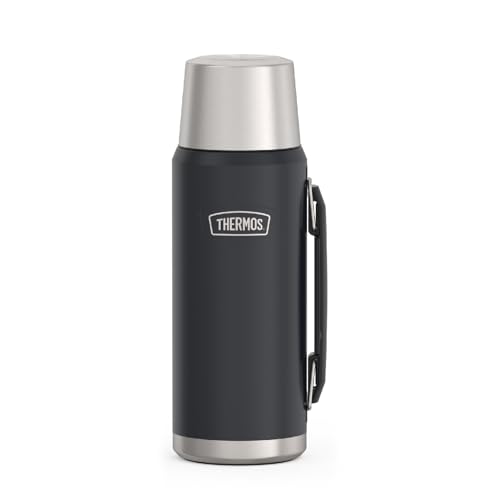
Best for: Workers who carry one fill for water and coffee across a long shift, and anyone raised on the twist-and-pour Thermos tradition who wants the modern version of it.
The ICON Series is Thermos updating its own classic. The 40 oz capacity is the largest in this guide, the body is 18/8 stainless steel with vacuum insulation, and the DURA-TEMP stopper pours with a partial twist so the bottle never sits fully open collecting dust while you fill a cup. That lid cup is a real feature on site: the double-wall drink cup doubles as a serving cup, which is how generations of workers have shared coffee on a tailgate, and the TRAVERSE carry handle plus the GRIPTEC non-slip base are modern additions aimed at grip and stability.
For construction use, the size is the argument. Forty ounces of coffee stays hot through a winter morning pour by pour, and forty ounces of ice water covers a longer stretch between cooler trips than any 32 oz bottle here. The wide mouth takes ice and a bottle brush, and the listing rates the bottle dishwasher safe on the top rack. It is also the most traditional bottle in the guide: no flip mechanism, no straw, nothing small to snap off in a gang box.
Two checks belong with this pick. First, it is a pour bottle, not a drink-on-the-move bottle; if you want to sip one-handed on a ladder, the chug and flip lids elsewhere in this guide fit better. Second, read the recall note in the safety section below carefully. Thermos recalled its Stainless King and Sportsman lines in 2026 over stopper ejection, and the distinction matters: this ICON Series bottle is a different line with a different model, and it is not part of that recall, but any older Stainless King bottle already in your lunch kit deserves a model check against the recall before you keep using it.
Specs
- Capacity: 40 oz (1.2 L)
- Material: 18/8 stainless steel
- Insulation: Thermos vacuum insulation technology
- Lid: DURA-TEMP twist-and-pour insulated stopper; double-wall drink cup included
- Handle and base: TRAVERSE carry handle; GRIPTEC non-slip base
- Dimensions: 4.5 x 4.5 x 11.7 in; about 1.6 lb
- Care: Dishwasher safe (top rack)
- Tier: Mid-range
3. Hydro Flask Trail Series 32 oz Lightweight Wide Mouth with Flex Cap, Obsidian — The Light Carry

Best for: Roofers, tower and scaffold crews, and anyone who carries water on their back or belt all day and counts every ounce on the climb.
The Trail Series is Hydro Flask’s answer to a real jobsite problem: a standard 32 oz steel bottle is heavy before you fill it, and the people who work at height carry their water the farthest. This bottle is built about 25 percent lighter than the standard Hydro Flask 32 oz wide mouth, with a listed item weight of about 0.9 lb empty, while keeping the same TempShield double-wall vacuum insulation the brand rates at up to 24 hours cold and 12 hours hot. The Flex Cap is a simple, sealed screw cap with a carry handle: no mechanism to jam with grit, nothing to pop open in a tool bag.
The wide mouth matters at height for the same reason it matters everywhere: it takes ice fast at the morning fill, it fits a brush at the evening wash, and it drinks like a cup when the cap is off. The powder-coat finish grips with gloves and shrugs off the scuffs that scaffolding and shingle bundles dish out.
Be clear-eyed about the trade the lighter wall makes. Thin-walled bottles dent more easily than the Milwaukee above, and a hard drop onto concrete that the Milwaukee would shrug off can leave a mark here. For ground crews whose bottles get kicked around a slab all day, that durability gap is real. For the worker climbing with water on a harness or in a pack, the weight saving is worth more than the dent resistance, and that is exactly the reader this pick serves. One more note: this guide covers the Trail Series bottle itself; the silicone boots and slings sold for this line are separate accessories with their own listings, not part of this pick.
Specs
- Capacity: 32 oz
- Material: 18/8 pro-grade stainless steel, lightweight Trail Series build
- Insulation: TempShield double-wall vacuum; rated by the maker up to 24 hours cold and 12 hours hot
- Lid: Flex Cap screw cap with carry handle, leakproof when closed
- Weight: About 0.9 lb empty
- Finish: Powder coat, Obsidian
- Tier: Premium
4. Zojirushi SM-VA60 Stainless Mug, 20.3 oz, Mint Blue — The Coffee Specialist

Best for: The worker whose bottle is really a coffee vessel: early starts, winter mornings, and a long drive to the site with one hand on the wheel.
Not every jobsite bottle is about water volume. The Zojirushi SM-VA60 is a 20.3 oz stainless mug built around hot drinks, and its one-touch flip lid is the best sealed-drink design in this guide for a truck cab: press the button and it opens for a sip, close it and a safety lock keeps it shut in a lunch bag or door pocket. Zojirushi’s vacuum insulation is the quiet benchmark in this category, and the brand publishes multi-hour hot and cold retention for this mug family, which in practice means coffee poured at five in the morning is still properly hot at the mid-morning break.
The detail that earns it a place here is the seamless interior. The inside has an integrated, non-stick style finish with no separate gasket seam at the rim, which removes the groove where coffee oils and dust usually settle, and makes the evening rinse genuinely quick. For a bottle that will hold coffee five days a week, that hygiene detail outlasts any novelty lid.
The limits are obvious and worth stating. At just over 20 oz it is not a hydration bottle for a roofer in August, and the flip lid, while lockable, has more small parts than a screw cap and deserves a weekly rinse of the lid assembly. Buy it as the coffee half of a two-bottle system, paired with one of the larger water bottles above, and it is close to perfect for its job. The listing covered here is the mint blue colorway; the same mug is sold in other colors under their own listings, so confirm the color on the listing before ordering if it matters to you.
Specs
- Capacity: 20.3 oz (600 ml)
- Material: Stainless steel body; BPA-free plastic lid components
- Insulation: Vacuum insulated; maker-published retention of 6 hours or more for hot and cold drinks
- Lid: One-touch flip lid with safety lock
- Interior: Seamless design with integrated gasket for easier cleaning
- Colorway: Mint Blue
- Tier: Mid-range
5. Under Armour Playmaker Jug, 32 oz, Hi Vis Yellow and Black — The Budget Fence Bottle
Best for: Crew bottles, apprentices, and anyone who wants a cheap, visible, hang-it-on-the-fence water jug that nobody mourns when it gets run over.
Every crew has a bottle that belongs to the site more than to a person, and the Playmaker Jug is built for exactly that role. It is a 32 oz foam-insulated plastic jug, not vacuum steel, and Under Armour rates it to keep drinks cold for up to 10 hours, which covers a working day near the cooler even if it will not match the steel picks above in a hot cab. The built-in fence hook is the feature that sells it: the jug hangs on chain-link, on a scaffold rail or on the side of a lift, up off the ground, out of the dust and the forklift path.
The hi-vis yellow and black colorway is a safety feature in its own right. A bottle you can see is a bottle that does not get backed over, and on a busy site the bright jug by the gate is easy to spot at cleanup time. The cap is leak-resistant, the body is light, and the whole thing costs a fraction of the steel bottles in this guide, which changes how you feel about lending it, losing it or retiring it after a season of concrete dust.
Set expectations correctly and it delivers. Foam insulation sweats less than bare plastic but will not hold ice from dawn to dusk in August, the plastic body is a hand-wash proposition, and it is a pour-and-drink jug rather than a precision bottle. As the second bottle in the truck, the crew spare, or the apprentice’s first jug, it is the smartest cheap buy in this category.
Specs
- Capacity: 32 oz
- Material: Foam-insulated plastic body
- Insulation: Foam insulation; rated by the maker to keep drinks cold up to 10 hours
- Lid: Leak-resistant jug cap
- Carry: Built-in fence hook; integrated handle
- Colorway: Hi Vis Yellow and Black
- Tier: Budget
Safety and Checks Before You Order
- Check the Thermos recall scope by line and model, not by brand. In April 2026, the Consumer Product Safety Commission announced recall 26-444 covering Thermos Stainless King Food Jars with model numbers SK3000 and SK3020 made before July 2023, and Thermos Sportsman Food and Beverage Bottles with model number SK3010, because the stopper on those models can eject forcefully when opened after pressure builds inside. The Thermos ICON Series bottle recommended in this guide is a different product line with a different model and is not part of that recall. If you already own an older Stainless King or Sportsman bottle, check its model number against the recall and contact Thermos about the replacement stopper program before using it again.
- Do not store perishable drinks sealed for long periods. The pressure buildup behind the Thermos recall is a general lesson for every stoppered bottle: milk, smoothies and other perishable drinks left sealed in a warm truck can generate pressure. Rinse bottles daily, and never leave perishable drinks sitting in a sealed bottle between shifts.
- Stanley Switchback and Trigger Action mugs are not in this guide. Stanley recalled those travel mug lines in December 2024 (CPSC 25-063) because the lid threads can shrink when exposed to heat and torque, letting the lid detach. Stanley’s other bottle lines are separate products, but because Stanley bottles are common on jobsites, check any Switchback or Trigger Action mug you own against that recall.
- Ozark Trail 64 oz stainless bottles, model 83-662, were recalled in July 2025 (CPSC 25-377) over a lid ejection hazard, and Bindle Bottle insulated bottles were recalled under an FDA action in February 2023 over lead in a solder point inside the storage compartment. Neither brand appears in this guide; both are worth checking if they are already in your kit, along with the green sprouts stainless straw bottle recall from November 2022 if a bottle from this category is shared with kids at home.
- Variants are separate listings. Color and size variants of the same bottle are sold under separate listings with separate identifiers, and the reference table below pins the exact variant checked for this guide. The Zojirushi pick is the mint blue listing and the Hydro Flask pick is the Obsidian listing; other colors of the same models are their own listings. For the Milwaukee bottle, which is sold in red and black versions, confirm the listing in front of you is the 36 oz chug-lid PACKOUT bottle before ordering.
- Confirm the live offer at checkout. A listing page can show no featured offer in a summary view while the bottle is still sold by other sellers on the same listing, so check the offer panel on the live page itself before deciding a pick is unavailable, and confirm capacity and lid type one last time at checkout.
Frequently Asked Questions
How much water should a construction worker carry on a shift?
Carry for the gap between refills, not for the whole day. Occupational heat guidance is built around drinking small amounts frequently, up to about a quart an hour in extreme heat, which no personal bottle covers alone. A 32 to 40 oz bottle, refilled at every break from the site cooler, is the practical system for most crews; workers far from the cooler, like roofers, should size up or stage a second bottle rather than rationing.
Is stainless steel or plastic better for a jobsite bottle?
Steel is better for almost every full-time role: it insulates for a full shift, tolerates drops onto concrete, and does not hold flavors. Plastic foam-insulated jugs win on replacement cost and weight, which makes them the right choice for crew spares and apprentice bottles. The split in this guide is deliberate: steel for your personal bottle, plastic for the bottle that belongs to the site.
Will a 36 or 40 oz bottle fit a truck cup holder?
Usually not, and it is worth measuring before you buy. Wide jobsite bottles run from about 3.3 to nearly 4 inches across; the Milwaukee in this guide measures about 3.93 inches in diameter, wider than most console cup holders. If console carry is non-negotiable, choose a narrower bottle for the cab and keep the big bottle for the site, or use a storage mount like the PACKOUT system instead.
Can these bottles go in the dishwasher?
It depends on the model, so check the care line on the listing. The Milwaukee bottle in this guide is dishwasher safe, and the Thermos ICON listing specifies top-rack dishwasher use. Lids with small gaskets and flip mechanisms last longer with a hand rinse and a full air dry, whatever the body allows, and a weekly scrub of lid threads is the habit that keeps a dusty jobsite bottle tasting clean.
Conclusion
The best water bottle for construction work is the one that survives your actual day: dropped on concrete, opened with gloves, and still cold at the last break. For most workers that is the Milwaukee PACKOUT 36 oz, a bottle designed around the storage system already in the truck. The Thermos ICON 40 oz carries the big-volume classic role, the Hydro Flask Trail Series 32 oz keeps climbers light, the Zojirushi SM-VA60 handles coffee better than anything else here, and the Under Armour Playmaker Jug covers the crew-spare job for very little money. Match the bottle to your refill distance and your carry, check the recall notes before you order, and any of the five will outlast the disposable bottles most sites run on.