Key takeaways
- Compare five squeeze water filters for hiking and travel by pore size, rated filter life, flow rate, weight and the bottles and pouches each one fits.
A squeeze filter is the lightest complete way to treat water on a trail: fill a soft pouch or bottle, screw the filter on, and squeeze clean water out the other side. The five filters below all work that way, but they differ in pore size, rated filter life, flow rate, weight and the containers each one fits.
Two designs dominate. Inline filters such as the Sawyer models and the HydroBlu Versa Flow thread onto standard 28 millimeter bottles and pouches, while bottle systems such as the LifeStraw Peak and the Platypus QuickDraw pair the filter with a reservoir of their own. Every figure quoted here is a published maker specification, stated as a label fact.
As an Amazon Associate, we earn from qualifying purchases.
Quick answer
For most hikers, the Sawyer Micro Squeeze is the squeeze filter to pack: a 0.1 micron membrane, a rated life of up to 100,000 gallons and a 32-ounce pouch in a 2-ounce filter. The Sawyer MINI and HydroBlu Versa Flow cover the budget tier, the LifeStraw Peak 1L adds its own bottle, and the Platypus QuickDraw flows fastest.
1. Sawyer Products MINI Water Filtration System (SP128) — Budget

The MINI is Sawyer’s smallest and simplest squeeze filter, and the one most often carried as a backup. The filter body weighs about 2 ounces and holds a 0.1 micron absolute hollow fiber membrane, the finest pore size in this guide. Sawyer rates it for up to 100,000 gallons, because the membrane can be backflushed with the included plunger to restore flow instead of being replaced.
The kit is built around a single 16-ounce squeeze pouch, the smallest container here, so expect more trips back to the source on a dry stretch. The filter also threads onto standard disposable bottles, works inline on a hydration pack, and ships with a short straw for drinking straight from a stream or lake. For a solo hiker filtering one bottle at a time, it is the lightest package Sawyer sells.
Specs:
- Type: squeeze filter, hollow fiber membrane
- Pore size: 0.1 micron absolute
- Filter weight: about 2 ounces
- Rated filter life: up to 100,000 gallons (maker-stated)
- Included: MINI filter, 16-ounce reusable squeeze pouch, drinking straw, cleaning plunger
- Maker-stated removal: 99.99999 percent of bacteria, 99.9999 percent of protozoa, 100 percent of microplastics
- Fits: included pouch, standard 28 millimeter bottles, hydration pack tubing
- Cleaning: backflush with the included plunger
2. HydroBlu Versa Flow Water Filter — Budget
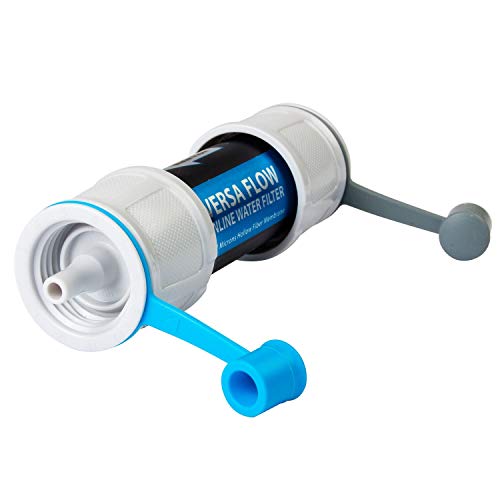
The Versa Flow is a filter only, with no pouch in the box, and female 28 millimeter threads on both ends. That dual-thread layout is the point. One end screws onto a dirty-water bottle or bladder and the other onto a clean container, so the same filter works as a squeeze filter, an inline filter on a hydration pack, a gravity filter between two reservoirs, or a straw at the source.
HydroBlu publishes a flow rate of one gallon in five minutes and a filter life of up to 100,000 gallons with backflushing, matching the Sawyer figures on paper at the budget tier. The trade-off is that you supply the reservoirs yourself, and thread fit varies between bottle brands, so check your bottles before a trip rather than at the trailhead.
Specs:
- Type: inline squeeze filter, hollow fiber membrane
- Pore size: 0.1 micron
- Weight: under 2 ounces (56 grams)
- Threads: 28 millimeter female thread on both ends
- Flow rate: 1 gallon in 5 minutes (maker-stated)
- Rated filter life: up to 100,000 gallons (maker-stated)
- Maker-stated removal: 99.9999 percent of bacteria, 99.9 percent of protozoan cysts
- Cleaning: backflush
- Included: filter only; reservoirs sold separately
3. Sawyer Products Micro Squeeze Water Filtration System (SP2129) — Mid-range
The Micro Squeeze keeps the MINI’s 0.1 micron membrane and 2-ounce weight but pairs it with a 32-ounce pouch, twice the MINI’s capacity, and a removable flip-top cap for drinking straight from the filter. Its body is about half the length of the full-size Squeeze, which is where the Micro name comes from.
That smaller body holds less fiber area, so in silty water it generally needs backflushing sooner than the full-size Squeeze, and the included cleaning plunger earns its place in the kit. Like the MINI, it is rated for up to 100,000 gallons, attaches to standard bottles and hydration packs, and comes with a drinking straw. For most solo hikers it is the balance point of this guide: full-size capacity, pocket-size filter.
Specs:
- Type: squeeze filter, hollow fiber membrane
- Pore size: 0.1 micron absolute
- Filter weight: about 2 ounces
- Rated filter life: up to 100,000 gallons (maker-stated)
- Included: Micro Squeeze filter, 32-ounce reusable squeeze pouch, drinking straw, flip-top drinking cap
- Maker-stated removal: 99.99999 percent of bacteria, 99.9999 percent of protozoa, 100 percent of microplastics
- Fits: included pouch, standard bottles, hydration packs
- Cleaning: backflush with the cleaning plunger
4. LifeStraw Peak Series Collapsible Squeeze Bottle Water Filter System, 1L — Mid-range

The Peak Series squeeze bottle folds the filter into a 1-liter collapsible bottle, so there is no separate pouch to thread on and no loose parts to keep track of. Fill the bottle, then either sip through the mouthpiece or squeeze filtered water into a pot or second container. The filter also comes out, leaving a plain soft bottle for camp use.
LifeStraw fits a 0.2 micron membrane microfilter rated for up to 2,000 liters, the shortest life in this guide alongside the QuickDraw, and states a flow of up to 3 liters per minute. At 110 grams all-in, it suits runners and fast movers who would rather carry one piece of kit than a filter plus a bottle.
Specs:
- Type: collapsible squeeze bottle with integrated membrane microfilter
- Pore size: 0.2 micron
- Capacity: 1 liter
- Weight: 110 grams (about 3.9 ounces)
- Rated filter life: up to 2,000 liters (maker-stated)
- Flow rate: up to 3 liters per minute (maker-stated)
- Maker-stated removal: 99.999999 percent of bacteria, 99.999 percent of parasites, 99.999 percent of microplastics, plus silt, sand and cloudiness
- Standards: maker states it meets US EPA and NSF P231 protocols for bacteria and parasite removal
5. Platypus QuickDraw Microfilter System, 1L — Premium

The QuickDraw is the premium system here, built around speed and checking your filter instead of trusting it. Platypus rates flow at up to 3 liters per minute squeezed and 1.75 liters per minute in a gravity setup, the fastest figures in this guide, and the cartridge carries an integrity check: a published procedure for confirming whether the hollow fibers survived a freeze or a drop.
The 1-liter reservoir uses a tri-layer film the maker describes as taste-free, both filter ends cap shut to keep the clean and dirty sides apart in your pack, and the ConnectCap and DrinkCap cover gravity and drinking setups. The cartridge is rated for 1,000 liters and is replaceable rather than restored by backflushing alone, so plan on a spare cartridge for a long thru-hike.
Specs:
- Type: squeeze filter system, hollow fiber cartridge with 1-liter reservoir
- Pore size: 0.2 micron
- System weight: 3.3 ounces (95 grams)
- Flow rate: up to 3 liters per minute squeezed, 1.75 liters per minute gravity (maker-stated)
- Cartridge life: 1,000 liters (maker-stated)
- Maker-stated removal: 99.9999 percent of bacteria, 99.9 percent of protozoa
- Included: QuickDraw filter, 1-liter reservoir, ConnectCap, DrinkCap, dirty-side caps, backflush gasket
- Cleaning: shake-to-clean or backflush; field integrity check
- Warranty: limited lifetime warranty (maker-stated)
How to choose
Start with pore size. The 0.1 micron filters here, both Sawyers and the Versa Flow, use a finer membrane than the 0.2 micron LifeStraw and Platypus filters. All five are maker-rated against bacteria and protozoa; none of them is rated to remove viruses, chemicals or heavy metals, so pore size alone does not change what a filter leaves behind.
Next, rated life. The Sawyer and HydroBlu filters are rated to 100,000 gallons because their membranes are backflushed rather than replaced. The LifeStraw and Platypus cartridges have shorter rated lives, 2,000 and 1,000 liters, and are swapped for new cartridges. For flow, the QuickDraw and the Peak publish up to 3 liters per minute, while the Versa Flow publishes about 0.75 liters per minute.
Finally, the container system. Check that the filter threads match the bottles you already carry; most here use the standard 28 millimeter thread, but fit varies by brand. Decide whether you want an included pouch, your own bottle, or the filter built into the bottle, and weigh the whole system you will actually carry.
Who should skip
Skip squeeze filters entirely if your water sources carry a real virus risk, as on some international trips: every filter here is a membrane microfilter, and the makers do not rate any of them for viruses, so look at a purifier instead. Groups of three or more will usually be better served by a gravity system or a pump. If your sources are silty or full of sediment, a pump with a cleanable prefilter handles dirty water with less clogging. If improving taste is the goal, none of these filters has a carbon stage; look at one with activated carbon instead.
FAQ
Do squeeze water filters remove viruses?
No. The makers rate these filters for bacteria, protozoa and, on the Sawyer models, microplastics. Viruses are smaller than the 0.1 and 0.2 micron pores used here, and no product in this guide carries a virus rating. Where viruses are a concern, use a purifier, or a filter followed by chemical or ultraviolet treatment.
How long does a squeeze filter last?
It depends on the design. The Sawyer and HydroBlu filters are maker-rated to 100,000 gallons because backflushing restores the membrane; Sawyer states backflushing can restore up to 98 percent of the original flow rate. The LifeStraw Peak cartridge is rated to 2,000 liters and the QuickDraw cartridge to 1,000 liters, after which the cartridge is replaced.
Will a squeeze filter fit my own bottle?
Usually. Most squeeze filters use the standard 28 millimeter thread found on common disposable water bottles and soft pouches, and the Sawyer and HydroBlu filters are published as fitting it. Some bottle brands use slightly different threads, so test the fit at home and carry the included pouch as a fallback.
What happens if my squeeze filter freezes?
Water left inside a hollow fiber membrane can freeze, expand and crack the fibers, and the damage is invisible from outside. Makers advise keeping a wet filter from freezing, for example inside a sleeping bag on cold nights. The QuickDraw includes a published integrity check for exactly this situation; for the other filters here, a filter that has frozen while wet should be replaced rather than trusted.
Final verdict
For a single recommendation, the Sawyer Micro Squeeze is the squeeze filter most hikers should buy first: a 0.1 micron membrane, a 100,000-gallon maker rating and a 32-ounce pouch in a 2-ounce filter. The Sawyer MINI covers the budget tier and doubles as a spare, while the Versa Flow suits tinkerers running bottles, bladders and gravity rigs. Choose the LifeStraw Peak 1L if you want the bottle and filter as one piece, and the Platypus QuickDraw if fast flow and a field integrity check matter more than cartridge life.