Key takeaways
- Compare the best water filters for travel, from a virus-removing press purifier to ultralight squeeze filters, with capacities, filter life and weights.
Quick answer: For most travelers, the LifeStraw Go Series 22 oz filter bottle is the best water filter to buy for travel, because it turns any hotel or airport tap into drinkable water through a two-stage filter, with no squeezing, pressing or setup. Travelers heading where viruses are a published risk should step up to the GRAYL UltraPress, the only pick here that also removes viruses. Weight counters get the Katadyn BeFree AC or the LifeStraw Peak squeeze bottle, and anyone who already owns good bottles should look at the Platypus QuickDraw filter on its own.
As an Amazon Associate, we earn from qualifying purchases.
A travel water filter solves a different problem from a backpacking filter, even when the hardware looks similar. On the trail the question is streams and lakes. In travel the question is taps: a hotel bathroom faucet in a city whose water you do not trust, an airport fountain, a guesthouse sink, a refill station of unknown maintenance. The water usually starts out treated, but treated is not the same as trustworthy once it has traveled through old pipes, rooftop tanks and building plumbing you know nothing about. The five products in this guide were chosen for that reality: bottles and pocket filters that live in a carry-on, work at a sink in seconds, and publish exactly what they do and do not remove.
The lineup covers the main travel formats rather than five versions of one idea. There is a press purifier for the highest-risk destinations, a filter bottle for everyday tap duty, a bare squeeze filter that turns bottles you already own into the system, a collapsible squeeze bottle that packs flat in a personal item, and a two-stage soft flask that adds a taste stage for city water. Every pick is a current Amazon listing with a verified identifier, recorded in the reference table at the end.
Table of Contents
- How to Choose a Water Filter for Travel
- Quick Comparison
- The 5 Best Water Filters for Travel
- Safety and Checks Before You Order
- Frequently Asked Questions
- Conclusion
How to Choose a Water Filter for Travel
Filter or purifier: the distinction that decides the trip
This is the one decision that matters most, and it is a destination question. A filter removes bacteria and protozoa: organisms like E. coli, salmonella, giardia and cryptosporidium, which are the realistic risk in most tap and surface water worldwide. A purifier does all of that and also removes viruses, which are far smaller than any portable membrane pore and pass straight through a standard filter. Viruses such as norovirus and hepatitis A are a genuine consideration in some regions and in any situation involving floodwater or possible sewage contamination, and they are a minor one in most city tap water in developed regions.
Four of the five picks in this guide are filters. They are honest about it: none of them claims virus removal, and their makers say so in print. The fifth, the GRAYL UltraPress, is a true purifier that publishes virus removal alongside bacteria and protozoa, plus filtration of many chemicals and heavy metals. If your itinerary includes rural areas in regions with known virus risk, or you simply want one device that answers every published scenario, the purifier is the pick and the extra weight is the price of that answer. If your travel is hotels, cities and developed infrastructure, a filter covers the published risk and the purifier is weight you will resent by day three.
Match the format to how you actually drink
Travel filters come in four working formats, and the right one follows your routine rather than a spec sheet. Filter bottles, like the LifeStraw Go, are the zero-effort option: fill at the tap, drink through the filter straw, done. They suit travelers who drink steadily through the day and refill often. Press purifiers, like the GRAYL, treat a batch at a time: fill, press, and you have a bottle of purified water to drink from freely or pour into a glass. They suit hotel-room routines, where you treat water at the sink and carry it out.
Squeeze filters split into two styles. A bare filter like the Platypus QuickDraw screws onto soft bottles and standard disposable bottles, so the system is whatever bottle is already in your bag; it is the lightest way to add filtration to an existing carry setup. Collapsible squeeze bottles, like the LifeStraw Peak and the Katadyn BeFree AC, bundle the filter with their own soft flask that rolls or folds flat when empty, which is the format that disappears into a personal item on a plane. The squeeze formats ask for hand effort on every liter; the bottle and press formats do not. Choose based on whether your bottleneck is effort or space.
Filter life is two numbers, not one
Every product here publishes a headline filter life, and for the two-stage models that headline is only half the story. A membrane microfilter is the long-lived stage: the rated lives in this guide run from 1,000 liters on the compact squeeze filters to 4,000 liters on the LifeStraw Go membrane. The carbon stage beside it is the short-lived one. On the LifeStraw Go the activated carbon filter is rated at 100 liters against the membrane’s 4,000, and on the Katadyn BeFree AC the carbon stage is rated at 200 liters or three months against a 1,000-liter membrane. The carbon stage is what improves taste and reduces chlorine, so it is the stage that decides your resupply interval on a long trip.
The practical takeaway is to plan replacements around the carbon number, not the membrane number, and to carry a spare carbon element on any trip longer than a few weeks. For single-stage squeeze filters, rated life is the whole story, but water quality shortens it: silty or cloudy water clogs hollow fibers faster than clear tap water, which is one more reason these filters live longer in hotel service than in stream service.
Weight, packed size and the carry-on reality
Travel filtration is a grams game because the filter competes with everything else in a carry-on. The spread in this guide is wide: the Katadyn BeFree AC flask and filter together weigh about 72 grams, the Platypus QuickDraw filter alone is about 69 grams, and the LifeStraw Peak squeeze bottle is about 110 grams, while the GRAYL UltraPress purifier weighs 354 grams before you add water. None of these numbers is disqualifying; the question is what the weight buys. The GRAYL’s grams buy virus removal. The squeeze filters’ lightness buys a shorter filter life and more hand effort.
Packed size matters as much as weight. Soft flasks collapse to nearly nothing, which is why two of the five picks are built on them. A rigid filter bottle takes the same space full or empty, but it also behaves like a normal bottle at security, at a desk and in a car cup holder. All five picks travel empty through airport security without issue; fill after the checkpoint. One hard rule applies to every hollow-fiber pick here: a filter that has been wet must never freeze, because ice inside the fibers can damage them invisibly. In winter travel, the filter rides in the cabin bag and, outdoors, in an inside pocket, never in a checked bag on a cold tarmac or a car trunk overnight.
Taste is a separate problem from safety
Much travel water is safe and simply unpleasant: heavy chlorine, mineral flavors, the flat taste of a building tank. A plain membrane does nothing for any of that, because chlorine and taste compounds are dissolved, not suspended. If taste is your main complaint, you want a carbon stage in the system. The LifeStraw Go and the Katadyn BeFree AC both build one in, and the GRAYL’s purifier cartridge includes activated carbon as part of its treatment train. The two single-stage squeeze filters, the QuickDraw and the Peak, are safety devices only; water through them tastes like the source. Neither answer is wrong, but buying a membrane-only filter to fix a taste problem is a mismatch that disappoints a lot of travelers.
Cleaning and maintenance on the road
Each format maintains differently, and the method decides whether the filter survives a long trip. The LifeStraw Peak and the Platypus QuickDraw both backflush: pushing clean water backward through the membrane restores flow, and the QuickDraw adds a published integrity check, a field procedure that lets you confirm the fibers are still intact after a drop or a cold night instead of guessing. The Katadyn BeFree AC cannot be backflushed; it cleans by shaking or swishing the flask in clean water, which is simpler but less restorative, and Katadyn advises doing it at least every 5 liters. The bottle and press formats maintain by cartridge replacement rather than cleaning technique. Whichever you choose, the routine has to be one you will actually do in a hotel sink; a filter that needs a workbench and a free afternoon will quietly stop being maintained by the second week.
Quick Comparison
| Product | Format | Capacity | Filter Life | Best For |
|---|---|---|---|---|
| GRAYL UltraPress Purifier Bottle | Press purifier | 16.9 oz | 300 presses (cartridge) | Highest-risk destinations |
| LifeStraw Go Series Filter Bottle | Filter bottle | 22 oz | 1,000 gal membrane | Everyday tap water |
| Platypus QuickDraw Microfilter | Bare squeeze filter | Filter only | 1,000 L cartridge | Bottles you already own |
| LifeStraw Peak Squeeze Bottle | Collapsible squeeze bottle | 1 L | 2,000 L membrane | Packing flat, longer life |
| Katadyn BeFree AC | Collapsible two-stage flask | 0.5 L | 1,000 L membrane | Lightest carry, city taste |

The 5 Best Water Filters for Travel
1. GRAYL UltraPress 16.9 oz Water Purifier Bottle, Covert Black — The Full-Protection Press
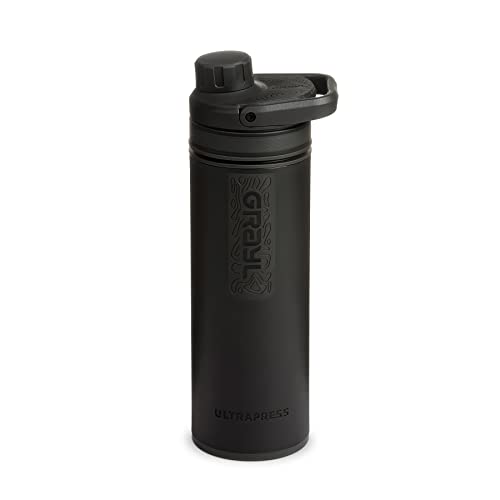
Best for: Travelers heading to regions where viruses are a published risk, anyone treating water beyond hotel taps, and anyone who wants one device that answers every scenario in this guide.
The UltraPress is the only true purifier in this lineup, and that word is doing real work. Where the four filters stop at bacteria and protozoa, the GRAYL’s electroadsorptive purifier cartridge also removes viruses, and its activated carbon stage filters many chemicals, pesticides, herbicides and heavy metals along the way. That is the broadest published protection available in a bottle format, and it is why this pick leads the guide despite being the heaviest and the only premium-tier product here.
The working method is a press. You fill the outer cup from a tap, a fountain or a stream, push the inner press down with body weight, and about ten seconds later the bottle holds 16.9 ounces of purified water, treated at a published rate of 3 liters per minute. There is no sucking through a straw and no squeezing, and because the water is treated in the batch rather than at the sip, you can pour it into a glass, a kettle or a companion’s bottle. The compact body is sized for a car cup holder and a pack side pocket, which the larger press bottles in this category are not.
The trade-offs are weight and consumables. At 12.5 ounces empty it weighs roughly three times the lightest picks here, and the purifier cartridge is rated for 300 press cycles, about 150 liters, before replacement. Unused cartridges carry a published shelf life of ten years, so a spare bought today is not wasted if the trip changes. For a two-week city trip the cartridge math is comfortable; for a season of daily use in one place, a filter bottle with a longer-lived membrane is the cheaper habit. Buy the GRAYL when the destination justifies purification; it is overbuilt, deliberately, for everywhere else.
Specs
- Capacity: 16.9 oz (500 ml)
- Weight: 12.5 oz (354 g)
- Treatment: Purifier; electroadsorptive media plus activated carbon
- Removes: Viruses, bacteria and protozoa; filters many chemicals, pesticides, herbicides and heavy metals
- Flow rate: 3 L per minute (about 10 seconds per fill)
- Cartridge life: 300 press cycles (about 150 L); 10-year shelf life unused
- Material: BPA-free polypropylene with food-grade silicone seals
- Dimensions: Not stated
- Tier: Premium
2. LifeStraw Go Series Water Filter Bottle, 22 oz — The Everyday Tap Bottle
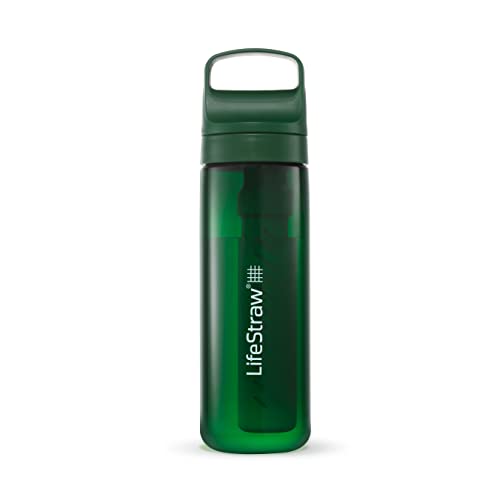
Best for: Hotel-and-city travelers who want filtration with zero technique: fill at any tap, drink, refill, and never think about the system again.
The Go Series bottle is the travel filter reduced to its simplest form. The bottle looks and behaves like an ordinary 22 oz water bottle, and the filtration happens in the straw as you drink: a 0.2 micron membrane microfilter handles bacteria, parasites and microplastics, and an activated carbon filter behind it reduces chlorine and improves taste. There is nothing to squeeze, press or assemble, which is exactly the point for a traveler whose water routine is a hotel sink at midnight and an airport fountain at dawn.
The published numbers reward a close read, because this bottle has two filter lives. The membrane is rated for 1,000 gallons, which at travel drinking rates is years of service. The carbon filter is rated for 26 gallons, roughly two months of regular use, and it is the part that keeps the water tasting clean. Budget for carbon replacements the way you budget for any consumable, and note that the membrane keeps protecting long after the carbon stage is spent; what fades first is taste, not safety. LifeStraw publishes the removal figures precisely: 99.999999 percent of bacteria, 99.999 percent of parasites and 99.999 percent of microplastics, tested to published drinking-water protocols.
The honest limits are the ones LifeStraw prints itself. This is a filter, not a purifier: it makes no virus claim, so it is the wrong tool where viruses are the concern. The 22 oz capacity means frequent refills on heavy drinking days, though for tap-based travel a refill is never far away. And like every membrane here, a wet filter must be protected from freezing. Within its brief (taps you distrust for bacteria or taste, in places where the underlying water system is treated) it is the most complete answer in this guide.
Specs
- Capacity: 22 oz (650 ml)
- Weight: 8.7 oz
- Dimensions: 3.15 x 3.15 x 11.02 in
- Filter: 0.2 micron membrane microfilter plus activated carbon filter
- Membrane life: 1,000 gal (4,000 L)
- Carbon life: 26 gal (100 L)
- Removes: 99.999999 percent of bacteria, 99.999 percent of parasites, 99.999 percent of microplastics; carbon reduces chlorine and improves taste
- Material: BPA-free plastic
- Tier: Mid-range
3. Platypus QuickDraw Microfilter, Filter Only — The Filter for Bottles You Own

Best for: Travelers who already carry bottles they like, minimalists building the lightest possible filtration kit, and anyone who wants a filter that can be checked for damage in the field.
The QuickDraw in this configuration is not a bottle at all; it is the filter alone, a 69-gram cartridge that screws onto reservoirs and standard bottles and turns whatever it threads onto into the system. For travel, that modularity is the appeal. The filter rides in a wash bag or a jacket pocket, the bottle it serves can be a soft flask, a collapsible reservoir or a disposable bottle bought at the destination, and when the trip is mostly tap water in safe cities, the whole kit can stay home without leaving a dedicated bottle behind.
On published performance it is the strongest of the squeeze filters here. The hollow-fiber cartridge is rated at up to 3 liters per minute, the fastest flow in this guide, and its cartridge life is 1,000 liters. It removes bacteria and protozoa, and Platypus is plain that it does not remove viruses or chemicals. Two maintenance features separate it from every other pick. It backflushes without tools to restore flow, and it supports a manufacturer integrity check: a short published procedure that verifies the fibers are intact. After a filter has been dropped, crushed in a bag or caught in a cold night, that check converts a guess into an answer, and no other product in this guide offers one.
The compromises follow from the format. The filter-only package includes the filter, its caps, the connect and drink caps and a backflush washer, but no reservoir, so your first use needs a compatible vessel: Platypus reservoirs, or bottles with matching threads, and not every bottle in a hotel minibar fridge will fit. It is also a safety-only device with no carbon stage, so treated-but-bad-tasting city water still tastes bad. Buy it as the filtration core of a kit you assemble, not as a complete product.
Specs
- Format: Squeeze filter, filter only (no reservoir included)
- Weight: 2.4 oz (69 g) filter; 83 g total published
- Size: 5.1 x 2 in (13 x 5 cm)
- Filter: 0.2 micron hollow fiber
- Flow rate: Up to 3 L per minute
- Cartridge life: 1,000 L
- Removes: Bacteria and protozoa; not viruses or chemicals
- Maintenance: Tool-free backflush; manufacturer integrity check
- Includes: Filter, dirty-side cap, ConnectCap with cover, DrinkCap, backflush washer
- Tier: Mid-range
4. LifeStraw Peak Series Collapsible Squeeze Bottle, 1L — The Flat-Packing Long Life
Best for: Carry-on-only travelers, backpackers crossing into travel use, and anyone who wants a full liter of capacity that vanishes into a bag when empty.
The Peak squeeze bottle is built around the problem of space. The soft 1-liter bottle collapses as it empties and rolls down to a fraction of its filled size, so it crosses borders in a personal item and only becomes a bottle at the destination. The filter sits in the cap: fill the flask from a tap or a source, squeeze, and drink from the nozzle or fill a second container. It is the largest capacity in this guide tied to the second-lightest carry, which is a combination none of the rigid bottles can match.
Its membrane is the long-lived one among the squeeze picks, rated at 2,000 liters, double the rated life of the QuickDraw and BeFree cartridges, and it backflushes to restore flow as sediment builds. The published removal figures mirror the rest of the LifeStraw line: 99.999999 percent of bacteria, 99.999 percent of parasites and 99.999 percent of microplastics, plus silt, sand and cloudiness. At 110 grams it is light enough to justify carrying as a backup even on trips where it may never leave the bag, and its squeeze format doubles as a way to fill a travel kettle or a companion’s bottle, which a straw bottle cannot do.
The limits are the familiar squeeze-filter ones. There is no carbon stage, so taste passes through unchanged, and there is no virus removal. Squeezing a liter at a time is real hand work compared with drinking through the Go bottle’s straw, and flow slows as the membrane loads, which is the cue to backflush. Soft flasks also ask for a little care around sharp bag contents. None of that dents its role: for travelers who pack light and refill from mixed sources, this is the most forgiving squeeze system here.
Specs
- Capacity: 1 L
- Weight: 3.9 oz (110 g)
- Filter: 0.2 micron membrane microfilter
- Membrane life: 2,000 L (500 gal)
- Flow rate: Up to 3 L per minute (maker rated)
- Removes: 99.999999 percent of bacteria, 99.999 percent of parasites, 99.999 percent of microplastics, plus silt, sand and cloudiness
- Maintenance: Backflush to restore flow
- Material: Collapsible soft flask, BPA-free
- Tier: Budget
5. Katadyn BeFree AC 0.5L — The Lightest Two-Stage Flask
Best for: Weight-first travelers and runners-turned-tourists who want the lightest possible carry, plus city travelers who care about chlorine taste as much as safety.
The BeFree AC is the lightest complete system in this guide: flask and filter together weigh about 72 grams, less than a deck of cards, and the soft flask folds flat when empty. It is also the only squeeze pick with two stages. The 0.1 micron EZ-Clean hollow-fiber membrane removes bacteria, protozoa, cysts, sediment and microplastics, and a replaceable activated carbon element behind it reduces chlorine taste and odor, which makes this the squeeze filter aimed at city water rather than only at streams. Flow is fast, up to 2 liters per minute, so a fill-and-drink stop at a fountain takes seconds.
Katadyn’s cleaning method is the simplest here and the least restorative: the membrane cannot be backflushed, and you clean it by shaking or swishing the flask in clean water, a routine Katadyn suggests at least every 5 liters. The rated lives split the same way as the other two-stage system in this guide: up to 1,000 liters for the membrane, up to 200 liters or three months for the carbon element. Plan on carbon replacements for taste, and know that the membrane’s protection continues after the carbon is spent.
Two cautions belong with this pick. First, the flask uses Katadyn’s 42 mm thread family, so the filter lives on its own flask and compatible 42 mm vessels rather than on arbitrary bottles. Second, read Katadyn’s own positioning carefully: this listing describes its output in terms of sediment, particles, microplastics and taste alongside its membrane claims, and it publishes no virus removal, so it belongs in the same safety class as the other filters here, not with the purifier. As the ultralight, taste-aware option for treated-water travel, it has no real rival in this lineup.
Specs
- Capacity: 0.5 L
- Weight: 2.5 oz (72 g)
- Dimensions: 3.3 x 2.1 x 10.7 in
- Filter: 0.1 micron EZ-Clean hollow-fiber membrane plus activated carbon element
- Membrane life: Up to 1,000 L
- Carbon life: Up to 200 L or 3 months
- Flow rate: Up to 2 L per minute
- Removes: Bacteria, protozoa, cysts, sediment and microplastics; carbon reduces chlorine taste and odor; no virus removal
- Cleaning: Shake or swish; cannot be backflushed
- Tier: Budget
Safety and Checks Before You Order
Filters are not purifiers. Four of the five picks remove bacteria and protozoa and make no virus claim. Where virus risk is a published concern for your destination, choose the GRAYL UltraPress, boil the water, or follow local boil-water notices, which always override any device in this guide.
Check recalls before you buy. We checked the CPSC record for this product class and found no recall covering any of the five picks or portable travel water filters as a class. The standing exclusions for this niche are about other product types: they do not apply to any pick here, and no pick is a Bindle Bottle, a Stanley Switchback or Trigger Action mug, an Ozark Trail 64 oz bottle, a Thermos Stainless King or Sportsman product, a green sprouts straw bottle or a Tommee Tippee Sippee cup. If you already own any of those, check them against their recalls separately.
Protect every wet filter from freezing. Hollow-fiber membranes can be damaged invisibly when water inside them freezes, and the makers of the squeeze filters here all say a filter suspected of freezing should be replaced or, for the QuickDraw, verified with its integrity check before use. Carry the filter in the cabin, not in checked luggage, in cold weather.
Confirm the exact variant on the listing. Several of these products sell in multiple sizes and generations under near-identical names: the GRAYL in standard and titanium builds, the BeFree in original and AC versions, the QuickDraw as a filter alone or in reservoir kits, and the Peak squeeze in two capacities. The reference table below pins the exact listing for each pick; match it before ordering, especially on the BeFree, where the AC carbon stage is the entire point of the pick.
Mind the carbon clock. On the two-stage picks, taste protection expires months or years before membrane protection. If your water starts tasting like the tap again, the carbon element is due; the filter has not failed.
Frequently Asked Questions
Do I need a purifier, or is a filter enough for travel?
For most city and hotel travel, a filter is enough, because the realistic risks in treated tap water are bacteria and protozoa, which every pick here removes. Choose a purifier, the GRAYL UltraPress in this guide, when your destination carries a published virus risk, when you will treat surface water in rural areas, or when you want a single device that also filters many chemicals and heavy metals.
Can I take a water filter through airport security?
Yes. All five picks travel empty in a carry-on without issue, and you fill them after the checkpoint. The only cold-weather caution is that a filter that has been used stays wet inside, so in winter it should ride in the cabin rather than in a checked bag where it could freeze.
How long does a travel water filter actually last?
The membranes in this guide are rated from 1,000 liters on the compact squeeze filters to 4,000 liters on the LifeStraw Go, which is months to years of travel use. The shorter number is the carbon stage where one exists: about 100 liters on the Go and 200 liters on the BeFree AC. Cloudy water shortens any membrane’s life, and regular backflushing or swish cleaning extends it.
Will a travel filter make bad-tasting tap water taste better?
Only if it has a carbon stage. The LifeStraw Go, the Katadyn BeFree AC and the GRAYL UltraPress all include activated carbon, which reduces chlorine and improves taste. The Platypus QuickDraw and the LifeStraw Peak are membrane-only safety devices, and water through them tastes like the source.
Conclusion
The right travel water filter is the one matched to your destination and your drinking routine. Take the LifeStraw Go if your travel is taps and cities and you want filtration that asks nothing of you. Take the GRAYL UltraPress when the destination, not convenience, sets the requirements, because it is the only pick that also answers viruses and chemicals. Take the Platypus QuickDraw to add filtration to bottles you already own, with the field integrity check as insurance. Take the LifeStraw Peak when packed space is the constraint and filter life matters, and take the Katadyn BeFree AC when every gram counts and chlorine taste is part of the problem. All five are current, verified listings; the reference table below records each one exactly as it should be ordered.