Key takeaways
- Compare the best water bottles for kayaking by lid style, tether points, insulation and stability on deck, with five verified picks for every paddler.
Quick answer: Start with the Stanley IceFlow Flip Straw 2.0 Bottle in the 24 oz size if you want one insulated bottle that sips through a flip straw while your other hand stays on the paddle. Add the Polar Bottle Insulated 24 oz if you prefer a squeeze bottle you can drink from without breaking your stroke, the Klean Kanteen Classic 27 oz if your route involves refilling and filtering lake water, the Simple Modern Summit 32 oz if you need the biggest cold capacity for a long hot day, and the Survivor Filter Collapsible Canteens if you want reserve liters that roll up and clip to a deck line.
As an Amazon Associate, we earn from qualifying purchases.
Kayaking rewrites the water bottle brief in ways that gym and trail guides never have to think about. Your hands are busy: one holds a paddle, and the other is usually steadying the boat, holding a fishing rod, or keeping a spray skirt grab loop within reach. Your storage is a cockpit with no flat surfaces, a tank well behind the seat, and a web of deck bungees that everything must either clip to or wedge under. And the failure mode for a dropped bottle is not a scuffed floor — it is watching your only water supply drift away on the current, upright, full, and just out of reach.
The best water bottles for kayaking are therefore chosen on a different spec sheet. One-handed drinking matters more than almost anything: a flip straw, a squeeze valve, or a chug spout you can work without setting the paddle down. A leakproof lid matters because the bottle will spend the day on its side in bilge water, not upright in a cup holder. An attachment point matters because anything loose in a kayak eventually goes swimming. And stability matters, because a tall round bottle under loose bungees rolls with every stroke until it works itself free.
The five picks in this guide divide by how they solve that brief. Two are insulated stainless steel bottles with handles built for clipping and carrying. One is a classic squeeze bottle, the kind cyclists have used for decades, whose soft walls and tether handle turn out to suit a cockpit remarkably well. One is a single-wall steel bottle with a wide mouth made for refills and filter work. And one is a pair of collapsible canteens that carry reserve water in almost no space at all. Every pick is a current Amazon listing with a verified identifier, and the evidence behind each identifier, the variant traps in each listing family, and the recall records checked for this category are laid out in the Safety and Checks section near the end.
Table of Contents
- How to Choose the Best Water Bottles for Kayaking
- Quick Comparison
- The 5 Best Water Bottles for Kayaking
- Safety and Checks Before You Order
- Frequently Asked Questions
- Conclusion
- Product and ASIN Reference
How to Choose the Best Water Bottles for Kayaking
One hand on the paddle, one hand on the bottle
The defining skill of drinking in a kayak is doing it without stopping. Setting a paddle down across the cockpit to unscrew a wide-mouth cap with both hands costs you your brace, your steering, and — in wind or current — your position. The lid styles that work on the water all open with one hand and drink without tipping the bottle far: a flip straw you thumb open and sip from upright, a squeeze bottle whose valve flows when you bite and squeeze, or a chug spout that opens with a twist of the wrist. Rank lids in that order for moving water, and treat any lid that needs two hands and a full tip — a plain screw cap over a wide mouth — as a lunch-stop bottle rather than a paddling bottle.
Flow rate is the second half of the equation. A straw lid sips steadily but slowly, which suits all-day sipping discipline. A squeeze bottle delivers the fastest drink of any style here, because your hand pressure does the work. A chug lid sits between them. None of this is about speed for its own sake: on a hot crossing, the bottle you can drain quickly during a short drift break is the one that actually gets used, and the elegant bottle that takes two hands and a stable boat quietly becomes the bottle you stop bothering with.
A lid that seals like it means it
A kayak cockpit is a wet place even on a calm day. Paddle drip, splash, and the inch of water that collects around the seat mean your bottle spends hours lying on its side in shallow bilge, and it will be fully submerged at least briefly if you roll, wet-exit, or haul it across a wet deck. A lid that is merely splash resistant will weep all day into that bilge and, worse, let lake water in. Look for a positive seal — a gasketed lid the maker rates as leakproof when closed — and learn the closed state of your lid by feel, because you will check it by touch more often than by sight.
Straw lids deserve one extra check: the straw and its hinge collect grit and grow film faster than any other lid style, and a kayak adds sand and sunscreen to the mix. A straw lid that strips down for washing, with a removable straw and a spout that comes apart, will stay pleasant for seasons; a sealed one-piece straw assembly becomes a science project by August. Squeeze valves and chug spouts have fewer parts and forgive more neglect, which is part of their appeal on the water.
Tether points, deck lines and the roll test
Everything in a kayak should be attached to the kayak. The practical forms of attachment are a rigid carry handle wide enough for a small carabiner, a flexible strap handle you can loop a deck line through, or — on soft bottles — an included clip. Run a short tether from the bottle to a deck line or seat strap and the worst case for a fumbled bottle becomes a wet bottle dangling alongside, not a bottle receding downstream. Handles differ in tether quality: a folding handle that lies flat against a lid clips cleanly, while a molded loop on a cap can be too small for anything but a finger, so check the opening size against the carabiner you actually own.
Then apply the roll test. Lay the full bottle on its side and picture it under your deck bungees through a mile of chop. Tall, narrow, perfectly round bottles roll; shorter, wider bottles and bottles with any flat or texture to the wall stay put far better. In the cockpit, the spot between your feet or beside the seat is the stable zone, and a bottle that wedges there without rolling into the foot braces earns its place. Soft bottles pass the roll test by default — they slump into whatever space they are given and stay there.
Capacity and the refill question
A liter of water weighs about 2.2 pounds, and a kayak carries it low and central, where weight is nearly free — which tempts paddlers to solve hydration with one enormous bottle. Resist the single-jug strategy for the same reason backpackers do: one container is one point of failure, and a 40 or 64 ounce bottle is the worst shape in this guide for cockpit storage. The working pattern for day paddling is a drinking bottle of 24 to 32 ounces within reach of the seat, plus reserve capacity — a second bottle in the tank well or a rolled soft bottle in a hatch — for the paddle back.
Refills decide the mouth question. If your route is a lake loop with a treated-water tap at the launch, mouth size barely matters. If you plan to scoop from the lake and treat the water, you want a mouth that accepts a filter’s output stream without spilling half of it, and a bottle whose neck or mouth works with the treatment you carry. Wide steel mouths shine here; straw lids are the worst refill targets afloat, because every refill means removing the whole lid assembly and threading a straw back through lake water residue. Match the bottle to the water you will actually meet.
Insulation versus weight on the water
Vacuum-insulated steel keeps water cold through a full summer day and does not sweat, which in a cockpit means a dry grip and no extra water pooling at your feet. The cost is empty weight: the insulated picks here run from about 0.84 pounds to just under a pound, against a few ounces for a squeeze bottle or soft canteen. In a kayak that weight penalty is smaller than in a backpack — the boat carries it, not your shoulders — but it is not zero, because you haul the boat, and because a heavy bottle that does go overboard sinks with conviction.
Single-wall steel and insulated plastic split the difference in opposite directions. Single-wall steel weighs little, takes dents instead of cracks, and delivers water at lake temperature by midday. An insulated squeeze bottle keeps a chill for hours rather than all day, weighs almost nothing, and drinks faster than anything else here. Decide by trip length and temperature: short and mild favors light; long and hot favors insulated, and the premium for insulation buys the most on the days when cold water is the difference between drinking enough and not.
Steel, squeeze plastic and soft film
Materials fail differently, and on the water the failure that matters is the slow one. Stainless steel dents, and a dented steel bottle keeps sealing for years; its lid gasket is the wear item, and replacements are cheap and widely sold. Squeeze bottles age at the valve and the wall — the plastic stiffens over seasons of sun, and a valve that no longer self-seals turns the bottle into a leaker — but the bottle itself costs little and weighs less. Soft film canteens fail at seams and punctures, which is why they are sold in pairs and carried as reserves rather than trusted as the only container.
Sun and salt are the two environmental taxes. Ultraviolet stiffens plastics and fades finishes over seasons, so a bottle that lives on a sunny deck ages faster than the same bottle in a pack. Salt water corrodes nothing on these five picks outright, but it creeps into lid threads and hinges and dries into grit that eats gaskets, so a freshwater rinse after salt days is maintenance, not fussiness. Steel bottles with powder-coat finishes shrug off deck rash better than bare finishes, and every finish lasts longer if the bottle rides in the cockpit rather than grinding under bungees all day.
Quick Comparison
| Product | Capacity | Empty weight | Insulation | Price tier |
|---|---|---|---|---|
| Stanley IceFlow Flip Straw 2.0 Bottle, 24 oz | 24 oz | 0.84 lb | Double-wall vacuum | Mid-range |
| Polar Bottle Insulated Water Bottle, 24 oz | 24 oz | 4.4 oz | Tri-Layer insulated plastic | Budget |
| Klean Kanteen Classic 27 oz with Sport Cap | 27 oz | 8.2 oz | None — single-wall | Mid-range |
| Simple Modern Summit Water Bottle with Chug Lid, 32 oz | 32 oz | About 13.2 oz | Double-wall vacuum | Mid-range |
| Survivor Filter Collapsible Canteens, 1 L, 2-Pack | 1 L each | About 2.4 oz each | None | Budget |
The 5 Best Water Bottles for Kayaking
1. Stanley IceFlow Flip Straw 2.0 Bottle, 24 oz, Frost

Best for: The all-rounder — insulated steel that sips through a flip straw while your other hand stays on the paddle, in the lightest steel package in this guide.
The IceFlow Flip Straw 2.0 solves the kayaking brief in the order the brief demands. First, the drinking: a flip straw you thumb open and sip from with the bottle nearly upright, no tipping, no unscrewing, no setting the paddle across your lap. Second, the weight: the body uses Stanley’s AeroLight spun-steel construction, which the maker rates as thirty-three percent lighter than standard stainless bottles, and the 24 oz size lists at 0.84 pounds empty — noticeably less than the classic steel bottles this brand built its name on, and the lightest insulated steel pick here. Third, the carry: a folding handle on the lid gives a carabiner a real target, so the bottle clips to a deck line or seat strap instead of roaming the cockpit.
The insulation is full double-wall vacuum in 18/8 stainless steel, with ninety percent recycled content per the maker, and the published ratings — cold for 8 hours, iced for 40 hours — cover any day paddle with margin. On the water, the quiet benefit is the absence of sweat: a vacuum bottle does not rain condensation into the bilge, and its powder-coat style finishes grip a wet hand better than polished steel. The flip straw assembly removes for washing, which matters in a sport that coats lids in sunscreen and lake film, and the maker lists the bottle as dishwasher safe.
The honest limits are the straw’s own. Flow is a sip, not a gulp, so this is a steady-drinking bottle rather than a drain-it-at-the-landing bottle, and the straw is one more part to rinse after salt days. At 24 ounces it is also the joint-smallest capacity in the guide, sized as a drinking bottle to pair with a reserve rather than as an all-day supply on its own. As the single bottle a paddler clips in front of the seat and sips from for hours, though, nothing else here matches its combination of one-handed drinking, real insulation, and low empty weight.
Specs
– Capacity: 24 oz (710 ml)
– Material: AeroLight spun steel; ninety percent 18/8 recycled stainless steel per the maker
– Insulation: Double-wall vacuum; maker rates cold for 8 hours and iced for 40 hours
– Lid: Flip Straw 2.0 with built-in straw and folding carry handle; leak resistant per the maker
– Dimensions: 3.74 x 3.34 x 10.04 in per listing data
– Empty weight: 0.84 lb per the maker
– Care: Dishwasher safe per the maker
– Color pinned: Frost
– Tier: Mid-range
2. Polar Bottle Insulated Water Bottle, 24 oz

Best for: The squeeze drinker — the fastest drink in the guide, from a soft-walled bottle with a tether handle, at a budget tier.
Polar Bottle built its name on bicycle cages, and the design transfers to a cockpit almost unchanged. The body is a squeezable BPA-free plastic with the maker’s Tri-Layer insulation — a reflective foil layer in the wall that slows warming for hours rather than all day — and the cap is a high-flow self-sealing valve: bite, squeeze, drink, and the valve closes itself when you stop. There is no lid to open, nothing to unscrew, and no straw to aim. Of the five picks, this is the one that asks least of your free hand, and in a fishing kayak or a photography paddle where that hand is already employed, the squeeze bottle is often the bottle that gets used most.
The detail that earns it a place over other squeeze bottles is the Dash Handle, a flexible strap handle integrated into the cap. It carries two fingers comfortably at the launch, and on the water it is the tether point: loop a deck line or a short cord through it and the bottle can dangle, drag briefly, or hang off the seat strap without leaving. At 4.4 ounces empty per the maker’s published figures, it is also the lightest rigid bottle here by a wide margin, and its 2.9 inch diameter is sized for standard bottle cages, which on a kayak translates to a snug, rattle-free fit under deck bungees.
The trades are insulation and lifespan. Tri-Layer insulation buys hours of chill, not the full-day cold of vacuum steel, and a squeeze bottle’s wall and valve age in sun and seasons in a way steel does not — expect to replace it on a cycle of years rather than own it for a decade. It is also a cold-drink bottle only, and its soft wall means it should ride in the cockpit rather than under a hatch lid stacked with gear. For the paddler whose priority is drinking often without breaking rhythm, those are the right trades to make.
Specs
– Capacity: 24 oz (710 ml)
– Material: BPA-free squeeze plastic with Tri-Layer insulation per the maker
– Cap: High-flow self-sealing squeeze valve
– Handle: Integrated Dash Handle for carrying and tethering
– Dimensions: 10.4 x 2.9 in per the maker
– Empty weight: 124 g (4.4 oz) per the maker
– Fit: Diameter sized for standard bottle cages; sits securely under deck bungees
– Care: Dishwasher safe per the maker
– Tier: Budget
3. Klean Kanteen Classic 27 oz Water Bottle with Sport Cap, Hawaiian Ocean
Best for: The refill strategist — a wide 44 mm mouth that takes filter output, ice and a brush, in single-wall steel light enough to forget.
The Classic is the original Klean Kanteen, and its spec sheet is a study in what a bottle needs when refilling is part of the trip. The mouth is 44 millimeters across — wide enough to accept the output stream of a squeeze filter held above it, wide enough for ice cubes at the launch cooler, and wide enough for a bottle brush to actually scrub. The body is single-wall 18/8 stainless steel, now made with certified ninety percent post-consumer recycled steel per the maker, with an electropolished interior that rinses clean and does not hold flavors. At 8.2 ounces with the sport cap per the maker’s figures, it weighs about half what an insulated steel bottle of similar capacity weighs, because there is no vacuum wall to carry.
The pinned listing pairs the bottle with the brand’s sport cap, a spout cap that drinks quickly and seals for transport, and the Classic’s quiet superpower is that every cap in the Classic family fits it — including the loop cap, which converts the bottle into a clip-anywhere container with a full stainless loop for a carabiner. For kayaking, that swap is the difference between a bottle that rides loose in the tank well and a bottle tethered to a deck line. The colored finishes use the maker’s chip-resistant powder coat, which tolerates deck rash and paddle knocks better than the paint on cheaper steel.
What the Classic does not do is insulate. Single-wall steel delivers water at ambient temperature by afternoon and sweats in humidity, and the sport cap is a two-hand cap at refill time even if drinking is quick. It is also worth knowing the family tree before ordering: the same Classic name covers an insulated sibling line with vacuum walls and different caps, under separate listings. The pinned listing is the single-wall original in the 27 oz size. For paddlers who treat water on the route — scooping, filtering, refilling — it is the most capable tool in this guide, and the bottle most likely to still be in service a decade from now.
Specs
– Capacity: 27 oz (800 ml)
– Material: Single-wall 18/8 stainless steel; certified ninety percent post-consumer recycled steel per the maker
– Opening: 44 mm (1.75 in)
– Cap: Sport Cap; interchangeable with the full Classic cap family, including the Loop Cap
– Dimensions: 10.9 x 2.9 in with sport cap per the maker
– Empty weight: 8.2 oz (232.8 g) with sport cap per the maker
– Finish: Chip-resistant Klean Coat powder coat on colored bottles; electropolished interior
– Care: Dishwasher safe per the maker
– Color pinned: Hawaiian Ocean
– Tier: Mid-range
4. Simple Modern Summit Water Bottle with Chug Lid, 32 oz, Midnight Black

Best for: The long, hot day — the largest insulated capacity in the guide, with a chug lid that pours fast and a handle built for a deck line.
Where the Stanley sips, the Summit chugs. The chug lid is a wide spout cap you drink straight from, with a flow rate closer to an open mouth than to a straw, which makes it the insulated pick for paddlers who drink in deliberate stops — a raft-up, a shoreline break, a slow drift — and want a third of the bottle gone in one go. The lid seals leakproof when closed per the maker and carries a rigid transport handle, the tether point that lets a bottle this size ride clipped in the tank well or under rear bungees instead of loose at your feet. Under it sits the largest vacuum-insulated body in the guide: 32 ounces of 18/8 stainless steel, double-wall vacuum insulated, with the maker’s size chart rating the 32 oz size for cold retention up to 28 hours.
The dimensions explain its storage personality. The base is 3.5 inches across and the mouth 2.25 inches — wide enough for ice and a brush, and wide enough that the bottle does not fit most car cup holders, a fact the maker states plainly and which matters not at all in a kayak. What matters afloat is that the wide, straight-walled body wedges stably beside a seat or in a tank well and resists rolling better than the tall narrow bottles, and that the powder-coat finish grips wet hands. At about 13.2 ounces empty per the maker’s chart, it is the heaviest pick here, and a full one is a genuinely dense object — tether it, because it will not float, bob, or hesitate on its way to the bottom.
The compromises are the chug lid’s two-handed refill and the bottle’s sheer presence in a small cockpit. In a compact recreational kayak, a 32 oz wide-body bottle competes for the same space as your feet; in a touring or fishing kayak with a tank well, it disappears. Buy it as the capacity anchor of a two-container system — this bottle in the well, a smaller drinker at the seat — and it covers the days when 24 ounces is simply not enough water.
Specs
– Capacity: 32 oz (946 ml)
– Material: 18/8 stainless steel, double-wall vacuum insulation
– Insulation: Maker’s size chart rates the 32 oz size for cold retention up to 28 hours
– Lid: Chug lid, leakproof when closed per the maker, with transport handle; BPA-free per the maker
– Mouth: 2.25 in; base diameter 3.5 in per the maker’s size chart
– Empty weight: About 13.2 oz per the maker’s size chart
– Care: Lids top-rack dishwasher safe; hand wash the bottle per the maker
– Color pinned: Midnight Black
– Tier: Mid-range
5. Survivor Filter Collapsible Canteens, 1 L, 2-Pack
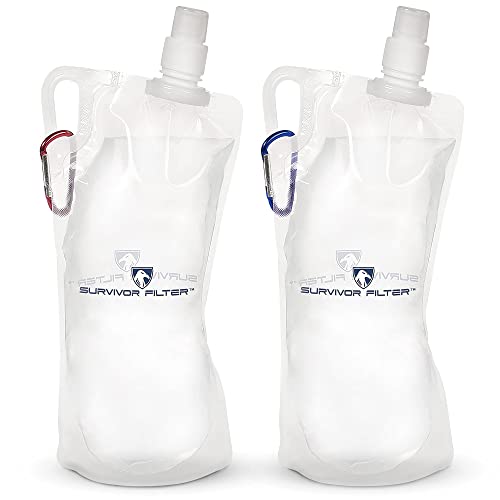
Best for: The reserve — two roll-up liters that clip to deck lines, stand when full, pair with a filter, and vanish when empty.
Full disclosure of framing: these are soft canteens, not bottles, and they are in a kayaking guide because reserve water is where kayak hydration systems quietly fail. A single drinking bottle covers the paddle out; the question is what covers the paddle back, the unexpected headwind, or the extra hour waiting out weather on a beach. The Survivor Filter canteens answer with capacity that costs almost nothing to carry: one liter each, two to a pack, each weighing about 2.4 ounces per published figures, rolling into a fist-sized cylinder when empty and clipping to a deck line or hatch with the carabiners included in the pack.
Filled, they behave better than most soft bottles. The body stands upright on a flat surface when full, which makes them usable as camp and landing bottles rather than two-handed squeeze toys, and the push-pull cap under a protective cover drinks adequately for a reserve. Their second role is treatment: the threaded neck is built for the maker’s filter straw, so a canteen can be filled from the lake, filtered as you drink or squeeze, and used to top up the steel bottles — the dirty-water half of a system whose clean half rides at your seat. Used that way, the pair turns any of the other four picks into a lake-refill system without adding a rigid container.
The limits are the soft-bottle limits. There is no insulation, the film wants a rinse and an air-dry after trips to stay fresh, and a seam or puncture ends a canteen’s career — which is precisely why the pack contains two, and why they are positioned here as reserves rather than as your only water. Hand wash them, keep them away from the sharp hardware in a hatch, and retire one that starts weeping at a seam. As insurance measured in ounces, nothing else in the guide comes close.
Specs
– Capacity: 1 L (33 oz) each; two canteens per pack
– Material: BPA-free flexible film per the maker
– Cap: Push-pull cap with protective cover
– Attachment: Carabiners included per listing data
– Neck: Threaded for the maker’s filter straw per the maker
– Empty weight: About 2.4 oz each per published figures
– Design: Stands upright when full; rolls up when empty
– Care: Hand wash per listing data
– Tier: Budget
Safety and Checks Before You Order
- Recall status of these five picks: None of the five products in this guide is subject to a CPSC or FDA recall. The category records below are named with their exact scope because they are the ones most likely to surface in a search, and none of them covers a pick here.
- The Stanley recall is a travel mug story, and its scope stops at mugs. Stanley’s Switchback and Trigger Action travel mugs were recalled in December 2024 (CPSC 25-063) after their lid threads could shrink when exposed to heat and torque, letting lids detach. That action covers those two mug lines and their screw lids only. The Stanley pick in this guide is the IceFlow Flip Straw 2.0 bottle — a different product with a straw lid, not a threaded mug lid — and it is not part of that recall. If you own one of the recalled mugs, though, check it against the recall separately; the mug in your cupboard is not cleared by anything on this page.
- The Thermos stopper action is a food jar story. The April 2026 action (CPSC 26-444) covers specific Thermos Stainless King food jars and a Sportsman food jar with stoppers made before July 2023 — sealed food jars, not drink bottles. There is no Thermos pick in this guide; the transferable lesson is narrower and worth keeping: any stoppered container can build pressure with hot or fermenting contents, so respect each maker’s fill guidance.
- The Ozark Trail recall is one large steel model. Walmart’s Ozark Trail 64 oz insulated bottle, model 83-662, was recalled in July 2025 (CPSC 25-377) after its lid ejected when carbonated or perishable drinks built pressure inside. No pick in this guide is that jug, but the lesson applies to every sealed bottle here: never store carbonated drinks in a sealed kayak bottle, and never leave perishable liquids sealed in one on a hot deck.
- Compartment and children’s bottle actions, for completeness. The Bindle Bottle was the subject of an FDA action in February 2023 over lead solder inside a hidden storage compartment — no pick in this guide has a storage compartment. A November 2022 action covered a green sprouts stainless steel straw bottle for young children over lead solder at its base — no pick here is a children’s bottle.
- Salt and sun are maintenance items, not recalls. Rinse lid threads, hinges and gaskets with fresh water after salt days, and let caps dry open; dried salt works like grit in a seal. Ultraviolet stiffens squeeze-bottle walls and valves over seasons, so a squeeze bottle that no longer springs back or whose valve weeps is a bottle to retire, not to nurse. None of that appears in any recall database, and all of it decides how long the picks here stay leakproof.
- Match the exact variant, not the product family. Every pick here lives in a listing family with near-identical siblings. The IceFlow Flip Straw 2.0 comes in several sizes and many colors — the pinned listing is the 24 oz in Frost. The Polar insulated bottle comes in 20 and 24 oz sizes — the pinned listing is the 24 oz. The Klean Kanteen Classic comes in 18, 27 and 40 oz sizes with several cap options, and an insulated Classic line exists under separate listings — the pinned listing is the single-wall 27 oz with the Sport Cap in Hawaiian Ocean. The Summit is sold with straw, chug and flip lids under different listings — the pinned listing is the chug lid version in Midnight Black. The Survivor Filter canteens are sold alone and bundled into kits with a filter straw — the pinned listing is the canteens-only 2-pack, and no filter is included. Confirm size, lid and color on the listing itself before checkout.
- Evidence notes, stated plainly. The Stanley identifier was confirmed from Amazon product information, and its listing record showed the bottle shipped from and sold by Amazon.com. The Polar identifier was confirmed from Amazon product information matched to the maker’s classic insulated 24 oz listing; the listing family is long-lived and its crawl record is months old, so a glance at the live offer is worthwhile. The Klean Kanteen identifier rests on the price-tracking record for the Hawaiian Ocean sport-cap listing, the oldest evidence in this guide — its tracking history was last updated in July 2024 — so check that listing first and hardest. The Simple Modern identifier was confirmed from Amazon product information, with the crawl showing Amazon.com as shipper and seller. The Survivor Filter identifier was confirmed from Amazon product information agreed across the US, UK and Canadian stores.
Frequently Asked Questions
What size water bottle is best for kayaking?
For most day paddles, a drinking bottle of 24 to 32 ounces at the seat, backed by reserve capacity behind you. Twenty-four ounces suits short outings and steady sipping; thirty-two suits long, hot days but needs a tank well or a bigger cockpit to store well. Total carried water matters more than the size of any one bottle: the system in this guide — a 24 or 32 oz drinker plus a one-liter soft reserve — covers everything from an hour’s evening paddle to a full day on a lake with no treated water.
Is a straw lid, a squeeze bottle or a chug lid best on the water?
Each wins a different moment. A flip straw is best for steady sipping without stopping, because it opens with a thumb and drinks upright. A squeeze bottle is best for the fastest drink with the least hand involvement, which is why it suits fishing and photography paddles. A chug lid is best at stops, when you want volume quickly and the boat is stable. Many paddlers end up with two of the three: a sipper at the seat for the moving hours and a chug or wide-mouth bottle for breaks and refills.
Will a full insulated bottle float if it falls off the kayak?
Do not count on it. A full steel bottle is close to the density of the water it displaces and will sink or hang just under the surface in most conditions; an empty, sealed steel bottle may float briefly, which is a fact about physics, not a recovery plan. Squeeze plastic and soft canteens float more readily, but a floating bottle in wind or current still leaves faster than you can turn a loaded kayak. The only reliable answer is attachment: handle, strap or carabiner, clipped to a deck line or seat strap, every time.
How do you refill a bottle from the lake on a long paddle?
Scoop or pour into the widest mouth you carry, then treat the water before it becomes drinking water. The wide-mouth steel pick here accepts a filter’s output stream cleanly; the soft canteens thread onto their maker’s filter straw, so they can be filled from the lake and filtered on the way to your mouth or into another bottle; and a squeeze filter’s output can top up any bottle in this guide at a shoreline stop. What no bottle in this guide does is make untreated lake water safe by itself — the bottle is the container, and the treatment step is yours to add.
Conclusion
Kayaking rewards bottles that respect the paddler’s hands, the cockpit’s chaos, and the current’s claim on anything loose. The Stanley IceFlow Flip Straw 2.0 is the bottle to build around if you want insulated steel that sips one-handed and clips down light. The Polar Bottle Insulated is the rhythm keeper — a squeeze, a drink, no break in the stroke. The Klean Kanteen Classic 27 oz is the refill tool, wide-mouthed and single-walled for routes where the lake is the water supply. The Simple Modern Summit 32 oz is the capacity anchor for long hot days, and the Survivor Filter Collapsible Canteens are the reserve that weighs almost nothing until the day it is the only water you have left. Pick the drinker that matches your hands, tether everything, and confirm the size and lid variants before ordering.