Key takeaways
- Compare the best water bottles for backpacking by empty weight, capacity and filter fit, from a rigid daily drinker to a four-liter dry-camp hauler.
Quick answer: Start with the YETI Yonder 1L if you want one durable rigid bottle that survives years of side-pocket duty and drinks easily at a walking pace. Build the rest of the system around your filter: the CNOC Outdoors Vesica 1L is the soft bottle shaped for squeeze-filter work, the HydraPak Stow 1L is the near-weightless backup that lives rolled in a pack lid, the Klean Kanteen Reflect 27 oz is the plastic-free steel option, and the MSR Dromedary 4L is the hauler that makes dry camps possible.
As an Amazon Associate, we earn from qualifying purchases.
Backpacking rewrites the water bottle brief. At a desk or in a gym bag, a bottle’s empty weight is a rounding error. On your back, it is a permanent tax paid on every step, and it competes with the heaviest consumable you carry: a single liter of water weighs about 2.2 pounds, so the container strategy around that water matters almost as much as the water itself. The best water bottles for backpacking are not simply light bottles. They are the bottles that fit a system — a filter, a carry rhythm, a resupply pattern — without wasting ounces or failing at the seams three days from the trailhead.
The five picks in this guide divide by design philosophy rather than by brand. One is a rigid plastic bottle built to be dropped, frozen in a side pocket overnight and refilled ten thousand times. Two are soft bottles that weigh about as much as the water bottle label on a disposable bottle, collapse to nothing when empty, and exist largely to work with the squeeze filters most backpackers already own. One is a single-wall steel bottle for hikers who want no plastic touching their water and a container that shrugs off dents. And one is not really a bottle at all: a four-liter expedition bag included because dry camps, not daily drinking, are where backpacking water systems actually break down.
Every pick below is a current Amazon listing with a verified identifier, matched to the backpacking job it does best. The evidence behind each identifier, the variant traps in each listing family, and the recall records checked for this category are laid out in the Safety and Checks section near the end, so you can see exactly what was confirmed and what deserves a second glance before you order.
Table of Contents
- How to Choose the Best Water Bottles for Backpacking
- Quick Comparison
- The 5 Best Water Bottles for Backpacking
- Safety and Checks Before You Order
- Frequently Asked Questions
- Conclusion
- Product and ASIN Reference
How to Choose the Best Water Bottles for Backpacking
Empty weight is the first spec on the sheet
On trail, read a bottle’s spec sheet from the empty weight down. The five picks here span a wide range: the two soft bottles weigh around two ounces each, the steel bottle a little over eight ounces per its listing data, and the rigid plastic bottle about two-thirds of a pound. Against a liter of water at roughly 2.2 pounds those numbers look small, but they are the only part of the load that never gets consumed. A bottle that is six ounces heavier than an alternative is six ounces you carry up every climb of a week-long trip, in exchange for durability or drinking convenience you may or may not use.
The honest trade is failure mode, not comfort. Rigid bottles fail slowly and visibly — a cracked cap, a worn gasket — and usually keep working while they do it. Soft bottles fail at seams and punctures, which is why experienced hikers carry them in pairs: the second soft bottle weighs almost nothing and turns a puncture from a trip problem into an inconvenience. Weight comparisons that ignore redundancy are incomplete; compare systems, not single bottles.
Capacity is water math, and the system total is what counts
A liter is the working unit of backpacking water, and most hikers’ systems total two to three liters of capacity spread across containers. One liter is the drinking bottle, sized to the distance between reliable sources on a typical day. The rest is flexibility: a second liter for a dry stretch, a long lunch stop, or a camp that sits above the last creek. Chasing a single two-liter bottle usually backfires — it is awkward in a side pocket, unbalanced when half full, and a single point of failure.
Match capacity to your driest expected day, not your average one. In well-watered eastern mountains, two liters of total capacity is generous. On a desert traverse or a ridge walk with one source per day, three to four liters of total capacity is the floor, and that is where a large-format hauler stops being optional. Every pick in this guide is one liter except the steel bottle at 27 ounces and the expedition bag at four liters, and the system logic behind that mix is deliberate: small drinking units, one big reserve.
The bottle is half of your filter system
Most backpackers treat water with a hollow-fiber squeeze filter, and those filters speak two thread languages. The dominant one is the 28 millimeter thread used by the best-known squeeze filters and by a large family of soft bottles built to receive them. The other is a wider 42 millimeter thread used by one popular gravity-and-squeeze filter family. A soft bottle in the wrong thread is not an inconvenience; it simply cannot connect, and it becomes dead weight in exactly the terrain where you can least afford it.
Before buying any soft bottle, confirm which thread your filter uses and buy the bottle that matches — both soft bottles in this guide use the 28 millimeter standard. Rigid and steel bottles play a different role: they are the clean side of the system, the vessels filtered water lands in, and their mouths matter for a different reason. A wide mouth accepts a filter’s output stream, ice, and a scrub brush; a narrow mouth drinks better while walking. The rigid pick here splits the difference with a two-piece cap that offers both a drinking spout and a wide refill opening.
Rigid versus collapsible is a packing decision
A rigid bottle holds its shape, stands on a rock while you pump or squeeze into it, survives being sat on, and keeps drinking easy at mile twenty when fine motor skills are gone. It also occupies the same volume empty as full, which on a long food carry can genuinely matter. A collapsible bottle inverts every term of that deal: it drinks a little less gracefully, needs two hands more often, and disappears into a hip-belt pocket the moment it is empty.
Most well-sorted kits use both. The rigid bottle is the daily drinker that lives in the side pocket. The collapsible bottles are the capacity that appears only when the route demands it — the extra liter for the dry stretch, the camp water for cooking, the backup when a seam lets go. Buying only rigid bottles caps your flexibility; buying only soft bottles makes every drink stop a small project. The five picks here are weighted accordingly: one rigid, one steel, two soft, one hauler.
When the problem is not drinking but hauling
The least-discussed backpacking water problem is the dry camp: a high, view-rich campsite a mile or more from the last water source. Every liter cooked with, drunk at dinner, and carried into the next morning has to be hauled up that mile, and one-liter bottles make that arithmetic painful — four trips to the creek in bottle units, or a pack loaded with rigid plastic. This is the one job a large soft reservoir does better than any bottle: four liters in a single armored bag that hangs from a branch, pours through a small spout for cooking, and rolls flat for the rest of the trip.
A hauler is not a daily drinker, and this guide does not pretend otherwise. It earns its place in exactly the itineraries where water, not distance, dictates the plan: desert routes, alpine traverses between tarns, group trips where one person carries camp water for four. If your routes never leave sight of water, skip it and save the weight. If they do, it is the pick that changes what camps are possible.
Quick Comparison
| Product | Capacity | Empty Weight | Type | Best For |
|---|---|---|---|---|
| YETI Yonder 1L | 1 L (34 oz) | 0.67 lb | Rigid plastic, chug cap | The durable daily drinker |
| CNOC Outdoors Vesica 1L | 1 L | 60 g | Collapsible soft bottle, 28 mm | Squeeze-filter duty |
| HydraPak Stow 1L | 1 L | Under 2 oz | Collapsible soft bottle, 28 mm | Backup and second bottle |
| Klean Kanteen Reflect 27 oz | 27 oz | 8.1 oz per listing | Single-wall steel, bamboo cap | Plastic-free carry |
| MSR Dromedary Bag 4L | 4 L | 6.9 oz | Expedition water bag | Dry camps and group water |
The 5 Best Water Bottles for Backpacking
1. YETI Yonder 1L / 34 oz Water Bottle with Yonder Chug Cap, Cosmic Lilac

Best for: The default daily drinker — a rigid bottle for hikers who want one container that lasts for years and drinks easily without breaking stride.
The Yonder is YETI’s answer to a fair question: what does the brand’s durability-first approach look like when the material is plastic instead of steel? The bottle is molded from a BPA-free plastic made with 50 percent recycled content per the maker, and it is built noticeably thicker and stiffer than the disposable-bottle school of ultralight thinking. At 0.67 lb empty it is the heaviest one-liter drinker in this guide by a wide margin, and it makes no apology for that. The argument is longevity: this is the bottle that survives being dropped on granite, frozen solid in a January side pocket, and run over by the slow attrition of a thousand refills, and for hikers who buy gear once and keep it, that argument has real weight — literally and otherwise.
The cap is the design’s center. The Yonder Chug Cap is a two-piece system: a narrow spout for drinking at a walking pace, sitting inside a large threaded opening that accepts ice, a filter’s output stream, and a bottle brush without a fight. The maker rates the cap as 100 percent leakproof, and the whole cap family is interchangeable across the Yonder line, so a straw cap or tether cap from the same series swaps on if your drinking preference changes. The bottle is dishwasher safe, which matters more than it sounds for a bottle that will spend summers growing the faint taste of old drink mix in its seams.
Know the maker’s two warnings before you commit. The Yonder is not for hot or carbonated beverages — the bottle is not pressure-rated, and hot liquid in a non-insulated plastic bottle is a burn risk on trail anyway. And at 3.8 inches wide per the listing data, it is too wide for most cup holders, which is irrelevant at mile fifteen and mildly annoying on the drive to the trailhead. Within those limits, it is the most straightforward recommendation in this guide: one bottle, no system required, nothing to learn.
Specs
– Capacity: 1 L (34 oz)
– Material: BPA-free plastic with 50 percent recycled content in the bottle, per the maker
– Cap: Yonder Chug Cap, two-piece spout plus wide refill opening, rated leakproof by the maker
– Empty weight: 0.67 lb per the maker
– Insulation: None
– Care: Dishwasher safe per the maker
– Color pinned: Cosmic Lilac
– Tier: Mid-range
2. CNOC Outdoors Vesica 1L Collapsible Bottle, Purple, 28 mm

Best for: The filter partner — a soft bottle shaped from the start to work with a 28 millimeter squeeze filter.
CNOC Outdoors is a small Portland company that built its name on one insight: the soft bottles bundled with squeeze filters were the weak link in most hikers’ water systems, so it made better ones. The Vesica is its drinking-bottle answer — a one-liter collapsible bottle in TPU, free of BPA and PVC per the maker, weighing 60 grams. What separates it from generic soft bottles is the structure. A rigid base and collar let the Vesica stand upright on a rock when full, which sounds trivial until you have tried to fill a floppy bottle one-handed from a trickling seep while your filter drips. It stands, it fills, it behaves like a bottle — and then it rolls down to almost nothing when empty.
The thread is the headline spec. The pinned version uses the 28 millimeter standard, which mates directly with the most widely carried squeeze filters: the bottle becomes the dirty reservoir you squeeze from, or the clean bottle you squeeze into, with no adapters and no proprietary parts. CNOC also sells a 42 millimeter version of the Vesica for the other filter family, under a separate listing — check your filter before ordering, because the two versions are not interchangeable and the product name alone does not tell you which you are holding.
As a drinker, the Vesica’s narrow mouth is a deliberate trade: it sips cleanly without sloshing on the move, at the cost of slower fills from shallow sources and no room for ice. Treat it as the working half of a system rather than a standalone bottle — paired with any rigid drinker, it is the extra liter that appears for dry stretches and camp chores, then vanishes. For hikers whose filter already speaks 28 millimeter, it is the most purpose-built soft bottle in this guide.
Specs
– Capacity: 1 L
– Material: TPU, BPA-free and PVC-free per the maker
– Empty weight: 60 g per the maker
– Thread: 28 mm, compatible with widely used squeeze filters per the maker
– Design: Rigid base and collar; stands upright when full; narrow mouth
– Color pinned: Purple
– Tier: Budget
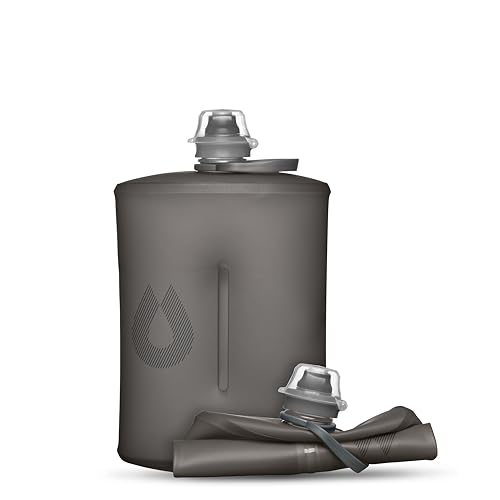
3. HydraPak Stow 1L Collapsible Bottle, Mammoth Grey
Best for: The backup — a second bottle that weighs under two ounces and disappears into a pack lid until the day it saves the trip.
The Stow is HydraPak’s simplest bottle, and its spec sheet reads like a list of things removed. No rigid shell, no wide mouth, no insulation — just a TPU body with radio-frequency welded seams, an internal baffle that keeps the filled bottle from ballooning into a water balloon’s shape, and a spill-proof twist nozzle under a flip-top dust cap. Per the maker it weighs under two ounces, flattens and rolls when empty, and secures inside its own bail handle, which is why it is the bottle most likely to actually be in your pack on the day a primary bottle punctures, a cap cracks, or a dry stretch appears that the forecast did not mention.
Drinking from the Stow is a nozzle experience: twist, sip or squeeze, twist shut. It is not as satisfying as a rigid bottle’s open mouth, and that is the correct trade for a backup. Where the Stow earns a second look as more than a spare is its thread: the 28 millimeter neck accepts the same squeeze filters as the Vesica, including HydraPak’s own 28 millimeter filter kit, so the backup can step into filter duty without an adapter. Listing data describes the bottle as top-rack dishwasher safe and freezer safe, and rated for warm water — useful for the old trick of a warm bottle in a sleeping bag on a cold night, within the maker’s stated limits.
Between the two soft bottles here, the division of labor is simple. The Vesica is the structured one, built to stand and fill and work a filter all day. The Stow is the ghost, carried for emergencies and extra capacity and forgotten the rest of the time. Many hikers will rationally own both, because together they weigh less than a single rigid bottle’s cap assembly and cover more failure modes than any one container can.
Specs
– Capacity: 1 L
– Material: TPU with RF-welded seams, BPA-free and PVC-free per the maker
– Empty weight: Under 2 oz per the maker
– Cap: Spill-proof twist nozzle with flip-top dust cover; bail handle
– Thread: 28 mm, filter compatible per the maker
– Features: Internal baffle; flattens and rolls for storage when empty
– Color pinned: Mammoth Grey
– Tier: Budget
4. Klean Kanteen Reflect 27 oz Water Bottle with Bamboo Cap, Brushed Stainless

Best for: The plastic-free pick — single-wall steel for hikers who want no plastic in the water path and a bottle that dents rather than cracks.
The Reflect is the minimalist of the Klean Kanteen line: one material story told three ways. The body is single-wall 18/8 food-grade stainless steel with an electropolished interior, the cap is a single piece of stainless steel finished with sustainably harvested bamboo, and the only other component is a food-grade silicone gasket. No paint, no plastic, nothing to chip into your water. For backpackers, the single-wall construction is the point that needs understanding: there is no vacuum insulation, so the bottle weighs 8.1 ounces per its Amazon listing data instead of the pound-plus of an insulated steel bottle, and it behaves like what it is — a metal canteen. Cold water sweats in summer humidity, and hot drinks make the wall hot to hold, which is why the maker positions it for cold and room-temperature drinks.
What steel buys on trail is a particular kind of durability. A rigid plastic bottle’s end usually comes from a cracked cap thread or a split seam; a steel bottle accumulates dents and keeps sealing, and its wide mouth takes ice, filter output, and a brush without complaint. The brushed finish hides the scratches that a mirrored finish would advertise. The bamboo cap needs hand washing per the listing’s care instructions, while the bottle itself is listed as dishwasher safe — a small chore split worth knowing about before the first trip, not after.
At 27 ounces it is the smallest drinker in this guide, which suits it to shorter carries between sources and to hikers who treat steel as a long-term purchase: this is the bottle in the guide most likely to still be in service a decade from now. Pair it with either soft bottle for capacity, and the system covers plastic-free daily drinking plus filter-ready reserve volume for about the weight of the rigid pick alone.
Specs
– Capacity: 27 oz (800 ml)
– Material: Single-wall 18/8 stainless steel, electropolished interior
– Cap: Stainless steel and bamboo with food-grade silicone gasket; no plastic in the water path per the maker
– Empty weight: 8.1 oz per Amazon listing data
– Insulation: None — single-wall; maker positions it for cold and room-temperature drinks
– Care: Bottle dishwasher safe per listing data; bamboo cap hand wash
– Finish pinned: Brushed Stainless
– Tier: Mid-range
5. MSR Dromedary Bag, 4L

Best for: The dry-camp hauler — four liters of expedition-grade water storage that hangs in camp and rolls flat on the trail.
Full disclosure of framing: this pick is a bag, not a bottle, and it is here because the hardest water problem in backpacking is not drinking but hauling. The Dromedary is MSR’s heavy-duty answer, built from a 1,000-denier Cordura nylon shell laminated to a food-grade, BPA-free polyurethane lining per the maker, and it has been the default expedition water bag for decades for one reason: it survives the abuse that kills lighter reservoirs. It can be dragged across tailgates, frozen, sat on by accident, and — per the maker — filled with boiling water, which turns it into a camp hot-water supply as well as a reservoir. At 6.9 ounces for four liters of capacity, its weight per liter is lower than every bottle in this guide.
The cap system is a three-in-one design: a large opening for fast filling under a tap or in a stream, a smaller spout for controlled pouring into a cook pot, and a flip drinking spout. Perimeter webbing gives it tie-down and hanging points, so in camp it lives on a branch at working height and dispenses by gravity. For a group, one Dromedary at the last creek replaces four people’s worth of bottle-shuffling at dinner, and for a solo hiker heading into a dry high camp it is the difference between cooking and not cooking.
The limits are honest ones. It is a poor daily drinker — wide, sloshy, and happiest stationary — and MSR advises against storing water in it long-term, so it is a trip tool, not a pantry container. The pinned listing is the 4 liter size; the same product family runs to 6 and 10 liters under separate listings, and the 4 is the size that stays backpacking-sane. If your routes are water-rich, this pick is dead weight and the guide’s soft bottles cover you. If they are not, it is the most trip-changing item on this page.
Specs
– Capacity: 4 L
– Material: 1,000-denier Cordura nylon exterior with food-grade, BPA-free polyurethane lining per the maker
– Empty weight: 6.9 oz per the maker
– Dimensions: 10 x 18.3 in per the maker
– Cap: Three-in-one cap with large fill opening, pour spout and drinking spout
– Features: Perimeter webbing for hanging and tie-down; handles boiling water and freezing per the maker
– Warranty: Three-year limited warranty per listing data
– Tier: Premium
Safety and Checks Before You Order
- Recall status of these five picks: None of the five products in this guide is subject to a CPSC or FDA recall. The category records below are named with their exact scope because they are the ones most likely to surface in a search, and none of them covers a pick here.
- The travel mug recalls do not reach these bottles. Stanley’s Switchback and Trigger Action travel mugs were recalled in December 2024 (CPSC 25-063) after lid threads could shrink with heat and let lids detach. That action covers those two mug lines and their lids only — no bottle in this guide is a Stanley product, and no pick uses that lid design.
- The Thermos stopper action is a food jar story. The April 2026 action (CPSC 26-444) covers specific Thermos Stainless King food jars and a Sportsman food jar with stoppers made before July 2023 — sealed food jars, not drink bottles. There is no Thermos pick in this guide; the transferable lesson is narrower and worth keeping: any stoppered container can build pressure with hot or fermenting contents, so respect each maker’s fill guidance.
- The Ozark Trail recall is one large steel model. Walmart’s Ozark Trail 64 oz insulated bottle, model 83-662, was recalled in July 2025 (CPSC 25-377) after its lid ejected when carbonated or perishable drinks built pressure inside. It is a different product from every pick here, but it is the same lesson the Yonder’s maker prints on its own bottle: never store carbonated drinks in a sealed trail bottle, and never leave perishable liquids sealed in one.
- Compartment and children’s bottle actions, for completeness. The Bindle Bottle was the subject of an FDA action in February 2023 over lead solder inside a hidden storage compartment — no pick in this guide has a storage compartment. A November 2022 action covered a green sprouts stainless steel straw bottle for young children over lead solder at its base — no pick here is a children’s bottle.
- A note on filter hygiene. The two soft bottles here are filter partners, not filters: they protect nothing by themselves, and the water safety of the system comes from the filter you thread onto them. Follow your filter maker’s backflushing guidance, let hollow-fiber filters dry between trips, and never let a wet filter freeze — ice expansion inside the fibers can damage them invisibly, which is why experienced winter hikers sleep with the filter in the bag. A soft bottle that survives freezing, as the Stow is rated to do, does not make the attached filter freeze-proof.
- Match the exact variant, not the product family. Every pick here lives in a listing family with near-identical siblings. The Yonder is sold with chug, straw and tether caps and in several colors — the pinned listing is the 1 liter with the Chug Cap in Cosmic Lilac. The Vesica exists in 28 millimeter and 42 millimeter thread versions under separate listings — the pinned one is 28 millimeter, and choosing the wrong thread is the single easiest ordering mistake in this guide. The Stow comes in 350 ml, 500 ml and 1 liter sizes; the pinned listing is the 1 liter in Mammoth Grey. The Reflect comes in 18 and 27 ounce sizes and two finishes; the pinned listing is the 27 ounce in Brushed Stainless. The Dromedary runs 4, 6 and 10 liters; the pinned listing is the 4 liter. Confirm the size, thread and color on the listing itself before checkout.
- Evidence notes, stated plainly. The Yonder’s identifier was confirmed from its Amazon product information, and its price-tracking record shows current offers led by third-party sellers rather than a direct Amazon offer — glance at the seller on the live listing. The Reflect’s identifier rests on Amazon product information agreed across the US and Canadian stores; a mirrored-finish sibling listing in the same family showed a no-featured-offers note in crawl summaries, while the pinned brushed listing did not — glance before ordering. The Stow’s smaller sibling listings showed the same no-featured-offers pattern in some crawl summaries; the pinned 1 liter listing showed standard listing data. The Dromedary’s Amazon listing record is the oldest of the five, though outdoor retailers show the 4 liter in current stock; a glance at the live offer is worthwhile. The Vesica’s identifier comes from its Amazon listing address in search results rather than a printed product-information block, the lightest evidence route in this guide.
Frequently Asked Questions
How much water capacity should a backpacker carry?
Work backward from your driest day, not your average one. Total system capacity of two liters covers most well-watered routes, split between a drinking bottle and a reserve. Three to four liters is the realistic floor for desert stretches, high ridges and dry camps. The mix in this guide — one-liter drinkers, one-liter soft reserves and a four-liter hauler — is designed so you can assemble any of those totals without buying a different bottle for each trip length.
Will my squeeze filter fit these bottles?
If your filter uses the common 28 millimeter thread, yes for both soft bottles: the Vesica and the Stow are built to that standard, and the Vesica’s maker designs around the best-known squeeze filters explicitly. If your filter uses the wider 42 millimeter thread, neither soft bottle here fits — the Vesica is also made in a 42 millimeter version under a separate listing. The rigid and steel bottles are clean-side vessels: their mouths accept filtered water, but no filter threads onto them, and the Dromedary is filled from a filter’s output rather than connected to one.
Are soft bottles tough enough for a long trail?
Tough enough, with the right expectations. Modern TPU bodies with welded seams survive seasons of daily squeezing, and their failure modes — a puncture, a worn cap thread — are why this guide pairs two of them rather than trusting one. Keep them away from crampons, stove parts and the sharp hardware corners inside a pack, and retire one that starts weeping at a seam. A rigid bottle still wins on outright lifespan; the soft bottles win on the weight and packability that let you carry redundancy in the first place.
How do I carry water to a dry camp?
Fill everything at the last reliable source, and let the big container do the work. A four-liter bag hauled full for the final mile replaces four separate bottle trips and gives you cooking water, drinking water and a morning reserve in one carry. Hang it in camp for gravity dispensing, keep the day’s drinking bottle separate so camp use does not silently drain tomorrow’s walking water, and walk out with the bag rolled flat. On routes where the camp is always near water, leave the hauler home — the two soft bottles here already give you two liters of flexible capacity.
Conclusion
Backpacking water gear rewards systems thinking. The YETI Yonder 1L is the bottle to build around if you want a rigid daily drinker that shrugs off years of trail abuse. The CNOC Outdoors Vesica 1L and HydraPak Stow 1L divide the soft-bottle work between them — one structured for daily filter duty, one light enough to forget until it is needed. The Klean Kanteen Reflect 27 oz serves hikers who want steel and no plastic in the water path, accepting ambient-temperature water as the fair price. And the MSR Dromedary 4L solves the problem bottles cannot: moving camp-sized water from the last creek to a dry site. Match the pieces to your driest route, confirm the thread and size variants before ordering, and every ounce in the system will be earning its place.