Our Short List of 3
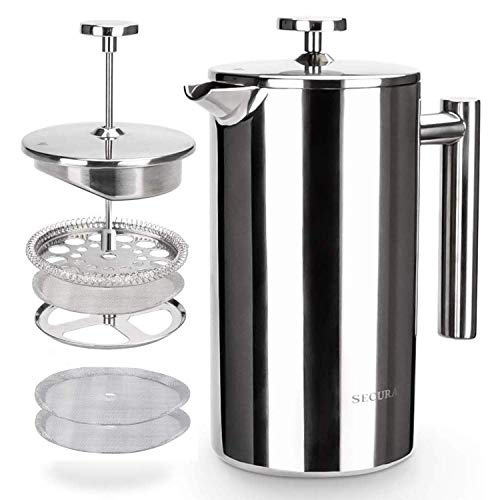
- Capacity: 34 oz (1 liter)
- Material: 18/10 stainless steel, double-wall insulated, interior and exterior
- Filter: 3-layer stainless steel filter with 2 extra screens included
- Dimensions: 6.7 x 6.1 x 9.8 inches
- Capacity: 34 oz (1 liter)
- Material: Double-wall 304 stainless steel, rust-free
- Filter: 4-level filtration system
- Care: Dishwasher safe, food-grade materials

- Capacity: 34 oz (1 liter)
- Material: Double-wall stainless steel, chrome finish
- Filter: Stainless steel mesh plunger with silicone rim
- Lid: Safety lid that rotates to close the spout
All 5 Picks at a Glance
| Product | Specs | Action |
|---|---|---|
| 1. Secura French Press Coffee Maker 34 oz |
| Check price on Amazon |
| 2. Mueller French Press Coffee Maker 34 oz |
| Check price on Amazon |
| 3. Bodum Columbia Thermal French Press 34 oz |
| Check price on Amazon |
 4. Espro P3 French Press Coffee Maker 32 oz |
| Check price on Amazon |
 5. SterlingPro French Press Coffee Maker 59 oz |
| Check price on Amazon |
Key takeaways
- Compare five French presses for rich, full-bodied coffee, from double-wall steel presses that hold heat to a micro-filter premium pick and a large size.
The best French press for most households is the Secura 34 oz stainless steel press, because its double-wall body keeps coffee hot through a slow breakfast, its three-layer steel filter traps fine grounds better than a single mesh screen, and it ships with two extra screens so the filter stays effective for years. If you want the lowest tier in this roundup without giving up steel construction, the Mueller 34 oz press is the budget pick, with a four-level filtration system and a double-wall body at a lower tier. Households that drink a second and third cup from the same pot should look at the Bodum Columbia 34 oz thermal press, which Bodum says holds coffee hot for up to two hours. The Espro P3 32 oz is the premium pick for the cleanest cup, thanks to a patented double micro-filter that catches far more fine sediment than a standard mesh. For large households and offices, the SterlingPro 59 oz press brews more than half again as much as a standard 34 oz pot in a single steep.
As an Amazon Associate, we earn from qualifying purchases.
Quick Answer
A French press brews by steeping coarsely ground coffee directly in hot water, then pressing a mesh filter down to separate the grounds from the finished cup. That full immersion is what gives French press coffee its heavy body and deep flavor, since the paper filter of a drip machine never touches the brew and the coffee oils stay in the cup. The five presses below cover the main choices a buyer faces: glass or stainless steel, single mesh or multi-layer filtration, standard or oversized capacity, and a budget tier or a premium build. Every press here holds at least 32 ounces, which brews about four standard mugs, and every one is dishwasher safe, so cleanup never decides the purchase on its own. Choose the Secura for the best balance of heat retention, filtration, and included spares. Choose the Mueller when the budget matters most. Choose the Bodum Columbia when coffee needs to stay hot for a second round. Choose the Espro P3 when sediment in the cup is the main complaint. Choose the SterlingPro when one pot must serve a crowd.
Table of Contents
- The Best French Press for Most Households
- How We Chose These Five Presses
-
- Secura French Press Coffee Maker 34 oz
-
- Mueller French Press Coffee Maker 34 oz
-
- Bodum Columbia Thermal French Press 34 oz
-
- Espro P3 French Press Coffee Maker 32 oz
-
- SterlingPro French Press Coffee Maker 59 oz
- How to Choose a French Press
- Who Should Skip a French Press
- Brewing and Care Tips
- Frequently Asked Questions
- Conclusion
- Product and ASIN Reference
How We Chose These Five Presses
Every press in this roundup was selected from published specifications and Amazon listing data, with capacity, body material, filter design, and care instructions taken from the manufacturer listing for each model. We looked for presses that cover the real range of home brewing: a steel press for daily use, a glass press for drinkers who want to watch the brew, a thermal press for slow mornings, a micro-filter press for the cleanest cup, and an oversized press for households that brew for guests. Capacity was kept close across four of the five picks so the comparison stays honest, with the SterlingPro standing apart as the deliberate large-format choice. Filtration mattered more than brand, since the filter is the part that decides how much sediment reaches the cup, so we favored presses with multi-layer screens, silicone-edged plungers, or patented micro-filters over a bare single mesh wherever the tier allowed it. Dishwasher-safe construction was treated as a baseline, not a bonus, because a press that is hard to clean is a press that stops being used. Finally, each pick had to be a current Amazon listing with a verifiable ten-character ASIN, and no pick here appears in any earlier rippll article.
1. Secura French Press Coffee Maker 34 oz
- Capacity: 34 oz (1 liter)
- Material: 18/10 stainless steel, double-wall insulated, interior and exterior
- Filter: 3-layer stainless steel filter with 2 extra screens included
- Dimensions: 6.7 x 6.1 x 9.8 inches
The Secura 34 oz press is the most complete French press in this roundup for a household that brews every morning. Its body is 18/10 stainless steel on both the interior and the exterior, so there is no glass to crack when the carafe meets the edge of the sink, and the double-wall construction holds heat far longer than a single-wall glass press. The capacity is 34 ounces, which the listing states as one liter, and that brews about four standard mugs, or enough for two people to have a second cup without brewing a second pot. The filter is the feature that sets the Secura apart from cheaper steel presses: a three-layer stainless steel filter structure traps the smallest grounds, and the box includes two extra screens, so the filtration stays tight even after years of daily pressing and washing. All of the parts are dishwasher safe, which matters for a press whose filter assembly has several pieces that would be tedious to wash by hand every morning.
In daily use, the Secura suits a household that wants one press to do everything without fuss. The cool-touch handle and knob stay comfortable to hold while the pot is full of hot coffee, and the steel body takes the knocks of a busy kitchen without the worry that follows a glass carafe. The 34 oz size is the sweet spot for most homes: large enough for a family breakfast, small enough to lift and pour with one hand when full. The extra screens deserve a second mention, because the mesh is the part of any French press that wears out first, and having two spares in the box means the press keeps brewing clean cups long after a press with a single screen would start letting sediment through. The double-wall body also makes the Secura a reasonable choice for brewing loose-leaf tea, since the same heat retention that keeps coffee hot works for a long tea steep.
The trade-offs are modest. The steel body is opaque, so you cannot watch the coffee bloom or judge the level remaining in the pot without lifting the lid. The press is heavier than a glass model of the same capacity, which some drinkers notice when pouring the last cup. And the three-layer filter, while effective, has more parts to rinse than a single mesh, although the dishwasher-safe design makes that a small chore. None of these is a reason to pass on the press for most buyers, and the combination of steel durability, heat retention, and included spare screens is why the Secura leads this roundup.
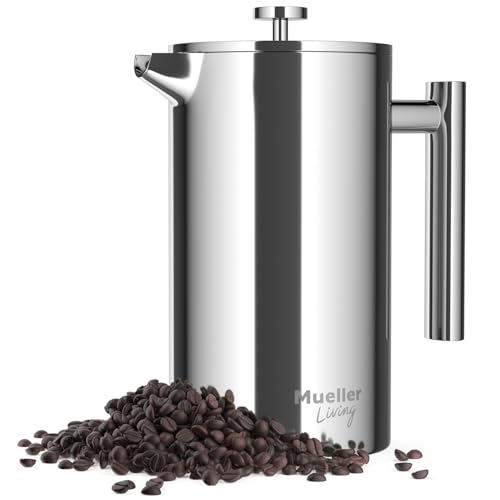
2. Mueller French Press Coffee Maker 34 oz
- Capacity: 34 oz (1 liter)
- Material: Double-wall 304 stainless steel, rust-free
- Filter: 4-level filtration system
- Care: Dishwasher safe, food-grade materials
The Mueller 34 oz press is the budget pick in this roundup, and the best value for a household that wants a steel French press without paying a premium tier. Its body is double-wall 304 stainless steel, which keeps coffee hot longer than a glass press and removes the breakage worry entirely, and the rust-free construction suits a kitchen where the press lives on the counter next to the sink. The capacity matches the Secura at 34 ounces, so it brews the same four-mug pot, and the four-level filtration system is the most layered filter at the budget tier: four filters work in sequence to catch grounds before they reach the cup, which shows up as a cleaner pour than a single-mesh budget press delivers. The press is dishwasher safe, and the food-grade steel construction means no plastic touches the brew.
For a first French press, the Mueller is hard to fault. The brewing routine is the same as any press: coarse grounds, hot water just off the boil, a four-minute steep, and a slow, steady press. The double-wall body forgives a slow morning, holding the coffee at drinking temperature while breakfast cooks, and the steel carafe survives the drops and bumps that end a glass press. The four-filter system is the real story at this tier, because sediment is the most common complaint about cheap presses, and Mueller addresses it with filtration rather than asking the buyer to grind coarser or accept a cloudy cup. The handle and lid are sized for a comfortable one-hand pour, and the whole assembly breaks down for cleaning without tools.
The compromises match the tier. The finish and fittings are simpler than the premium steel presses here, and the lid and plunger assembly feel lighter in the hand than the Secura or the Bodum Columbia. The opaque body hides the brew level, as with every steel press, and the press has no spare screens in the box, so the filter will eventually need a replacement part when the mesh wears. For a household brewing once a day, that is a distant concern, and the value at the budget tier is strong. Choose the Mueller when the budget matters most and a steel body with multi-level filtration is the priority, and step up to the Secura when spare screens and a heavier build are worth the higher tier.
3. Bodum Columbia Thermal French Press 34 oz
- Capacity: 34 oz (1 liter)
- Material: Double-wall stainless steel, chrome finish
- Filter: Stainless steel mesh plunger with silicone rim
- Lid: Safety lid that rotates to close the spout
The Bodum Columbia 34 oz is the thermal press in this roundup, and the right choice when coffee needs to stay hot for a second and third cup. Its double-wall stainless steel body is built like an insulated thermos, and Bodum says the press keeps coffee hot for up to two hours, which is roughly double what a single-wall glass press manages. The capacity is 34 ounces, or one liter, which Bodum counts as about eight small cups of four ounces each, and in practical terms that is four standard mugs. The plunger pairs a fine stainless mesh with a silicone rim, which seals against the inside wall of the pot and keeps fine grounds out of the cup better than a bare mesh edge. The safety lid rotates to close off the spout, which keeps heat in between pours and guards against spills when the pot is carried to the table.
The Columbia suits a slow household. Brew a full pot, pour the first round, close the spout, and come back for a second cup without reheating, which is the routine that glass presses fail at. The steel body will not shatter, so the press also suits a kitchen where a glass carafe has already been lost to the tile floor, and the chrome finish looks at home on an open shelf or a sideboard. The silicone-edged plunger is a thoughtful detail: it wipes the inside wall as it descends, which reduces the ring of grounds that a loose mesh leaves behind, and it avoids scratching the steel interior. The press stands about eight and a half inches high including the plunger top, so it fits under most upper cabinets, and all parts are dishwasher safe.
The trade-offs are the ones that follow any thermal steel press. The opaque body means you cannot see how much coffee is left, and coffee left sitting on the grounds keeps extracting, so the last cup pours stronger than the first unless you decant the pot after pressing. The Columbia costs more than a basic glass press, and the plunger and lid are specific to this model, so a replacement means ordering the matching part rather than a generic screen. For a household that drinks its coffee in one sitting, a glass press at a lower tier may be the better buy. For a household that brews once and drinks slowly, the Columbia is the strongest pick in this roundup.
4. Espro P3 French Press Coffee Maker 32 oz
- Capacity: 32 oz
- Material: Thicker borosilicate glass carafe with black plastic frame and handle
- Filter: Patented double micro-filter
- Care: Dishwasher safe
The Espro P3 32 oz is the premium pick for the cleanest cup in this roundup. Its defining feature is a patented double micro-filter: two fine mesh filters sit between the plunger and the grounds, and together they catch far more fine sediment than the single mesh of a standard press. The result is a cup that tastes like a French press, full and oily, without the gritty last sip that makes many drinkers abandon the method. The carafe is thicker borosilicate glass than a standard press uses, which resists heat shock better and gives the pot a solid feel in the hand, and the frame and handle are black plastic that stays cool and provides a secure grip. The capacity is 32 ounces, just under the 34 oz standard of the other picks, which brews about four standard mugs.
The P3 suits a drinker who loves French press flavor but dislikes sediment. The double filter is the reason to pay the premium tier: it does the work that a paper filter does in a drip machine, without removing the coffee oils that give French press its body. The glass carafe lets you watch the bloom and judge the level at a glance, which steel presses cannot offer, and the brewing routine is unchanged, so no new technique is needed. The press is also a capable tea brewer, since the fine filters hold back small tea leaves that slip through a coarse mesh. Espro sells the P3 in 18 oz and 32 oz sizes, and the 32 oz size here is the household size, while the 18 oz suits a single drinker or a travel setup.
The trade-offs are the ones that follow any glass press. The carafe can break if dropped on a hard floor, so the P3 is the wrong pick for a clumsy kitchen or a campsite, where a steel press is the safer choice. The double filter has more surface area to rinse than a single mesh, and the premium tier costs more than the steel presses in this roundup. Glass also loses heat faster than double-wall steel, so the coffee should be poured soon after pressing rather than left to sit. For a drinker who values a clean cup above all else, those are acceptable trade-offs, and the P3 delivers the most refined French press cup in this group.
5. SterlingPro French Press Coffee Maker 59 oz
- Capacity: 59 oz (1.75 liters)
- Material: Double-wall stainless steel, interior and exterior
- Filter: Stainless steel mesh filter with 2 free filters included
- Care: Dishwasher safe
The SterlingPro 59 oz press is the large-format pick in this roundup, built for households, offices, and gatherings where a standard 34 oz pot runs dry before everyone has a cup. Its capacity is 59 ounces, or 1.75 liters, which brews roughly seven standard mugs in a single steep, and the double-wall stainless steel body keeps that large volume hot while the pot makes its rounds. The construction is stainless steel inside and out, so there is no glass to break and no plastic touching the brew, and the press ships with two free filters, which extends the life of the filtration before any replacement is needed. The inside of the pot carries cup and ounce markings, which help when scaling a recipe up or down for a smaller group.
In daily use, the SterlingPro suits a household that entertains, a shared office kitchen, or a family where several people drink coffee at the same time. Brewing for a crowd with a standard press means either a second pot or a second brew, and the 59 oz size removes that step. The double-wall body matters more at this size than at 34 oz, because a large pot of coffee cools from the surface, and the insulation keeps the last pours as hot as the first. The press is dishwasher safe, and the steel body handles the weight of a full pot without flexing. SterlingPro also sells the same press in 34 oz and 51 oz sizes, so a household that likes the design but not the volume can step down, although the 59 oz model here is the one that earns its place for large-batch brewing.
The trade-offs follow the size. A full 59 oz pot is heavy, and pouring the last cups takes two hands and a steady grip. The press takes up more counter and cabinet space than a standard pot, and it is more press than a single drinker or a couple needs, since coffee left sitting on the grounds over-extracts. The 59 oz size also uses more beans per brew, which adds up across a week of daily use. For a small household, the Secura or the Mueller at 34 oz is the better fit. For a large household, an office, or a weekend gathering, the SterlingPro is the only pick here that brews enough in one steep.
How to Choose a French Press
Start with capacity. A 32 oz or 34 oz press brews about four standard mugs, which suits one or two drinkers, while a 50 oz or 59 oz press suits a household of four or more, or a table with guests. Bodum and other makers count cups in four-ounce servings, so a press labeled eight cups is a 32 oz pot, not eight full mugs, and that labeling catches first-time buyers out. Buy the size that matches the largest pot you brew regularly, not the average, since a half-filled press brews unevenly and a press that is too large wastes beans.
Next, choose the body material. Glass lets you watch the brew and judge the level, and it is the classic French press experience, but it breaks when dropped and loses heat quickly. Double-wall stainless steel keeps coffee hot far longer, survives drops, and suits kitchens with tile floors, but it hides the brew level and weighs more. Single-wall steel splits the difference on heat but not on durability. For a first press, steel is the safer choice unless watching the bloom matters to you, and for a household with children or pets underfoot, steel is the clear choice.
Then look at the filter, because the filter decides how much sediment reaches the cup. A single mesh screen is the standard, and it works well with a coarse grind, but fine particles slip through and settle in the last sip. A multi-layer filter, a silicone-edged plunger, or a double micro-filter catches more of those fine particles, and the difference is visible in the cup. Spare screens in the box are worth favoring, since the mesh is the part that wears out first, and a press with spares keeps brewing clean cups for years longer than one without.
Finally, check the practical details. Dishwasher-safe construction saves time every morning, and a press that breaks down without tools is easier to clean thoroughly. A cool-touch handle matters when the pot is full of hot coffee, and a lid that closes the spout keeps heat in between pours. A safety note applies to any glass press: inspect the carafe for chips or cracks before each use, and stir with a plastic or wooden spoon rather than a metal one, since a damaged glass carafe can break under hot liquid. Replace a carafe at the first sign of damage rather than brewing with it again.
Who Should Skip a French Press
A French press is not the right brewer for everyone. Drinkers who hate any sediment in the cup should consider a pour-over dripper with a paper filter instead, since even the best micro-filter press leaves more fine particles than paper does. Households that brew a single mug at a time waste beans and effort with a full-size press, and a single-serve pour-over or a small 12 oz press fits that routine better. Offices that need coffee ready for a crowd on a timer should look at a drip machine with a thermal carafe, since a French press needs a person to steep and press each pot by hand. Anyone who wants coffee to stay hot for hours after brewing should decant into a separate insulated carafe, since coffee left sitting on the grounds in any press keeps extracting and turns bitter. And a kitchen with very limited counter space may be better served by a compact brewer, since even a 34 oz press needs a permanent home near the kettle.
Brewing and Care Tips
Good French press coffee starts with a coarse grind, about the texture of coarse sea salt, because fine grounds slip through the mesh and cloud the cup. Use one rounded tablespoon of coffee for every four ounces of water as a starting ratio, then adjust to taste over the next few brews. Heat the water to just off the boil, pour it over the grounds, stir gently with a plastic or wooden spoon, and set the lid on top with the plunger raised. Let the coffee steep for four minutes, then press the plunger down slowly and evenly, and pour the coffee out right away so it stops extracting. Decanting into a second vessel is the simplest way to keep the last cup tasting like the first.
Cleaning is simple when it becomes a habit. Knock the grounds into the trash or a compost bin, rinse the carafe, and wash the filter assembly under running water to clear trapped grounds from the mesh. A weekly deep clean keeps the mesh clear: take the filter apart, scrub each screen with a soft brush, and run the parts through the dishwasher if the listing allows it. Dry the filter screens fully before reassembling, since trapped moisture dulls the mesh over time. Store the press with the plunger raised so air circulates through the carafe and the seal stays fresh. With that routine, a steel press lasts for years, and a glass press lasts until the day the carafe meets the floor.
Frequently Asked Questions
How much coffee does a 34 oz French press brew?
A 34 oz press brews about four standard mugs of coffee, since a standard mug holds about eight ounces. Makers often label the same pot as eight cups because they count a cup as four ounces, so check the ounce capacity rather than the cup count when comparing presses.
What grind size works best in a French press?
A coarse grind works best, about the texture of coarse sea salt. Fine grounds slip through the mesh filter and settle in the cup, while a coarse grind stays above the filter and steeps evenly during the four-minute brew.
How long should French press coffee steep?
Four minutes is the standard steep time for a full pot. Shorter steeps taste thin and under-extracted, while longer steeps pull bitter notes from the grounds, so set a timer and press as soon as it rings.
Can I brew tea in a French press?
Yes, a French press brews loose-leaf tea well, since the mesh filter holds back the leaves while the tea steeps in hot water. Use the same four-minute steep as a starting point, rinse the filter thoroughly afterward so tea leaves do not flavor the next pot of coffee, and avoid pressing tea leaves hard enough to push them through the mesh.
Conclusion
The best French press is the one that matches how your household actually drinks coffee. The Secura 34 oz press leads this roundup for most buyers, with double-wall steel, a three-layer filter, and two spare screens in the box. The Mueller 34 oz press is the budget choice, with four-level filtration and a steel body at the lowest tier here. The Bodum Columbia 34 oz thermal press is the pick for slow mornings, keeping coffee hot for up to two hours in a double-wall body with a silicone-edged plunger. The Espro P3 32 oz press is the premium choice for the cleanest cup, with a patented double micro-filter and a thicker glass carafe. The SterlingPro 59 oz press is the large-format choice for households and offices that brew for a crowd. Measure your counter, count your mugs, and choose the press that fits both, and your next pot will taste the difference that full immersion brewing makes.
Product and ASIN Reference
| Product | ASIN |
|---|---|
| Secura French Press Coffee Maker 34 oz | B00JE36GLQ |
| Mueller French Press Coffee Maker 34 oz | B07JGBK6XV |
| Bodum Columbia Thermal French Press 34 oz | B00005YY9X |
| Espro P3 French Press Coffee Maker 32 oz | B011WTM622 |
| SterlingPro French Press Coffee Maker 59 oz | B014U0ZNG6 |