Our Short List of 3
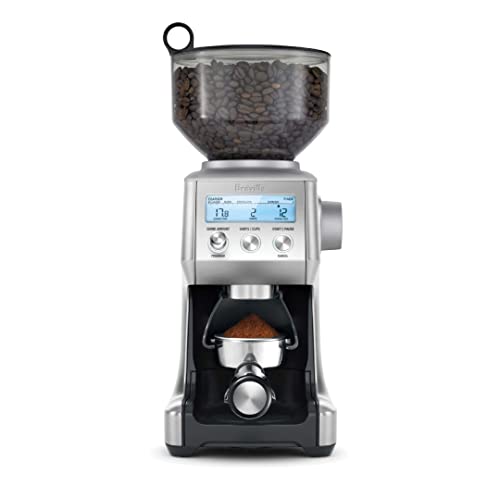
- Burr type: Stainless steel conical burrs
- Grind settings: 60 settings, from espresso fine to French press coarse
- Dosing: Timed dosing in 0.2 second increments with LCD display
- Hopper capacity: 18 ounces of beans

- Burr type: 40 mm six-blade stainless steel conical burrs
- Grind settings: 41 settings plus inner-ring micro adjustment
- Dosing: Single-dose with magnetic catch cup, up to 110 grams per load
- Motor torque: 6 Nm

- Burr type: Automatic burr mill
- Grind settings: 18-position grind selector
- Cup selector: 4 to 18 cups
- Operation: One-touch automatic grinding
All 5 Picks at a Glance
| Product | Specs | Action |
|---|---|---|
| 1. Breville Smart Grinder Pro |
| Check price on Amazon |
| 2. Fellow Opus |
| Check price on Amazon |
| 3. Cuisinart DBM-8 Supreme Grind |
| Check price on Amazon |
 4. Shardor CG835B |
| Check price on Amazon |
 5. Krups F203 |
| Check price on Amazon |
Key takeaways
- Compare five coffee grinders for drip, espresso, French press and cold brew, from a compact blade mill to timed burr models with wide grind ranges.
The best coffee grinder for most home brewers is the Breville Smart Grinder Pro, because its 60 grind settings run from fine espresso to coarse French press, its timed dosing repeats the same amount in 0.2 second steps, and it grinds straight into a portafilter or a sealed container. If one grinder must cover every brew method in a single-dose format, the Fellow Opus is the stronger pick, with 41 settings plus an inner micro-adjustment ring and a 40 mm six-blade conical burr set. For a smaller outlay, the Cuisinart DBM-8 Supreme Grind covers drip, espresso-style and French press grinding with 18 settings and a cup-count selector, while the Shardor CG835B adds a 16-setting burr mill with a 2 to 14 cup selector at a budget tier. The Krups F203 is the compact blade option for drip coffee and spices when counter space and simplicity matter more than grind uniformity.
As an Amazon Associate, we earn from qualifying purchases.
Grinding beans just before brewing is the single change that improves a cup the most, and it costs less than a new brewer. Pre-ground coffee loses aroma quickly once the bag is opened, because grinding exposes far more surface area to air. A grinder that produces even particles also brews more evenly, so the cup tastes sweet and clear instead of sour in one sip and bitter in the next. The five grinders below were chosen from published specifications and Amazon listing data to cover the main ways people brew at home: drip machines, espresso machines, French press pots, pour-over drippers and cold brew jars. Each one fits a different budget tier and a different daily routine, from a single morning cup to a full pot for a household.
Table of Contents
- How to Choose a Coffee Grinder
- 1. Breville Smart Grinder Pro
- 2. Fellow Opus
- 3. Cuisinart DBM-8 Supreme Grind
- 4. Shardor CG835B
- 5. Krups F203
- Comparison at a Glance
- Who Should Skip a Burr Grinder
- Care and Cleaning
- Frequently Asked Questions
- Conclusion
- Product and ASIN Reference
How to Choose a Coffee Grinder
Start with the burr question, because it shapes everything else. A burr grinder crushes beans between two ridged surfaces set a fixed distance apart, so most particles come out close to the same size. A blade grinder chops beans with a spinning blade, so the grounds come out mixed, with fine dust alongside coarse chunks. That dust over-extracts and tastes bitter, while the chunks under-extract and taste sour. Burr grinders therefore suit every brew method, and they are the only sensible choice for espresso, where a small change in fineness changes the shot completely. Blade grinders still have a place for drip coffee and for spices, where the brew method forgives uneven grounds and the low cost and small footprint matter more.
Next, count the grind settings and check whether they cover the methods you actually use. Espresso needs a fine, powdery grind. Drip machines need a medium grind, about the texture of coarse sand. Pour-over sits near medium-fine to medium, depending on the dripper. French press and cold brew need a coarse grind, about the texture of coarse sea salt, so the grounds do not slip through the mesh or over-extract during a long steep. A grinder with 16 settings can cover that range in broad steps, which is enough for drip, French press and cold brew. A grinder with 41 or 60 settings adds finer steps, which helps when dialing in espresso or when switching between a pour-over dripper and a French press in the same week. Micro-adjustment, found on the Fellow Opus as an inner ring, adds even smaller steps between the main settings, which is useful once a shot is close but not quite right.
Then decide how the grinder doses. Hopper-fed grinders hold a supply of beans and grind on demand, either by time or by cup count. Timed dosing, used by the Breville Smart Grinder Pro, repeats the same grind time each morning, which is fast and consistent enough for a household that brews the same drink daily. A cup-count selector, used by the Cuisinart DBM-8 and the Shardor CG835B, asks how many cups you plan to brew and grinds roughly the right amount, which suits a drip routine where the pot size changes. Single-dose grinders, such as the Fellow Opus, hold only the beans you load for one drink, which keeps beans fresh in their bag instead of sitting in a hopper, and makes it easy to switch beans between drinks. The trade-off is a little more weighing and loading each time.
Capacity matters in a different way for each household. A hopper that holds 18 ounces of beans suits a household that brews a full pot every morning and does not want to refill daily. A 3-ounce blade bowl suits one or two cups at a time and forces a fresh grind for each brew, which is a benefit in disguise for occasional drinkers. Check the grounds container too: a sealed container keeps grounds from scattering across the counter, and a container that fits under the chute without wobbling saves cleanup time.
Physical fit is easy to overlook and annoying to get wrong. Measure the space under your upper cabinets before ordering, including room to lift the hopper lid off for refilling. The Breville Smart Grinder Pro stands about 15.33 inches tall, so it needs real headroom, while the compact blade and mid-size burr models in this roundup fit tighter kitchens more easily. Depth matters as well: a grinder that sits too close to the wall can be hard to load, and a grinder with a side-mounted dial needs clearance on that side. Weight helps stability, since a heavier grinder stays planted while the motor runs, but it also makes the unit harder to move for cleaning.
Portafilter compatibility matters only if you own an espresso machine, but it matters a lot then. The Breville Smart Grinder Pro includes cradles for 50 to 54 mm and 58 mm portafilter baskets, so it grinds directly into the basket. The Fellow Opus uses a dosing cup and a magnetic catch cup instead, which suits single-dose brewing and machines with baskets outside the common sizes. If your machine uses a 51 mm basket, confirm fit before relying on direct-to-portafilter grinding, and plan on grinding into a container and transferring the grounds.
Noise, cleaning and build quality round out the decision. Burr grinders are louder than blade grinders while running, but they run for a shorter time per dose, so the total noise is brief. Removable burrs and a cleaning brush make a real difference over months of use, because stale grounds and coffee oils build up inside any grinder and turn rancid, which dulls the flavor of fresh beans. Stainless steel burrs resist wear and keep their edge longer than ceramic burrs in daily use, while a metal housing survives knocks that would crack a plastic shell. A warranty of one or two years is standard in this group, and the Fellow Opus adds a third year with registration.
Finally, match the grinder to the brewer you already own. A drip machine owner needs a medium grind and a cup-count selector more than espresso range. An espresso machine owner needs fine adjustment steps and a way to dose repeatably. A French press owner needs a coarse grind without excessive fine dust, which clogs the mesh and clouds the cup. A cold brew drinker needs the same coarse range plus a grinder that does not heat the beans during a long grind. A household that brews several methods across the week needs the widest setting range, which is why the Breville Smart Grinder Pro and the Fellow Opus lead this roundup, while the Cuisinart DBM-8 and the Shardor CG835B cover the common methods at a lower tier, and the Krups F203 handles drip and spices in the smallest footprint.
1. Breville Smart Grinder Pro
- Burr type: Stainless steel conical burrs
- Grind settings: 60 settings, from espresso fine to French press coarse
- Dosing: Timed dosing in 0.2 second increments with LCD display
- Hopper capacity: 18 ounces of beans
The Breville Smart Grinder Pro is the most complete grinder in this roundup for a household that brews more than one way. Its stainless steel conical burrs sit behind 60 grind settings that run from fine espresso to coarse French press, so one machine covers a morning espresso shot, a midday pour-over and a weekend French press without a second grinder on the counter. Breville’s Dosing IQ system programs grind time in 0.2 second increments, and an LCD screen shows the grind setting, the grind time and the number of shots or cups selected, so a dose that works on Monday repeats on Friday without guesswork. The grinder dispenses into a portafilter seated in an adjustable cradle, into the included sealed grounds container, or into a filter basket, which covers espresso machines, drip machines and pour-over setups alike.
The hopper holds 18 ounces of beans and locks in place with a system that lets you remove it for storage or transfer without spilling beans across the counter. That matters in a busy kitchen, where a loose hopper is a daily annoyance and a spill wastes beans. The motor runs at 165 watts on standard 110 to 120 volt household current, and the burrs are designed to limit grinding heat, which protects the aromatic oils in the bean during a fine espresso grind. The unit stands 6.28 x 8.46 x 15.33 inches, so measure cabinet clearance before ordering, and note that the lid needs extra room above the hopper for refilling.
In daily use, the timed dosing is the feature that earns its keep. Once you find the grind time that fills your portafilter or your drip basket, you set it and the grinder repeats it, which removes the most common source of variation between cups. The LCD makes the setting visible at a glance, which helps when two people share the grinder and brew different drinks. The portafilter cradles accept 50 to 54 mm and 58 mm baskets, which covers the common home espresso machines, and the grounds container catches everything cleanly when you brew drip or pour-over instead.
Cleaning is straightforward: the upper burr lifts out for brushing, and Breville includes a cleaning brush for the burr chamber and the chute. Brush out the chamber weekly if you grind daily, and run grinder cleaning tablets through the burrs monthly if your manual allows them, since oils build up inside any grinder and turn stale. The stainless steel housing wipes clean with a damp cloth, and the hopper and grounds container wash by hand.
This is the right pick for a household with an espresso machine plus a drip or pour-over brewer, and for anyone who values repeatability over tinkering. It is overkill for a household that brews only drip coffee from a single bean, where the Cuisinart DBM-8 or the Shardor CG835B covers the same methods at a lower tier. It is also tall, so a kitchen with low upper cabinets may suit a shorter grinder better.
2. Fellow Opus
- Burr type: 40 mm six-blade stainless steel conical burrs
- Grind settings: 41 settings plus inner-ring micro adjustment
- Dosing: Single-dose with magnetic catch cup, up to 110 grams per load
- Motor torque: 6 Nm
The Fellow Opus is the all-rounder of this group, and the best choice when one grinder must cover every brew method in a single-dose format. Its 41 grind settings run from espresso fine to French press coarse, and an inner micro-adjustment ring lets you fine-tune between the main steps when a shot needs a smaller change than one click provides. The burr set is a six-blade 40 mm stainless steel conical design, and Fellow publishes a motor torque figure of 6 Nm, which is the spec that helps it keep turning through dense, light-roast beans at fine settings without stalling.
Single-dose brewing is the heart of the Opus workflow. You weigh the beans for one drink, load them, and grind, so nothing sits in a hopper going stale between brews. That suits a household that switches beans often, or a drinker who brews espresso in the morning and cold brew concentrate on the weekend from a different bag. The magnetic catch cup holds the grounds and lifts off cleanly, and anti-static technology limits the cling that scatters fine grounds across the counter. The load range runs to 110 grams, which covers a full French press pot as well as a single espresso dose.
The Opus is also the quietest-feeling grinder in this group in daily use, not because the motor is silent, but because the single-dose workflow runs the motor only as long as one dose needs, and the tidy catch cup keeps the routine calm. The matte black finish suits a modern kitchen, and the compact footprint fits under cabinets that would crowd the taller Breville. A two-year warranty applies, with a third year free when you register the grinder, which is the longest cover in this roundup.
Cleaning follows the same single-dose logic: with no hopper full of beans, the burr chamber stays accessible, and a quick brush after each session keeps stale grounds from building up. The catch cup washes by hand, and the burr set lifts out for a deeper clean when needed. Because the Opus grinds only what you load, there is no stale hopper residue to purge before the first cup of the day, which is a small daily saving that adds up.
This is the right pick for a drinker who switches beans or brew methods often, and for anyone who wants espresso range without a hopper full of beans going stale. It is less suited to a household that brews several large pots a day, where loading and weighing each dose gets tedious and a hopper-fed grinder such as the Breville Smart Grinder Pro or the Cuisinart DBM-8 is faster. It is also the premium tier pick in this roundup, so a drip-only household will find the same daily methods covered at a lower tier by the Shardor CG835B or the Cuisinart DBM-8.
3. Cuisinart DBM-8 Supreme Grind
- Burr type: Automatic burr mill
- Grind settings: 18-position grind selector
- Cup selector: 4 to 18 cups
- Operation: One-touch automatic grinding
The Cuisinart DBM-8 Supreme Grind is the long-running value pick in this roundup, and the simplest burr grinder here to use every morning. Its 18-position grind selector covers drip, espresso-style and French press grinding in broad steps, and a cup-size selector for 4 to 18 cups grinds roughly the right amount for the pot you plan to brew. One-touch operation starts the grind, and the unit stops when the selected amount is done, so there is no timer to program and no scale to weigh. The stainless steel finish suits a kitchen where the grinder lives on the counter next to the brewer.
The DBM-8 has been sold for many years under the same model number, which is a useful signal in itself: parts, manuals and owner guidance are easy to find, and the design has stayed simple because the simple version works. The removable bean hopper lifts off for filling and cleaning, and the grounds chamber slides out for emptying into a drip basket or a pour-over filter. The burr mill design produces a more even grind than any blade grinder, which shows up in the cup as cleaner drip coffee and a French press that pours without a heavy sludge layer.
In daily use, the cup-count selector is the feature that matters most. A household that brews a full pot on weekdays and a small pot on weekends sets the selector to match and gets a consistent amount each time, without weighing beans. The 18 grind settings are coarse enough in their steps that a beginner will not get lost, yet wide enough to cover the common methods. Espresso-style grinding is possible at the finest settings, though a dedicated espresso grinder with finer steps, such as the Breville Smart Grinder Pro or the Fellow Opus, dials in a shot more precisely.
Cleaning is simple: brush the burr chamber weekly, wash the hopper and grounds chamber by hand, and wipe the housing with a damp cloth. Because the hopper is removable, you can empty it fully when switching beans, which avoids mixing a dark roast into a light roast batch. The unit is compact enough to store in a cabinet between uses, which suits a small kitchen where counter space is shared with other appliances.
This is the right pick for a drip coffee household that wants a real burr grind without learning a new workflow, and for a first burr grinder that will last for years. It is less suited to an espresso-focused setup, where the broad steps make fine tuning harder, and to a household that brews cold brew exclusively, where a coarser-focused grinder with a larger batch capacity may suit better. For those routines, the Breville Smart Grinder Pro or the Fellow Opus is the stronger choice.
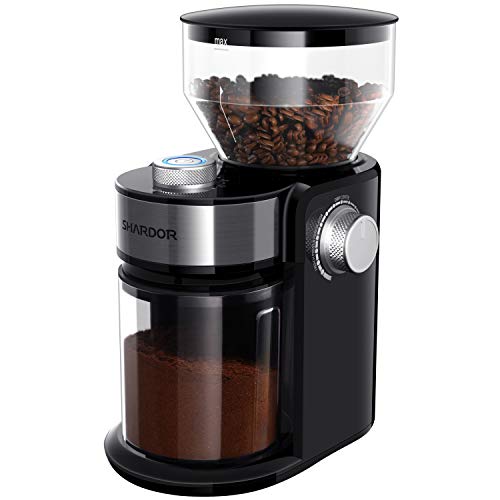
4. Shardor CG835B
- Burr type: Burr mill
- Grind settings: 16 precise grind settings
- Cup selector: 2 to 14 cups
- Model: CG835B
The Shardor CG835B is the budget burr pick in this roundup, and the best value for a household that wants an even grind without paying for espresso-grade adjustment. Its burr mill offers 16 precise grind settings that span fine espresso-style grounds through coarse French press, and a cup selector for 2 to 14 cups matches the grind amount to the pot size. The black finish and compact body fit a small counter, and the unit measures 7.48 x 5.16 x 9.76 inches, so it slides under upper cabinets that would crowd taller grinders.
For a drip or French press household, 16 settings is enough. The steps are broad, but each step is a real change in particle size, so moving from drip to French press is a matter of turning the dial a few clicks coarser, and the cup selector keeps the amount consistent. The burr mill produces a visibly more even grind than a blade grinder, which shows up in the cup as a cleaner flavor and less sediment in a French press. The 2 to 14 cup range covers a single large mug through a full pot, which suits a household where the pot size changes through the week.
The CG835B also suits a first burr grinder for a pour-over drinker. Pour-over needs a medium grind with few fines, because fine dust clogs the paper filter and slows the drawdown, which over-extracts the coffee. A burr mill at a medium setting produces that grind reliably, while a blade grinder leaves dust that stalls the brew. The Shardor covers that medium range well, and the cup selector helps when brewing two cups instead of a full pot.
Cleaning follows the same pattern as the other burr grinders here: brush the burr chamber and the chute weekly, wash the hopper and grounds container by hand, and wipe the housing with a damp cloth. The two-year warranty is generous for the tier, and the manual covers the burr mill in detail, including how to remove the upper burr for cleaning. Because the unit is light and compact, it is easy to move aside for a deeper clean or to store in a cabinet.
This is the right pick for a budget buyer who brews drip, pour-over or French press and wants a real burr grind at the lowest tier in this roundup. It is less suited to an espresso-focused setup, where 16 broad steps make fine tuning hard, and to a household that grinds large batches several times a day, where a hopper-fed grinder with a larger bean capacity, such as the Breville Smart Grinder Pro, is faster. For those routines, the Breville or the Fellow Opus is the stronger choice, while the Cuisinart DBM-8 sits between them on capacity and simplicity.
5. Krups F203
- Grinder type: Electric blade grinder with stainless steel blades
- Bowl capacity: 3 ounces, about 85 grams, enough for up to 12 cups
- Power: 200 watts
- Control: One-touch lid-press with lid-activated safety switch
The Krups F203 is the compact blade grinder in this roundup, and the right pick when counter space, simplicity and versatility matter more than grind uniformity. Its stainless steel blades spin inside a 3-ounce bowl, which holds enough beans for up to a dozen cups of drip coffee, and a 200 watt motor drives the blades with a one-touch lid-press control. A lid-activated safety switch stops the blades when the lid lifts, which is a useful safety feature in a household with children or in a kitchen where the grinder is used quickly before the first cup of the day.
Blade grinding works by chopping, so the grounds come out mixed in size, with fine dust alongside coarse chunks. For drip coffee, that unevenness is forgiving: the paper filter catches the fines, and the brew still tastes full and fresh when the beans are ground just before brewing. For spices, the same chopping action is ideal, and the F203 doubles as a spice grinder for whole peppercorns, dried herbs and nuts, which makes it the most versatile tool in this roundup for a cook who grinds both coffee and spices. The bowl holds 3 ounces, about 85 grams, which is enough for a full pot or a batch of spice mix.
The F203 measures about 4 x 4 x 9 inches, which makes it the smallest grinder here by a wide margin. It fits in a cabinet, a drawer, or a small gap between appliances, and it travels well for a holiday home or a camper with mains power. The black finish is plain and practical, and the one-button operation needs no learning: press the lid to grind, release to stop, and pulse in short bursts for a finer grind. Short pulses also limit heat, which keeps the blades from warming the grounds during a longer grind.
Cleaning is the simplest here: wipe the bowl and blades with a dry cloth or a soft brush after use, and wash the lid by hand. Because the bowl is small and the blades are exposed, a quick wipe removes most residue, though coffee oils build up over time and benefit from a wipe with a damp cloth followed by a dry one. Do not immerse the base in water, and let the bowl dry fully before the next use.
This is the right pick for a drip coffee drinker with limited counter space, for a cook who wants one small tool for coffee and spices, and for a second grinder kept near a pour-over station or a travel setup. It is not the right pick for espresso, where uneven grounds make a shot unpredictable, or for French press, where fine dust slips through the mesh and clouds the cup. For those methods, any burr grinder in this roundup, starting with the Shardor CG835B at the budget tier, is the better choice.
Comparison at a Glance
| Product | Burr or blade | Grind settings | Dosing | Tier |
|---|---|---|---|---|
| Breville Smart Grinder Pro | Stainless steel conical burrs | 60 | Timed, 0.2 second steps | Mid-range |
| Fellow Opus | 40 mm six-blade conical burrs | 41 plus micro adjustment | Single-dose, up to 110 grams | Premium |
| Cuisinart DBM-8 Supreme Grind | Burr mill | 18 | Cup selector, 4 to 18 cups | Mid-range |
| Shardor CG835B | Burr mill | 16 | Cup selector, 2 to 14 cups | Budget |
| Krups F203 | Stainless steel blades | Pulse control | Bowl, 3 ounces | Budget |
The table makes the trade-offs plain. The Breville Smart Grinder Pro offers the widest setting range and the most repeatable dosing, which suits a household that brews several methods. The Fellow Opus trades hopper capacity for freshness and bean switching, which suits a drinker who changes beans often. The Cuisinart DBM-8 and the Shardor CG835B cover the common methods with cup-count dosing at lower tiers, and they differ mainly in setting count, capacity and warranty length. The Krups F203 trades grind uniformity for size, simplicity and spice versatility, which suits a drip drinker or a cook more than a home barista.
Who Should Skip a Burr Grinder
A burr grinder is the right tool for most coffee drinkers, but not for every kitchen. If you brew only drip coffee from pre-ground beans and have no interest in buying whole beans, a grinder adds a step without a benefit, and a bag of freshly ground coffee from a local roaster will taste better than whole beans ground badly. If your counter space is limited to a single appliance and that appliance must also grind spices, the Krups F203 covers both jobs in a smaller footprint than any burr grinder here. If you travel often and brew in a camper or a holiday home, a manual grinder or a compact blade grinder fits the bag better than a countertop burr mill.
A household that brews espresso exclusively should skip the budget burr models here and choose a grinder with finer adjustment, such as the Breville Smart Grinder Pro or the Fellow Opus, because broad steps cannot dial in a shot. A household that brews large pots several times a day should skip single-dose grinding and choose a hopper-fed model, because weighing and loading each dose gets tedious at that volume. A buyer who wants the quietest possible morning should note that all electric grinders make noise while running, and that a hand grinder is the only silent option, though it is slower and better suited to one or two cups.
Finally, skip any grinder that does not fit under your cabinets or beside your brewer. A grinder that lives in a cabinet because it is too tall for the counter gets used less often, and a grinder that is hard to load gets skipped on busy mornings. Measure first, then choose among the models that fit, and let the setting range and dosing style decide between them.
Care and Cleaning
Every grinder in this roundup lasts longer and tastes better with a simple cleaning routine. Brush out the burr chamber or blade bowl after each use if you grind daily, and wash removable hoppers, grounds containers and lids by hand with warm water and a mild detergent, drying them fully before refitting. Coffee oils build up inside any grinder, and stale oils turn rancid, which dulls the flavor of fresh beans even when the grind is perfect. A weekly brush and a monthly deep clean keep the flavor clean.
For burr grinders, remove the upper burr when the manual allows it and brush the burr teeth and the chute, where grounds collect and clog. Grinder cleaning tablets, run through the burrs according to the manual, absorb oils and clear residue without disassembly. For the blade grinder, wipe the bowl and blades with a dry cloth after each use, and wipe with a damp cloth followed by a dry one when oils build up. Never immerse a motor base in water, and never run a grinder empty for long, since the burrs or blades can overheat without beans to grind.
Store beans in an airtight container away from light and heat, and grind only what you plan to brew within the hour. Beans left in a hopper for a week lose aroma, which defeats the purpose of grinding fresh. If you switch beans often, empty the hopper fully between bags, or use a single-dose grinder such as the Fellow Opus, which holds no beans between brews. Check the burrs or blades yearly for wear: chipped burr teeth or dull blades produce more fines and a muddier cup, and replacement burrs are available for the better-known models here.
Frequently Asked Questions
Do I need a burr grinder for drip coffee?
A burr grinder improves drip coffee because it produces even grounds that extract evenly, which gives a cleaner and sweeter cup. A blade grinder still works for drip, since the paper filter catches fine dust, but the cup will taste less clear than the same beans ground in a burr mill. If you brew drip daily and want the best flavor from your beans, the Cuisinart DBM-8 or the Shardor CG835B is the simplest step up.
How many grind settings do I need for espresso and French press?
You need a range that covers fine espresso grounds and coarse French press grounds, which means at least 16 settings with a wide span, and more steps help when dialing in espresso. The Breville Smart Grinder Pro covers the range with 60 settings, and the Fellow Opus covers it with 41 settings plus micro adjustment. A grinder with only a few settings will struggle at one end of the range or the other.
Can one grinder handle both coffee and spices?
A blade grinder such as the Krups F203 handles both well, because its spinning blades chop beans and spices alike. A burr grinder can grind spices too, but strongly flavored spices leave residue and aroma in the burr chamber, which can carry into the next batch of coffee. Keep a separate blade grinder for spices if you grind them often, and reserve the burr grinder for coffee.
How often should I clean my coffee grinder?
Brush out the grinding chamber after each use if you grind daily, and deep clean the burrs or blades monthly. Wash removable hoppers and grounds containers by hand, dry them fully, and wipe the housing with a damp cloth. Stale grounds and coffee oils build up quickly, and a clean grinder keeps fresh beans tasting fresh.
Conclusion
The best coffee grinder is the one that matches your brewer, your beans and your morning routine. The Breville Smart Grinder Pro is the strongest all-round choice, with 60 settings, timed dosing and portafilter cradles that cover espresso, drip, pour-over and French press in one machine. The Fellow Opus is the best single-dose choice, with 41 settings plus micro adjustment and a burr set that handles light roasts without stalling. The Cuisinart DBM-8 Supreme Grind is the simplest burr grinder here, with a cup-count selector that suits a drip household. The Shardor CG835B is the budget burr pick, with 16 settings and a 2 to 14 cup selector at the lowest tier. The Krups F203 is the compact blade option for drip coffee and spices when space and simplicity matter most. Measure your counter, count your brew methods, and choose the grinder that fits both, and your next cup will taste the difference that fresh, even grinding makes.
Product and ASIN Reference
| Product | ASIN |
|---|---|
| Breville Smart Grinder Pro, Brushed Stainless Steel | B00OXGXW8O |
| Fellow Opus Conical Burr Coffee Grinder, Matte Black | B0BV96VPSR |
| Cuisinart DBM-8 Supreme Grind Automatic Burr Mill, Stainless Steel | B00018RRRK |
| Shardor Electric Burr Coffee Grinder 2.0, Black | B087F8N6W3 |
| Krups F203 Electric Spice and Coffee Grinder, 3-Ounce, Black | B00004SPEU |