Key takeaways
- Compare five 7-inch cleavers for home cooks, from a budget Chinese chef knife to forged Damascus and heavy meat choppers, with specs to help you choose.
A good cleaver does the work of several knives at once. The wide, tall blade chops through joints and ribs, slices cabbage and squash, minces garlic and herbs, crushes cloves with its flat side, and scoops a whole pile of chopped food off the board in one move. The best cleaver for your kitchen depends on one question above all others: will it meet bone, or will it mostly meet vegetables? A thick meat cleaver powers through poultry joints and pork ribs, while a thin Chinese vegetable cleaver glides through produce and boneless meat but can chip if it is swung at bone. Choose the wrong kind and you will either fight every cut or damage a fine edge.


The short answer is that the Dexter-Russell 7-Inch Meat Cleaver with White Handle is the best all-round pick for cooks who want a real meat cleaver at a sensible tier, because it is made in the United States, carries NSF certification, and is built for ribs and cartilage. If your cooking leans toward vegetables and stir-fry prep, the Oaksware 7-Inch Chinese Chef Knife is the budget pick and the Kyoku Shogun Series 7-Inch Forged Damascus Cleaver is the premium pick, while the Mitsumoto Sakari 7-Inch 9Cr18MoV Cleaver covers the middle ground of poultry joints and dense vegetables with a hard clad blade. The Cuisinart 7-Inch Stainless Steel Cleaver with Blade Guard rounds out the list for cooks who store knives loose in a drawer and want a light, guarded blade.
As an Amazon Associate, we earn from qualifying purchases.
Table of Contents
- How to Choose a Cleaver
- The 5 Best Cleavers at a Glance
- 1. Dexter-Russell 7-Inch Meat Cleaver with White Handle
- 2. Mitsumoto Sakari 7-Inch 9Cr18MoV Cleaver
- 3. Kyoku Shogun Series 7-Inch Forged Damascus Cleaver
- 4. Oaksware 7-Inch Chinese Chef Knife
- 5. Cuisinart 7-Inch Stainless Steel Cleaver with Blade Guard
- Cleaver Care and Safety
- Frequently Asked Questions
- Conclusion
- Product and ASIN Reference
How to Choose a Cleaver
Meat cleaver or vegetable cleaver
Two very different tools share the cleaver shape, and the difference is the thickness of the blade and the grind of the edge. A meat cleaver is thick and heavy, with a sturdier edge that tolerates impact. It is built to chop down through bone and joints, split ribs, and break down whole poultry. A Chinese vegetable cleaver, also called a cai dao, is tall and thin, with a fine edge ground for slicing. It works like an oversized chef knife: it slices, dices, minces, and scoops, and it handles boneless meat well, but it is not made for bone. Before you buy, decide which job dominates your cooking. If you break down whole chickens most weekends, buy a meat cleaver. If you cook stir-fries and chop vegetables every night, buy a vegetable cleaver. If you do a bit of both, look for a cleaver whose maker explicitly lists poultry joints and dense vegetables as its jobs, and keep it away from thick beef bones.
Blade length and weight
Seven inches is the standard cleaver length, and every pick in this guide is a 7-inch blade. That size is large enough to give knuckle clearance above the board and to scoop a pile of chopped food, yet small enough to control with one hand. Weight matters as much as length. A heavier blade does more of the work for you on joints and ribs, because the mass of the falling blade drives the cut. A lighter blade is easier to control for long vegetable prep sessions and causes less fatigue. The picks here range from about 12 ounces to a heavier boxed weight on the Mitsumoto Sakari, so think about your wrist and your stamina as well as your cutting board. Cooks with smaller hands or less grip strength should lean toward the lighter picks, while cooks who butcher regularly should lean toward the heavier ones.
Steel and hardness
Cleaver steel is a trade between edge retention and toughness. Harder steel, measured higher on the Rockwell hardness scale, holds a fine edge longer but is more likely to chip when it meets bone or a twisting cut. Softer steel dulls sooner but is tougher and easier to resharpen. German stainless steels around 56 to 58 on the Rockwell scale are a forgiving middle ground for meat work. Japanese steels hardened to 58 to 62 hold a keener edge for vegetables but demand more care. Clad construction, where a hard core steel is sandwiched between softer outer layers, combines a hard cutting edge with a tougher body. When a listing names its steel and hardness, that is a good sign: it means the maker is willing to be judged on specifics. When a listing names neither, expect easy resharpening and modest edge life, and set your expectations accordingly.
Handle and grip
A cleaver handle must stay secure when your hands are wet, greasy, or covered in meat juices. Textured synthetic handles, such as the white polypropylene grip on the Dexter-Russell pick, are the most slip-resistant and the easiest to clean. Wooden handles, such as the octagonal rosewood grip on the Mitsumoto Sakari, feel warm and traditional and index the edge well, but they need drying after washing and should not sit wet in the sink. Triple-riveted handles with a full tang, where the blade steel runs the whole length of the handle, are stronger and better balanced than handles fixed to a short partial tang. If you have small hands, pay attention to handle thickness as well as length: a bulky grip can be tiring, while a slim grip can twist under a heavy blade.
Storage
A cleaver blade is wide, heavy, and awkward to store loose. A drawer without a guard is the worst option, because the edge can cut anyone reaching in and can be damaged by other tools. A blade guard, a sheath, a knife block with a wide slot, or a magnetic strip mounted high on the wall are all better choices. Two picks in this guide include storage in the box: the Cuisinart comes with a matching blade guard, and the Kyoku comes with a sheath and a case. The Mitsumoto Sakari ships in a sandalwood box that suits display and gift-giving but is less convenient for daily storage. Whatever you choose, plan the storage before the knife arrives, and never leave a cleaver loose in a drawer with the edge exposed.
Care basics
Every cleaver in this guide should be hand-washed in warm, soapy water, rinsed, and dried promptly with a towel. Dishwashers dull edges, loosen handles, and can chip a fine edge against other items. Dry the blade fully before storing it, and oil a wooden handle occasionally to keep it from drying out and cracking. Hone a meat cleaver regularly with a honing rod to keep the edge aligned, and sharpen a vegetable cleaver on a whetstone when honing no longer restores the bite. Store the blade with its edge protected, and keep fingers curled under in a claw grip while cutting, with the flat of the blade guiding your knuckles.
The 5 Best Cleavers at a Glance
| Cleaver | Best For | Blade | Handle |
|---|---|---|---|
| Dexter-Russell 7-Inch Meat Cleaver with White Handle | Meat, ribs and cartilage | 7-inch high-carbon steel | White polypropylene |
| Mitsumoto Sakari 7-Inch 9Cr18MoV Cleaver | Poultry joints and dense vegetables | 7.2-inch San-Mai clad steel | Octagonal rosewood |
| Kyoku Shogun Series 7-Inch Forged Damascus Cleaver | Thin vegetable slicing | 7-inch VG-10 Damascus | Triple-riveted G10 |
| Oaksware 7-Inch Chinese Chef Knife | Budget stir-fry prep | 7-inch German 1.4116 steel | Triple-riveted ABS |
| Cuisinart 7-Inch Stainless Steel Cleaver with Blade Guard | Drawer storage and light bone work | 7-inch stainless steel | Ergonomic handle |
The table above shows the shape of the whole guide at a glance. The Dexter-Russell is the only pick built first for meat and bone. The Mitsumoto Sakari is the mixed-prep pick, hard enough for joints and still fine enough for dense vegetables. The Kyoku and the Oaksware are both vegetable cleavers, one premium and one budget, and the Cuisinart is the light, guarded pick for small kitchens and drawer storage. Read the sections below for the detail behind each row, including what each cleaver should not be used for.
1. Dexter-Russell 7-Inch Meat Cleaver with White Handle
The Dexter-Russell 7-Inch Meat Cleaver with White Handle is the working meat cleaver of this guide, and it earns the top spot for cooks who actually break down meat. Dexter-Russell has made cutlery in the United States since 1818, and this pattern comes from its commercial kitchen lines rather than its home gift lines. That shows in the design choices: a stain-free high-carbon steel blade, a textured white polypropylene handle that stays grippy when wet, and NSF certification, which means the knife meets food-service sanitation standards. It is a plain, practical tool, and that is exactly the point. There is nothing decorative about it, and nothing about it is trying to impress anyone except the cook holding it.
The blade is 7 inches long and built for splitting ribs, cartilage, and large cuts. At about 12 ounces it is heavy enough that the weight of the blade helps drive each chop, but light enough to control through a whole chicken or a rack of ribs without tiring the wrist. The white handle is easy to spot on a crowded counter and easy to clean, and its textured surface resists slipping when hands are wet or greasy. For a home cook who butchers poultry, splits pork ribs, or breaks down large cuts for the freezer, this is the most honest tool in the list: it does one job, it does it well, and it does not pretend to be a precision slicer.
The limits are clear and worth stating plainly. This is a meat cleaver, not a vegetable cleaver, so it will not slice a tomato as thinly as the Kyoku or the Oaksware, and its edge is ground for impact rather than for delicate push-cuts. Dexter-Russell publishes no hardness figure for this model, so cooks who compare steels on paper will find less to work with here than on the Mitsumoto Sakari or the Kyoku. The plain white handle will not suit cooks who want a knife that looks as good as it cuts. None of that matters much at the cutting board, where the Dexter-Russell simply gets through the joint in front of it. Hand-wash it, dry it, and it will serve for years.
Specs
- Blade length: 7 inches
- Blade steel: stain-free high-carbon steel
- Handle: textured white polypropylene, slip-resistant grip
- Certification: NSF certified for food-service use
- Origin: made in the United States
- Weight: about 12 ounces
- Best for: splitting ribs, cartilage, and large cuts of meat
- Tier: Mid-range
2. Mitsumoto Sakari 7-Inch 9Cr18MoV Cleaver
The Mitsumoto Sakari 7-Inch 9Cr18MoV Cleaver is the mixed-prep pick of this guide, and it is the one to buy if your cooking crosses the line between meat and vegetables every week. Its blade is a three-layer San-Mai construction: a 9Cr18MoV high-carbon stainless core clad between two softer outer layers, deep-cryo treated to a hardness of 60 plus or minus 2 on the Rockwell scale. That is hard steel, harder than the German steels in most of this guide, and it holds a keen edge through long prep sessions. The listing names chicken joints, cartilage, ribs, and boneless meat as its jobs, and it also handles dense vegetables such as squash and large root vegetables. Few cleavers in this size class claim both sides of that line with a straight face; this one backs the claim with named steel and a stated hardness.
The handle is an octagonal rosewood grip, which indexes the edge in the hand: the flat faces of the octagon tell your fingers which way the blade points without looking. Rosewood feels warm and traditional, and the handle is comfortable for both left- and right-handed cooks. The knife ships in a sandalwood box, which makes it a strong gift choice and a pleasant unboxing, though the box is not a daily storage solution and you will still want a guard, a block, or a magnetic strip. The listed weight of 2.43 pounds appears to be the boxed figure rather than the knife alone, so treat that number with caution and expect a substantial but manageable cleaver in the hand rather than a two-and-a-half-pound blade.
The trade-offs follow from the hardness. A blade at 60 on the Rockwell scale holds its edge well, but hard steel can chip on thick beef bones, frozen food, or a twisting cut, so keep this cleaver away from the heaviest bone work and let the Dexter-Russell handle that. The rosewood handle needs drying after washing and should not sit wet in the sink. There is no sheath in the box, only the sandalwood case. For cooks who want one cleaver that covers poultry joints on Sunday and stir-fry prep on weeknights, those are acceptable limits, and the named steel, the stated hardness, and the clad construction put this pick a clear step above the budget options on materials.
Specs
- Blade length: 7.2 inches
- Blade steel: three-layer San-Mai with 9Cr18MoV core
- Hardness: 60 plus or minus 2 on the Rockwell scale
- Handle: octagonal rosewood
- Storage: sandalwood box included
- Best for: poultry joints, cartilage, ribs, and dense vegetables
- Tier: Premium
3. Kyoku Shogun Series 7-Inch Forged Damascus Cleaver
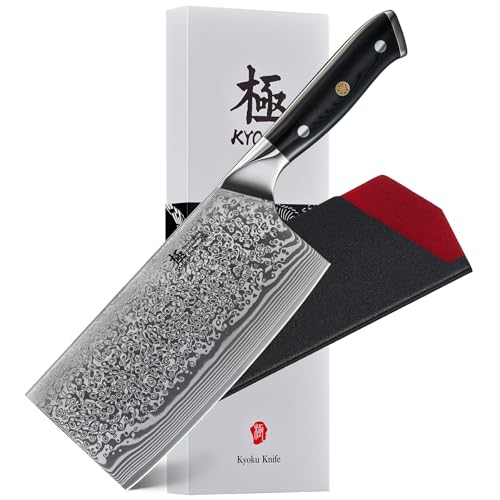
The Kyoku Shogun Series 7-Inch Forged Damascus Cleaver is the premium vegetable cleaver of this guide, and it is the pick for cooks who slice vegetables every day and want the finest edge available in this size class. The blade is built around a cobalt-added VG-10 core, cryogenically treated and hardened to 58 to 60 on the Rockwell scale, clad in forged Damascus steel. The edge is ground by the traditional three-step Honbazuke method to a fine 8 to 12 degrees per side, which is far keener than the edge on a meat cleaver. That fine edge is what lets the blade glide through cabbage, squash, and large onions with very little wedging or tearing, and the tall, wide blade then scoops the cut food off the board in one motion.
The handle is triple-riveted G10, a fiberglass laminate that shrugs off heat, cold, and moisture, with a mosaic pin for decoration. The knife is full tang, so the blade steel runs through the whole handle for strength and balance. It ships with both a sheath and a case, which solves the storage problem that plagues wide cleaver blades, and Kyoku backs it with a lifetime warranty. The overall length is about 12.2 inches, the blade is about 7 inches long, and the maker lists a net weight of about 14.3 ounces on its own product page, a believable figure for a full-size cleaver of this construction.
The limits are the other side of the fine edge. This is a vegetable cleaver for produce and boneless meat only. The thin, hard edge will chip if it meets bone, frozen food, or a twisting cut, so it must never be used as a bone chopper, no matter how sturdy it looks. One listing field for weight is plainly wrong, so ignore any weight figure that looks absurd and rely on the maker page instead. The price tier is premium, and cooks who mostly cut meat will get more value from the Dexter-Russell. For the cook who preps vegetables daily, though, the combination of VG-10 core, Damascus cladding, Honbazuke edge, G10 handle, sheath, case, and lifetime warranty makes this the most complete vegetable cleaver in the guide.
Specs
- Blade length: 7 inches
- Blade steel: VG-10 core in forged Damascus cladding
- Hardness: 58 to 60 on the Rockwell scale
- Edge: 8 to 12 degrees per side, Honbazuke ground
- Handle: triple-riveted G10 with mosaic pin
- Construction: forged, full tang
- Included: sheath and case
- Warranty: lifetime warranty from Kyoku
- Best for: thin slicing of vegetables and boneless meat
- Tier: Premium
4. Oaksware 7-Inch Chinese Chef Knife

The Oaksware 7-Inch Chinese Chef Knife is the budget pick of this guide, and it is the best way to find out whether a cleaver-shaped knife suits your cooking without committing to a premium tier. Do not let the low tier fool you: the specifications are named and respectable. The blade is German 1.4116 high-carbon stainless steel, hardened to 57 plus on the Rockwell scale, with a 14 to 16 degree edge. The construction is forged and full tang, with a triple-riveted handle. That is a serious specification sheet for a knife at this tier, and it explains why this model turns up in so many best-value lists. At about 13.6 ounces it has enough heft to feel like a real cleaver in the hand rather than a novelty.
In use, this is a vegetable cleaver in the Chinese chef knife tradition. The wide blade slices, dices, and minces produce, crushes garlic with its flat side, and scoops chopped food from the board to the pan. The 7-inch length gives good knuckle clearance, and the 14 to 16 degree edge is fine enough for clean push-cuts through cabbage, peppers, and onions, and for slicing boneless meat thin for stir-fries. The ABS handle is basic and plain, but it is triple-riveted to the full tang and easy to clean, and the whole knife is straightforward to maintain: hand-wash, dry, and hone or sharpen as needed.
The maker is explicit about the limit, and you should respect it: this knife is not for bones. The blade is too thin and the edge too fine for joints, ribs, or frozen food, and using it that way risks chipping the edge. The ABS handle feels basic next to rosewood or G10, and the listing gives no sheath or case, so you will need to arrange storage yourself. For a first cleaver, or for a second knife dedicated to vegetables while a heavier cleaver handles meat, those limits are easy to live with. If you cook stir-fries several nights a week and want a wide blade that scoops and crushes as well as it slices, this is the pick that delivers the most for the least.
Specs
- Blade length: 7 inches
- Blade steel: German 1.4116 high-carbon stainless steel
- Hardness: 57 plus on the Rockwell scale
- Edge: 14 to 16 degrees
- Handle: triple-riveted ABS
- Construction: forged, full tang
- Weight: about 13.6 ounces
- Best for: vegetables and boneless meat for stir-fry prep
- Not for: bones
- Tier: Budget
5. Cuisinart 7-Inch Stainless Steel Cleaver with Blade Guard

The Cuisinart 7-Inch Stainless Steel Cleaver with Blade Guard is the practical pick of this guide, and its reason to exist is right there in the name: it comes with a matching blade guard. A cleaver blade is wide and heavy, and storing one loose in a drawer is both unsafe and bad for the edge. The guard solves that problem in the box, with no extra purchase and no separate sheath to hunt for. For cooks in small kitchens, shared kitchens, or homes where knives live in a drawer rather than on a block or a magnetic strip, that single included accessory matters more than any steel specification.
The blade itself is a 7-inch stainless steel cleaver, light for its class at about 12.3 ounces. Cuisinart lists it for chopping soft poultry and meat bones and hard winter squash, which puts it between the pure vegetable cleavers and the heavy meat cleavers: it will handle a chicken joint and a butternut squash, but it is not a beef-bone splitter. The light weight makes it easy to control for quick chopping sessions, and the ergonomic handle is shaped for comfortable control. The overall length is about 13.9 inches on the unguarded version of the same blade, which gives a sense of the size in the hand.
The listing is thin, and honesty requires saying so. Cuisinart names no steel grade, no hardness figure, and no handle material for this guarded version, and unlike the unguarded version it carries no lifetime warranty statement in its listing. Expect easy resharpening and modest edge life rather than the long edge retention of the Kyoku or the Mitsumoto Sakari. The light weight that makes it easy to control also means it will not power through heavy bones the way the Dexter-Russell does. For the cook who wants a light, guarded, inexpensive cleaver for poultry, squash, and everyday chopping, and who stores knives in a drawer, this is still the right pick: the guard alone justifies it, and the blade does the jobs its maker claims for it.
Specs
- Blade length: 7 inches
- Blade steel: stainless steel, grade not stated by the maker
- Handle: ergonomic handle, material not stated by the maker
- Weight: about 12.3 ounces
- Included: matching blade guard
- Best for: soft poultry bones, meat bones, and hard winter squash
- Not for: heavy beef bones
- Tier: Budget
Cleaver Care and Safety
A cleaver rewards simple habits and punishes carelessness, so a short care routine is worth more than any accessory. Hand-wash every cleaver in warm, soapy water after use, rinse it, and dry it fully with a towel before storing it. Never leave a blade soaking in the sink, where it can cut a hand reaching for it and where moisture attacks the edge and the handle. Wooden handles need drying and occasional oiling to keep them from cracking, while synthetic handles need only washing and drying. Keep the edge protected with a guard, a sheath, or a block slot, and keep the blade away from glass cutting boards, granite counters, and bones it was not designed for, all of which can chip or roll an edge.
Sharpening a cleaver is the same skill as sharpening any knife, with one difference: the edge angle matters more because the blade is wider. A meat cleaver with a sturdier edge can be maintained with a honing rod and an occasional pass on a coarse stone. A vegetable cleaver with a fine edge, such as the Kyoku at 8 to 12 degrees per side, deserves a whetstone and a steady angle, and it should be sharpened before it gets truly dull, because restoring a neglected fine edge takes far longer than maintaining a keen one. If you are new to whetstones, practice on the budget Oaksware before touching the premium Kyoku.
Safety begins with the grip. Curl your fingertips under in a claw shape and let the flat of the blade slide against your knuckles, so the edge never travels toward your fingers. Cut on a stable board that does not rock or slide; a damp cloth under the board stops movement. When chopping bone, use firm, straight, downward strokes and let the weight of the blade do the work rather than forcing it with your shoulder. Never try to cut through a bone that the maker says the knife cannot handle, and never use the blade as a pry bar, a can opener, or a screwdriver. Store the cleaver with its edge covered and out of reach of children, and treat a freshly sharpened cleaver with more respect, not less, because a sharp blade cuts cleanly while a dull one slips.
Frequently Asked Questions
Can a cleaver cut through bone?
A thick meat cleaver can cut through poultry joints, ribs, and cartilage, and the Dexter-Russell in this guide is built for exactly that work. A thin vegetable cleaver cannot: its fine edge will chip or roll on bone, so keep the Kyoku and the Oaksware away from joints and use them for produce and boneless meat only. The Mitsumoto Sakari sits between the two, handling poultry joints and ribs but not thick beef bones, and the Cuisinart handles soft poultry bones and squash but not heavy beef bones. Always follow the maker limit for the knife you own.
What is the difference between a meat cleaver and a Chinese vegetable cleaver?
A meat cleaver is thick and heavy, with a sturdy edge made for impact against bone and joints. A Chinese vegetable cleaver, also called a cai dao, is tall and thin, with a fine edge made for slicing, dicing, mincing, and scooping produce and boneless meat. They look similar at a glance, but they are different tools, and using one like the other is the most common way to damage a good blade.
How do I store a cleaver safely?
Cover the edge and keep the blade out of loose drawers. A matching blade guard, a sheath, a knife block with a wide slot, or a magnetic strip mounted high on the wall all work well. The Cuisinart in this guide includes a blade guard, and the Kyoku includes a sheath and a case. Never store a cleaver loose in a drawer with other tools, where the edge can cut a hand reaching in and can be chipped by other metal.
Which cleaver should a beginner buy first?
Begin with the job, not the tier. If you break down whole chickens and cut ribs, begin with the Dexter-Russell meat cleaver. If you cook vegetables and stir-fries most nights, begin with the Oaksware budget vegetable cleaver, which is inexpensive and easy to learn on. Move up to the Kyoku or the Mitsumoto Sakari once you know which shape you reach for daily, and add the Cuisinart if your knives live in a drawer and you want a guarded blade.
Conclusion
The best cleaver is the one that matches the work you actually do. For meat and bone, the Dexter-Russell 7-Inch Meat Cleaver with White Handle is the straightforward choice: a United States made, NSF certified working knife built for ribs and cartilage. For mixed prep across poultry joints and dense vegetables, the Mitsumoto Sakari 7-Inch 9Cr18MoV Cleaver brings a hard clad blade and a rosewood grip. For daily vegetable slicing at the highest level, the Kyoku Shogun Series 7-Inch Forged Damascus Cleaver offers a VG-10 core, a Honbazuke edge, a G10 handle, and a sheath and case. For a first cleaver on a budget, the Oaksware 7-Inch Chinese Chef Knife delivers named German steel and a forged full-tang build. For drawer storage and light bone work, the Cuisinart 7-Inch Stainless Steel Cleaver with Blade Guard solves the storage problem in the box. Pick by the job, respect the maker limits, hand-wash and dry the blade, and any one of these five will earn its place on your board.
Product and ASIN Reference
| Product | ASIN |
|---|---|
| Dexter-Russell 7-Inch Meat Cleaver with White Handle | B004NG994K |
| Mitsumoto Sakari 7-Inch 9Cr18MoV Cleaver | B0999GF6YK |
| Kyoku Shogun Series 7-Inch Forged Damascus Cleaver | B07BK4DQN1 |
| Oaksware 7-Inch Chinese Chef Knife | B0BJ2Z7PNY |
| Cuisinart 7-Inch Stainless Steel Cleaver with Blade Guard | B0DGB71PTH |