Key takeaways
- Compare five mandolines for even slices, julienne cuts and safer prep, from budget workhorses to a premium V-blade pick for home cooks in any kitchen.
A mandoline earns its place in a kitchen by doing one thing a knife struggles to repeat: cutting slice after slice at the same thickness. When potato gratin layers cook evenly, when cucumber rounds look identical in a salad, and when julienne strips match so a stir fry cooks at one pace, the difference is usually a mandoline rather than steadier knife work. The five mandolines in this guide cover the range a home cook actually needs, from a budget five-blade stand slicer to a premium V-blade model with four labeled thickness settings. Every pick below uses a food holder or guard, because a mandoline blade is unforgiving and the holder is the feature that matters most. Choose by the cuts you make most often, the thickness control you want, and how much storage space you can spare, and any of these five will slice more evenly than freehand work.

As an Amazon Associate, we earn from qualifying purchases.
Table of Contents
- Quick Answer
- How to Choose a Mandoline
- The 5 Best Mandolines
- Who Should Skip a Mandoline
- Frequently Asked Questions
- Conclusion
- Product and ASIN Reference
Quick Answer
If you want one recommendation, take the Mueller Austria V-Pro for a budget stand slicer with five blades and a wide thickness dial, or the OXO Good Grips V-Blade for the most precise labeled settings in this guide. Cooks who slice soft fruit and vegetables and want the thinnest possible cuts should look at the Kyocera ceramic model, which adjusts to four fine thicknesses and resists staining from acidic produce. The Fullstar 3-in-1 suits a first mandoline because it bundles gloves, a finger guard, and a catch tray at a budget tier. The Borner V5 PowerLine Starter Set suits cooks who switch between slices, sticks, and dices, since its inserts swap without tools. Read the safety notes before your first session, use the holder every time, and keep a cut-resistant glove nearby for the final passes.
How to Choose a Mandoline
Blade shape: straight blade or V-blade
Mandoline blades come in two main shapes, and the shape decides which foods slice cleanly. A straight blade runs across the deck in one flat line and works well on firm produce such as potatoes, carrots, and beets, where a single clean edge meets steady resistance. A V-blade angles two edges toward a center point, so the blade meets the food progressively rather than all at once, which helps with soft foods such as tomatoes, ripe peaches, and citrus. The V shape also centers round produce on the deck, so onions and cucumbers track straighter. Straight-blade models tend to feel simpler to clean and to sharpen in concept, while V-blade models tend to feel easier on delicate foods. If you slice mostly firm vegetables for gratins and chips, either shape serves you. If you slice tomatoes and soft fruit often, favor a V-blade. Two picks in this guide use a V-blade, one uses a ceramic straight blade, and the remaining two use interchangeable blade sets that cover both straight and wavy cuts.
Thickness adjustment and cut styles
Thickness control is where mandolines separate from one another. The simplest models fix the blade at one height or offer two or three inserts, which is enough when you make one kind of slice again and again. Dial models let you turn a knob through a range, and the best of them label each setting so you can return to the same thickness next week. Look for a range that starts near one millimeter for paper-thin garnish slices and reaches at least six millimeters for hearty potato rounds. Julienne matters too: some mandolines cut julienne with a separate toothed blade, others flip a deck or swap an insert, and a few build the julienne blades into the frame so nothing loose needs storing. Crinkle and waffle cuts are a bonus rather than a need, but they earn their keep for garnishes and for fries that hold seasoning. Before buying, count the cut styles you will actually use in a normal month. A mandoline with ten cut styles sounds generous, yet most cooks rotate through three: a thin straight slice, a medium straight slice, and one julienne width.
Safety: the food holder matters more than the blade
Every mandoline blade is sharp enough to cut skin with little pressure, so the safety system deserves more attention than the blade steel. A good food holder grips produce with prongs or pins, keeps fingers behind the blade line, and pushes the last small piece through without asking you to chase it with fingertips. A cut-resistant glove adds a second layer of protection and is worth owning even when the holder works well, because gloves protect the hand that steadies the frame and the hand that feeds the holder. Non-slip feet or a rubber base keep the deck from walking across a counter, and a locking or covered storage position keeps the blade from meeting hands in a drawer. Never slice without the holder, never reach across the blade path, and wash the blade with a brush rather than a bare sponge. Keep the blade covered or boxed when the mandoline is stored, and teach everyone in the household that the mandoline is not a tool to grab casually from a drawer.
The recall record
Mandolines have drawn one notable recall in the United States, and it is worth knowing before you shop. In May 2018 the Consumer Product Safety Commission announced a recall of Sharper Image and Frigidaire mandoline slicers sold by Premier Kitchen Products, after reports that the small blades in the julienne attachment could separate from the plastic assembly and pose a laceration hazard. The recalled models carried model numbers 12SP1006 and 12EP203 and were sold between May 2017 and April 2018. None of the five mandolines in this guide is part of that recall, and none shares its maker or its detachable julienne attachment design. The lesson still applies: check that julienne blades and inserts lock firmly into the frame, inspect them for cracks or looseness before each use, and stop using any attachment that wobbles or flexes. A mandoline that feels solid and locks its blades in place is a safer mandoline, whatever its tier.
Size, storage, and cleaning
A mandoline that does not fit your kitchen will sit unused, so measure before you buy. Flat handheld models slide into a drawer or lean against a backsplash, while stand models with folding legs need a shelf or a deep cabinet. A long deck handles wide produce such as cabbage and eggplant, while a compact deck suits small kitchens and small batches. Weight matters during use: a heavier frame stays planted while you push firm vegetables across the blade, while a light frame may need a damp cloth under it or a bowl hooked beneath it. For cleaning, dishwasher-safe parts save time, but hand washing with a brush keeps edges keen longer and avoids warping plastic decks in high heat. Models with blades that store on board keep loose edges out of drawers, while models with a blade box or organizer do the same job with a little more bulk. If your kitchen is short on storage, favor a flat model with on-board blade storage and a locking closed position.
Matching the mandoline to your cooking
Think about the dishes you cook on a normal week before choosing. Gratin and scalloped potato cooks need thin, even rounds and will use the finest settings most. Salad cooks need cucumber, radish, and onion slices at medium thickness and will value a model that handles a high volume without clogging. Stir fry cooks need julienne strips in two widths and will value a model with dedicated julienne blades. Pickling and fermenting cooks need consistent thin slices in large batches and will value a wide deck and a comfortable holder. Garnish cooks need paper-thin slices of citrus and radish and will value the finest adjustment a model offers. There is no single best mandoline for every kitchen, only a best match for the cooking you actually do, so weigh the cut styles and thickness range against your own weekly menu rather than against a feature list.
The 5 Best Mandolines
1. Mueller Austria V-Pro Multi Blade Adjustable Mandoline — Best Budget Stand Slicer
Tier: Budget
The Mueller Austria V-Pro is the workhorse of this guide, a stand mandoline with five interchangeable blades and a thickness dial that runs from one millimeter to nine millimeters. That range covers nearly everything a home cook slices, from translucent potato rounds for gratin to thick slabs for roasting, and the dial means you can return to the same setting batch after batch without guessing. The five blades cover slicing, julienne, grating, shredding, and chopping, so one tool replaces several single-purpose gadgets in a drawer. The julienne adjustment runs from six millimeters to nine millimeters, which suits matchstick carrots, celery root, and zucchini for stir fries, while the wavy blade adds crinkle cuts for garnishes and for fries that hold salt and seasoning.
What sets the V-Pro apart at its tier is the stand design. Folding legs lift the deck above a cutting board or fold away so the slicer rests over a bowl or plate, letting slices fall directly where they are needed instead of piling on the deck. The frame weighs just over two pounds, which is heavy enough to stay planted while you push a firm sweet potato across the blade, and the handled food pusher keeps fingers behind the cutting edge. The deck measures about 16.7 x 5.5 inches, wide enough for large onions and small cabbages, and the blade frame uses stainless steel throughout. A cleaning brush and a food catch container round out the set, and the slicer is top-rack dishwasher safe for the parts the maker marks as washable, though hand washing the blades with a brush will keep the edges keen longer.
In daily use, the V-Pro suits cooks who prep in volume. Slicing a full batch of potatoes for a gratin takes steady, repeatable passes, and the dial holds its setting through a long session. The grating and shredding blades handle cheese, carrots, and cabbage for slaws, while the julienne blades turn cucumbers and peppers into even strips for salads and wraps. The learning curve is short: set the dial, fit the blade, load the pusher, and slide with even pressure. New users should start with the medium settings and firm produce before moving to the thinnest slices, since a thin setting on a soft tomato demands a slower, steadier hand. The main trade-off is size. This is not a drawer tool, and the five blades need their storage box or a dedicated shelf, so small kitchens should measure cabinet space first. For a household that slices often and wants one tool that does five jobs, the V-Pro is the strongest budget pick in this guide.
Specs
- Type: Stand mandoline with folding legs
- Blade material: Stainless steel
- Blades included: 5 blades for slicing, julienne, grating, shredding, and chopping
- Thickness range: 1 to 9 mm slice dial, 6 to 9 mm julienne
- Cut styles: Straight slice, wavy slice, julienne, grate, shred, chop
- Dimensions: 16.7 x 5.5 inches
- Weight: 2.2 pounds
- Body material: Plastic frame with stainless steel blade frame
- Color: Black
- Safety: Handled food pusher included, blade storage box included
- Cleaning: Top-rack dishwasher safe, cleaning brush included
- Operation: Manual
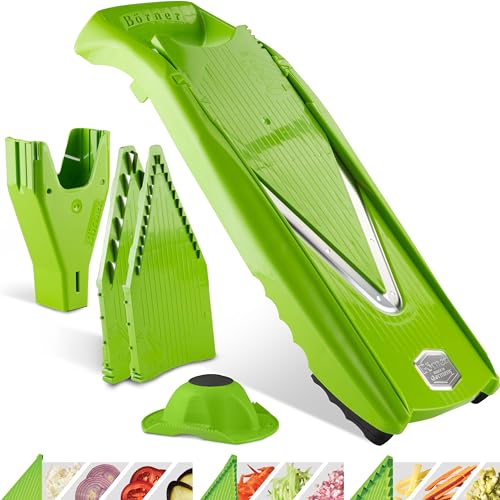
2. Borner V5 PowerLine Starter Set — Best for Slices, Sticks, and Dices
Tier: Mid-range
The Borner V5 PowerLine Starter Set is built around a simple idea: one V-shaped blade frame, a set of inserts that swap with a push of a button, and a safety holder that does the gripping for you. The V-blade meets food progressively, which makes it forgiving on tomatoes and soft fruit while staying decisive on carrots and potatoes. The slice insert offers four thicknesses, with the finest cutting down to about 1.2 millimeters, so the same tool handles paper-thin cucumber rounds and hearty potato slices. Two blade inserts, at 3.5 millimeters and 7 millimeters, cut sticks and dice, which means salads, stir fries, and gratins all come from the same frame. An insert box stores the blades you are not using, and the safety food holder locks produce in place while your fingers stay clear of the edge.
The frame measures 14.96 x 5.91 x 3.15 inches and weighs about 1.19 pounds, a long, low deck that sits steadily on a counter. The stainless steel V-blade runs the length of the deck, and non-slip feet keep the frame from sliding during firm passes. The maker builds the set in Germany, and the set includes the slice insert, both blade inserts, the safety holder, and the insert box. Hand washing is the recommended care routine, which suits a tool whose blades deserve a brush and a careful rinse rather than a hot dishwasher cycle. The insert change takes seconds: push the side button, slide the old insert out, slide the new one in until the arrows align, and keep slicing. That speed matters when a recipe needs two cuts, such as thin rounds for a salad and sticks for a garnish, because you do not lose momentum between steps.
Where the V5 earns its mid-range place is in the consistency of its cuts across a full batch. The V shape centers round produce, so onion and cucumber slices come out even from the first pass to the last, and the holder grips the tail end of a vegetable so little goes to waste. Cooks who make slaws, pickles, and fermented vegetables will appreciate the even thickness, since uniform slices brine and pickle at the same pace. The trade-offs are modest: the hand-wash routine adds a minute to cleanup, and the long deck needs a drawer or shelf of its own. Cooks who only slice occasionally may find the insert system more than they need, but anyone who changes cut styles mid-recipe will find the swap system genuinely useful. For a household that wants one frame to cover slices, sticks, and dices, the V5 Starter Set is a strong mid-range choice.
Specs
- Type: V-blade mandoline with interchangeable inserts
- Blade material: Stainless steel V-blade
- Blades included: Slice insert with 4 thicknesses, 3.5 mm and 7 mm blade inserts
- Thickness range: 4 slice thicknesses, finest about 1.2 mm
- Cut styles: Straight slice, sticks, dices
- Dimensions: 14.96 x 5.91 x 3.15 inches
- Weight: 1.19 pounds
- Body material: Plastic frame with stainless steel blade
- Color: Green
- Safety: Safety food holder included, insert box included
- Cleaning: Hand wash only
- Operation: Manual
3. Fullstar Mandoline Slicer 3-in-1 — Best First Mandoline
Tier: Budget
The Fullstar Mandoline Slicer 3-in-1 is the friendliest way to bring a mandoline into a kitchen, because it bundles everything a first-time user needs in one box. Three stainless steel blades cover the essential cuts: a 2 millimeter mandoline blade for thin slices, a 5 millimeter mandoline blade for thicker rounds, and a julienne blade for even strips. A blade organizer keeps the spare blades sorted, a finger guard and a pair of safety gloves protect hands during use, and a large catch tray sits beneath the deck so slices land in a container instead of scattering across the counter. The tray is dishwasher safe, and the whole slicer breaks down for storage, which suits kitchens where drawer space is limited.
The deck measures 13 x 5 x 4 inches and weighs about 1.5 pounds, a compact footprint that fits over a standard mixing bowl or on a cutting board. The body uses BPA-free ABS plastic with stainless steel blades, and the V-shaped blade profile helps center produce on the deck. In use, the 2 millimeter blade turns out even cucumber and radish rounds for salads, while the 5 millimeter blade handles potatoes for roasting and onions for sandwiches. The julienne blade cuts carrots and zucchini into strips that cook evenly in a stir fry, and the catch tray means a full batch of sliced vegetables goes straight from the slicer to the pan or the salad bowl. The included cleaning brush reaches around the blade teeth, and the cleaning tool that ships with the set helps clear food from the julienne slots without putting fingers near the edge.
The Fullstar suits cooks who want to try mandoline slicing without committing to a large stand model. The gloves deserve a special mention: many mandolines ship a holder and leave the glove as an extra purchase, while this set includes both, so a beginner can slice with a holder in one hand and a gloved hand steadying the frame. The trade-offs match the tier. Three blades cover the basics but not crinkle or waffle cuts, and the thickness choices are fixed at two settings plus julienne rather than a continuous dial. Cooks who already know they want fine dial control should look at the Mueller or the OXO picks instead. For a first mandoline, for a small kitchen, or for a cook who slices a few times a week rather than daily, the Fullstar 3-in-1 is a practical and well-equipped budget choice.
Specs
- Type: Handheld mandoline with catch tray
- Blade material: Stainless steel
- Blades included: 3 blades, 2 mm mandoline, 5 mm mandoline, and julienne
- Thickness range: 2 mm and 5 mm slice blades plus julienne
- Cut styles: Straight slice, julienne
- Dimensions: 13 x 5 x 4 inches
- Weight: 1.5 pounds
- Body material: BPA-free ABS plastic with stainless steel blades
- Color: White
- Safety: Finger guard and safety gloves included, blade organizer included
- Cleaning: Dishwasher safe catch tray, cleaning brush included
- Operation: Manual
4. Kyocera Advanced Ceramic Adjustable Mandoline — Best for Thin Slices and Soft Produce
Tier: Mid-range
The Kyocera Advanced Ceramic Adjustable Mandoline takes a different path from the steel-blade models in this guide: its blade is ceramic, made from zirconia, which holds a keen edge and resists staining from acidic foods such as tomatoes, citrus, and onions. The adjustable dial on the underside offers four thicknesses — 0.5, 1.3, 2.0, and 3.0 millimeters — so the thinnest setting produces translucent slices for garnishes and carpaccio-style presentations, while the thickest setting handles everyday cucumber and potato rounds. The included handguard holds food with prongs and keeps fingers away from the blade, and corner notches let the mandoline rest securely over a bowl so slices fall straight into it.
The slicer measures 10.6 x 3.6 x 0.4 inches and weighs only 3.87 ounces, making it the lightest and slimmest pick in this guide. It slides into a drawer, leans in a utensil crock, or travels in a picnic kit without demanding dedicated storage. The ceramic blade brings two practical benefits beyond sharpness: it does not react with acidic produce, so apple and avocado slices keep their color longer, and it stays keen through long use without the frequent honing steel blades need. The mandoline is dishwasher safe, though a gentle hand wash with a soft brush protects the ceramic edge and the dial mechanism. The body is black, the blade is ceramic, and the handguard is sized to the deck so it stores with the tool rather than rattling loose in a drawer.
In the kitchen, the Kyocera shines on delicate work. Paper-thin radish rounds for salads, fine garlic-adjacent slicing for garnishes, even strawberry slices for desserts, and thin fennel for slaws all come out cleanly, because the ceramic edge meets soft food without tearing it. The four fixed settings make repeatability easy: set the dial once for a recipe and every slice matches. The limits are real and worth naming. Ceramic blades chip if dropped on a hard floor or forced through very hard foods such as dense raw beets, so this is not the tool for heavy root vegetables or for cooks who want julienne and crinkle cuts from one frame. It cuts straight slices only, in four thicknesses, and it does its best work on produce that yields easily. For cooks who prize thin, clean slices of soft produce and want a tool that stores anywhere, the Kyocera is the most specialized and most rewarding mid-range pick here.
Specs
- Type: Handheld adjustable mandoline
- Blade material: Ceramic, zirconia
- Blades included: 1 ceramic blade with 4 thickness settings
- Thickness range: 0.5, 1.3, 2.0, and 3.0 mm
- Cut styles: Straight slice
- Dimensions: 10.6 x 3.6 x 0.4 inches
- Weight: 3.87 ounces
- Body material: ABS plastic with ceramic blade
- Color: Black
- Safety: Handguard included, corner notches for bowl use
- Cleaning: Dishwasher safe, hand wash recommended for the blade
- Operation: Manual
5. OXO Good Grips V-Blade Mandoline Slicer — Best Premium Pick
Tier: Premium
The OXO Good Grips V-Blade Mandoline Slicer is the most precise tool in this guide, and the precision comes from labeling: four slice thickness settings — 1.5, 3.0, 4.5, and 6.0 millimeters — are marked on the frame, so you can set a thickness, walk away, and return to the same setting days later without a test slice. The V-shaped blade is hardened stainless steel, angled to meet firm vegetables and soft fruit with equal ease, and the deck flips or swaps to julienne and French fry cuts without loose blades to track down. A crinkle blade is included for wavy slices, and every blade stores on board, which keeps sharp edges covered when the mandoline is put away.
The frame measures 5.5 x 6.0 x 15.5 inches and weighs 6.3 ounces, a long, narrow deck that bridges a bowl or sits flat on a counter. The food holder grips produce and slides it across the blade, and the soft grip handle gives steady control during long sessions. The blades are hand wash only, which is the right care routine for a hardened edge: a brush and a rinse keep the V-blade keen, while the frame wipes clean. The white body and the stored-blade design make the tool easy to keep in a drawer without a separate case, and the on-board storage means the julienne and crinkle blades are always where you expect them when a recipe calls for them.
In practice, the OXO V-Blade suits the cook who slices often and wants the same result every time. Gratin layers come out uniform because the labeled settings remove guesswork, and tomato slices hold their shape because the V-blade meets the skin progressively instead of pressing it flat. The julienne settings turn carrots and peppers into strips of matching width, and the French fry blade cuts potatoes into even batons that roast at one pace. The main consideration is the hand-wash routine, which adds a minute to cleanup, and the narrow deck, which suits everyday produce rather than the widest cabbages. For a household that cooks with a mandoline several times a week and wants the most repeatable settings in this guide, the OXO V-Blade is the premium pick that earns its place.
Specs
- Type: Handheld V-blade mandoline
- Blade material: Hardened stainless steel, V-shaped
- Blades included: Straight blade, julienne and French fry blades, crinkle blade
- Thickness range: 4 settings at 1.5, 3.0, 4.5, and 6.0 mm
- Cut styles: Straight slice, julienne, French fry, crinkle
- Dimensions: 5.5 x 6.0 x 15.5 inches
- Weight: 6.3 ounces
- Body material: Plastic frame with stainless steel blades
- Color: White
- Safety: Food holder included, all blades store on board
- Cleaning: Hand wash blades
- Operation: Manual
Who Should Skip a Mandoline
A mandoline is not the right tool for every cook. If you slice vegetables only a few times a month and mostly in small amounts, a sharp chef knife and a steady cutting board will serve you well without adding another gadget to a drawer. Cooks with limited hand strength or reduced grip may find the pushing motion tiring, especially on firm root vegetables, and should test a model in a shop or borrow one before buying. Households with young children should weigh storage carefully, since a mandoline blade in an unlocked drawer is a hazard, and a locking model or a blade box is worth the extra care. If your cooking rarely needs uniform slices — if you mostly chop roughly for soups, stews, and roasts where even thickness does not change the result — a mandoline will add little to your kitchen. Finally, cooks who dislike hand washing sharp tools should choose a model with dishwasher-safe parts or accept that the blades need a brush and a rinse after each use. For everyone else, especially cooks who make gratins, salads, slaws, and pickles weekly, a mandoline pays for its drawer space quickly.
Frequently Asked Questions
What is the safest way to use a mandoline for the first time?
Set the mandoline on a flat, dry surface or hook it over a bowl, fit the food holder before you begin, and load produce onto the holder prongs rather than holding it with bare fingers. Slide with slow, even pressure and keep your fingers behind the blade line at all times. Start with firm produce such as potatoes or cucumbers at a medium thickness, and wear a cut-resistant glove on the hand that steadies the frame until the motion feels natural.
Which thickness setting should I use for potato gratin?
A thin setting near one to two millimeters gives the even rounds that cook through at the same pace in a gratin, and a labeled dial makes it easy to repeat the setting across a full batch. If your mandoline offers only fixed blades, use its thinnest slice blade for gratins and reserve thicker blades for roasting and frying.
Can a mandoline cut julienne strips as well as straight slices?
Yes, most mandolines in this guide cut julienne with a dedicated blade, a flipped deck, or a swapped insert. The Mueller and Borner models use interchangeable blades or inserts for julienne, the Fullstar includes a julienne blade, and the OXO model builds julienne into its blade set. The Kyocera ceramic model cuts straight slices only, so choose one of the other four picks when julienne is a regular need.
How do I clean a mandoline without cutting myself?
Rinse the deck and blades under running water right after use, before food dries on the edge, and use a brush or a cleaning tool rather than a sponge or bare fingers around the blade. Wash hand-wash models with a brush and mild soap, and place dishwasher-safe parts on the top rack away from other items. Dry the blades fully, store them covered or in their organizer, and inspect inserts for looseness before the next use.
Conclusion
The best mandoline is the one that matches your cooking, your storage, and your comfort with a sharp tool. The Mueller Austria V-Pro gives a budget stand slicer with five blades and the widest thickness dial in this guide. The Borner V5 PowerLine Starter Set gives a mid-range V-blade frame that swaps between slices, sticks, and dices without tools. The Fullstar 3-in-1 gives a first-time buyer gloves, a guard, and a catch tray at a budget tier. The Kyocera ceramic model gives the thinnest, cleanest cuts on soft produce in the slimmest package here. The OXO Good Grips V-Blade gives the most repeatable labeled settings and the most complete on-board blade storage. Whichever you choose, use the holder every time, keep the blades covered in storage, and let the mandoline do what it does best: turn a pile of uneven knife work into slices that cook, pickle, and present at one pace.
Product and ASIN Reference
| Product | ASIN |
|---|---|
| Mueller Austria V-Pro Multi Blade Adjustable Mandoline | B01CT63964 |
| Borner V5 PowerLine Starter Set | B06Y1J4RT1 |
| Fullstar Mandoline Slicer 3-in-1 | B0CN9NVJQD |
| Kyocera Advanced Ceramic Adjustable Mandoline | B000KKNQZ6 |
| OXO Good Grips V-Blade Mandoline Slicer | B001THGPDO |