Our Short List of 3

- Best for: Medium lawns and like-for-like rotor replacement on existing lines.
- Throw distance: 19–32 ft per the listing
- 4 in pop-up height
- 1/2 in NPT female inlet
- Operating pressure: 25–55 psi

- Best for: High-pressure or sloped spray zones that mist and waste water.
- Model N91033
- 6 in pop-up height
- Pressure-regulating stem (PRS)
- Full-circle pattern, 8–15 ft throw

- Best for: Narrow strips, small beds and close-in coverage along a line.
- Model A18760
- 2 in pop-up height
- PRS dual spray design
- 360° pattern, 8–15 ft throw
All 4 Picks at a Glance
| Product | Specs | Action |
|---|---|---|
| Rain Bird 32SA Gear Drive Rotor Sprinkler |
| Check price on Amazon |
| Rain Bird 1806APPRS Pressure Regulating Spray Head |
| Check price on Amazon |
| Rain Bird 1802FDSPRS Dual Spray Head, 4-Pack |
| Check price on Amazon |
 Rain Bird 32HE In-Ground Rotor Sprinkler System Kit |
| Check price on Amazon |
Key takeaways
- Compare inline in-ground sprinklers by throw distance, pop-up height and pressure regulation, with Rain Bird rotors and sprays for lawns of every size.
An inline sprinkler system succeeds or fails on matching. Heads installed along the same line share one zone, one pressure and one run time, so a rotor that throws thirty feet sitting next to a spray that throws ten guarantees dry arcs and drowned corners. The real decision is which head type fits each stretch of your lawn: gear-driven rotors for long open runs, fixed sprays for short narrow strips, and pressure regulation where the line pressure would otherwise mist half your water into the wind.
This guide is for homeowners replacing worn heads on an existing in-ground line, people extending a zone, and anyone planning a first DIY system. Every pick is a Rain Bird in-ground head or kit chosen from its Amazon listing, with distances, pop-up heights and inlet sizes taken from those listings rather than from general irrigation advice.
Quick Picks
As an Amazon Associate we earn from qualifying purchases.
| Product | Best for | Key spec from title |
|---|---|---|
| Rain Bird 32SA Gear Drive Rotor | Medium lawns on a shared line | 19–32 ft throw, 4 in pop-up, adjustable arc |
| Rain Bird 1806APPRS Spray Head | Sloped or high-pressure zones | 6 in pop-up, pressure regulating, 8–15 ft |
| Rain Bird 1802FDSPRS 4-Pack | Short strips and small beds | PRS dual spray, 360°, 8–15 ft, 4-pack |
| Rain Bird 32HE In-Ground Rotor Kit | Starting a line from a hose tap | Kit with 4 rotors and 90 ft of tubing |
How to Choose
Match head type to the distance each line must cover
Rotors and sprays are not interchangeable. A gear-driven rotor throws a rotating stream nineteen feet and beyond, watering large open sections from few heads. A spray head fans water over a short radius, usually fifteen feet or less, and suits strips beside driveways and beds against the house. Putting sprays on a long line forces long run times that overwater everything near the head, while rotors on a short strip blast past the target. Walk each zone, note the longest throw it needs, and let that distance choose the head type for the whole line.
Pressure regulation keeps a shared line honest
Heads on one line all see the same pressure, and excess pressure turns spray into mist that drifts away instead of landing on grass. A pressure-regulating stem, marked PRS on listings, holds the nozzle at its intended pressure even when the street supply runs hot or the zone sits downhill. The visible symptom of missing regulation is fog at the head and dry grass a few feet out. If your system pressure is high or your lawn slopes, regulated heads pay for themselves in water that actually reaches the lawn.
Pop-up height must clear your grass, not your neighbor’s
A head that rises two inches waters short fescue fine and drowns in tall, thick turf, where the stream hits blades before it ever arcs out. Four-inch pop-ups are the standard for most lawns, and six-inch bodies exist for taller grass and for spraying over groundcover and small shrubs. Measure how high your grass stands before a mow, not after, and choose the body that clears it. Retrofitting taller bodies later means digging every head up again, so this is the specification to get right the first time.
Inlet size and arc adjustment decide installation pain
Most residential heads connect on a half-inch female thread, and matching that inlet to your existing fittings avoids adapter hunts mid-project. Arc adjustment matters just as much: a rotor that adjusts from part-circle to full-circle with a simple tool lets one head model serve corners, edges and open middle runs along the same line. Before ordering a box of heads, pull one existing head, read its inlet and throw, and buy replacements that match the line you already own rather than the line you wish you had.
The 4 Best Options
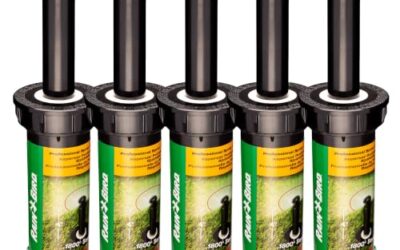
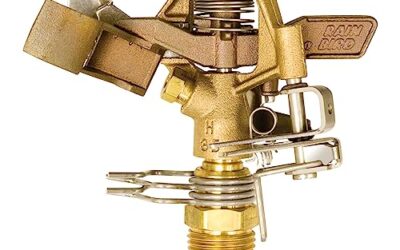
Rain Bird 32SA Gear Drive Rotor Sprinkler
- Best for: Medium lawns and like-for-like rotor replacement on existing lines.
- Throw distance: 19–32 ft per the listing
- 4 in pop-up height
- 1/2 in NPT female inlet
- Operating pressure: 25–55 psi
Medium lawns and like-for-like rotor replacement on existing lines.
Keep rotors and sprays on separate zones, since their precipitation rates differ sharply.
The 32SA is the dependable middle of most residential lines. Its listing specifies a 19 to 32 foot throw from a 4-inch pop-up body with a half-inch female inlet, an adjustable arc and a working range of 25 to 55 psi, which describes the majority of suburban zones. Gear drive keeps the rotation quiet and steady, and the distance range lets one model cover both the wide middle of a lawn and, dialed down, the shorter end runs. For replacing tired rotors head-for-head along an existing line, this is the specification to match first.
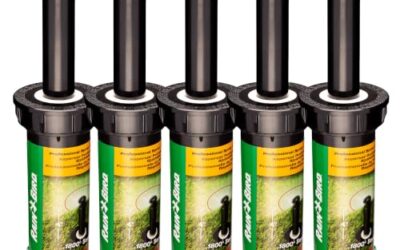
Rain Bird 1806APPRS Pressure Regulating Spray Head
- Best for: High-pressure or sloped spray zones that mist and waste water.
- Model N91033
- 6 in pop-up height
- Pressure-regulating stem (PRS)
- Full-circle pattern, 8–15 ft throw
High-pressure or sloped spray zones that mist and waste water.
Full-circle pattern only per this listing, so edge and corner positions need different nozzles or heads.
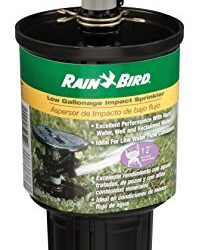
This head solves the misting problem. The listing describes a 6-inch pop-up spray with pressure regulation, a full-circle pattern and an 8 to 15 foot throw, model N91033. The taller body clears thick turf and low plantings, while the regulating stem keeps the nozzle performing at its rated distance when line pressure runs high. On sloped lawns, where lower heads see extra pressure and upper heads starve, regulated heads even out the zone. It is the thoughtful replacement for spray zones that fog on windy mornings.
Rain Bird 1802FDSPRS Dual Spray Head, 4-Pack
- Best for: Narrow strips, small beds and close-in coverage along a line.
- Model A18760
- 2 in pop-up height
- PRS dual spray design
- 360° pattern, 8–15 ft throw
Narrow strips, small beds and close-in coverage along a line.
The 2-inch pop-up needs short grass; tall turf will block the low spray.
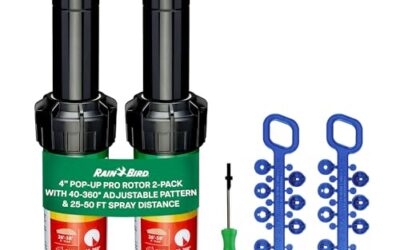
Short strips and small beds are where the 1802FDSPRS earns its place. The listing describes a 2-inch pop-up dual spray head with pressure regulation, a 360-degree pattern and an 8 to 15 foot range, model A18760, sold as a four-pack. Dual spray designs put water down close to the head as well as at full throw, filling the dry ring that single-stream sprays leave at their base. The four-pack format suits the reality of strip zones, which use several small heads rather than one big one.
Rain Bird 32HE In-Ground Rotor Sprinkler System Kit
- Best for: First DIY in-ground line run from a standard hose bib.
- Complete in-ground rotor kit
- Click-N-Go hose connection
- 90 ft of 1/2 in tubing included
- Four 32SA rotor sprinklers included
First DIY in-ground line run from a standard hose bib.
Hose-tap supply limits how many heads one line can feed, so plan zones around your home’s flow.
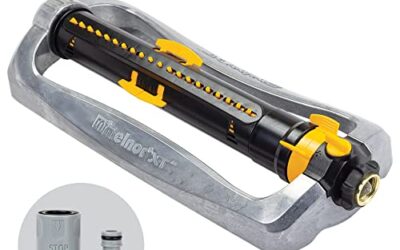
The 32HE kit is the on-ramp for a yard with no system at all. Its listing describes an in-ground rotor system with a Click-N-Go hose connection, 90 feet of half-inch tubing and four 32SA sprinklers, so a complete small line comes in one box and connects to an ordinary hose tap. That makes it a weekend project rather than a trench-and-manifold build. The same 32SA rotors can later tie into a larger system, so the starter line is not a dead end when the yard plan grows.
Which One Fits Your Situation
You are replacing dead rotors on an existing line
Match the 32SA to your current heads and swap them one for one. Its throw range, inlet size and pressure window cover most residential rotor zones, so the line’s watering pattern stays as designed. Pull one old head first and compare the inlet thread before ordering a full set.
Your spray zone fogs and the grass still looks dry
Switch the zone to pressure-regulating heads: the 1806APPRS for standard spray positions. Misting is water leaving as drift instead of droplets, and regulation at the stem is the direct fix. Expect the same run time to suddenly water farther and more evenly.
You are watering a narrow side yard or planting beds
Use the 1802FDSPRS four-pack. Short throw, close-in dual spray and a small pop-up body fit strips where a rotor would blast the fence. Several small heads along the line give the overlap these narrow spaces need.
You have no system and want one line this weekend
Start with the 32HE kit. It connects to a hose tap, includes the tubing and rotors, and covers a modest lawn section without valves or a controller. If it proves the concept, the same rotor model scales into a permanent multi-zone build later.
Common Mistakes
- Mixing rotors and spray heads on the same zone, then wondering why one end floods while the other stays dry.
- Ignoring pressure regulation on high-pressure lines, losing water to mist and wind drift.
- Choosing pop-up height by the grass right after mowing instead of at its tallest.
- Ordering heads before checking the existing inlet size, then stalling the project over a thread mismatch.
- Spacing heads for their maximum throw with no overlap, leaving dry seams between patterns.
Frequently Asked Questions
What does inline mean for a sprinkler system?
Inline describes heads installed along a shared supply line in an in-ground system, all fed by the same zone. Because they share pressure and run time, heads on one line should be the same type with matched throw distances. Mixing types on a line is the most common cause of uneven watering.
How far apart should rotor heads be spaced?
Space heads so each one’s throw reaches the next head, a principle called head-to-head coverage. For a rotor throwing up to 32 feet, that means spacing well inside the maximum, adjusted for your pressure. The listing’s distance range is measured at proper pressure, so low pressure at your home shortens the real-world throw.
Do I need pressure-regulating heads?
You need them when line pressure exceeds what the nozzle was designed for, which shows up as misting, fogging and dry patches a short distance out. Regulated stems hold output steady across slopes and strong street pressure. On a low-pressure system they add little, so test your pressure before paying for regulation everywhere.
Can I add these heads to an existing line of another brand?
Usually yes, provided the inlet thread matches, most commonly half-inch female NPT on residential heads. Throw distance and pop-up height should also match the zone’s design, or the pattern changes. Replacing one head with a different throw is fine for a test before committing the whole line.