Key takeaways
- Looking for the best hose end sprinklers for high wind? Compare impact and pulsating hose-end models built to hold a steady pattern when gusts pick up.
Wind is the quiet enemy of lawn watering. A sprinkler that lays down an even pattern on a calm morning can drift sideways in a gusty afternoon, leaving dry strips on one side and puddles on the other. Fine mist and high arcs make it worse: small droplets spend more time in the air and travel further off course.


That is why the best hose end sprinklers for high wind look different from models built for still, sheltered yards. They throw larger, heavier droplets on a lower trajectory, anchor firmly so a gust cannot tip them, and give you controls to shorten the throw and fatten the stream when the wind picks up. Impact and pulsating heads do this job well: a rotating arm breaks water into coarse droplets and sweeps them around in a steady arc, instead of lofting fine spray high into the air.
This guide compares four hose-end impact and pulsating sprinklers suited to windy conditions. Each one connects to a standard garden hose, covers a large area, and lets you adjust the pattern so water lands where it should. Use the choosing guide at the end to match a model to your yard, your water pressure, and the wind you face most often.
At a Glance
| Sprinkler | Head type | Base | Spray distance | Pattern adjustment | Wind advantage |
|---|---|---|---|---|---|
| Rain Bird 25PJDAC Brass Impact Sprinkler | Brass impact head | Head only; mount on a spike or riser | 20 to 41 ft radius | 20 to 360 degrees | Heavy brass head, diffuser screw |
| Orbit 58214N Brass Impact Sprinkler on Step Spike | Brass impact head | Zinc step spike | Up to 90 ft diameter | Partial circle to full 360 degrees | Anchored spike base, deflector and diffuser |
| Gilmour 196SPB Pattern Master Impulse Sprinkler | Pulsating impulse head | Polymer sled base | 16 to 43 ft radius | 30 to 360 degrees | Wide sled base; pattern ring shapes throw |
| Melnor 9536H All Metal Pulsating Sprinkler | Metal pulsating head | Metal step spike | Up to 100 ft diameter | 30 to 360 degrees | All-metal build, step spike for firm ground |
Rain Bird 25PJDAC Brass Impact Sprinkler
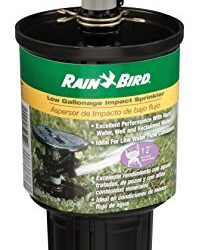
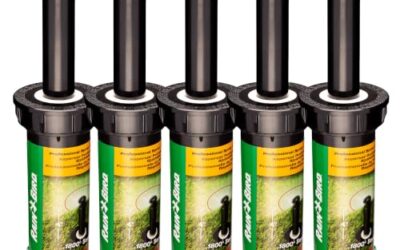
The Rain Bird 25PJDAC is a classic brass impact head, and its weight is part of the point. Brass, bronze, and stainless steel construction keeps it planted once mounted, so wind that would rattle a light plastic head has less to push against. The impact arm sweeps the stream around in a measured arc and throws coarse droplets that fall faster and drift less than a fine spray.
Pattern control runs from 20 degrees to a full 360-degree circle, with infinite adjustment in between, so you can water a wedge beside a path or a full circle over open lawn. The deflector flap sets spray distance from 20 to 41 feet in radius, and the diffuser screw breaks the stream into larger or smaller droplets. In windy weather, screwing the diffuser in to fatten droplets and pulling the deflector down to shorten the throw keeps more water on the grass. Maximum flow is listed at 5 gallons per minute and maximum pressure at 60 PSI, and the head is described as working even where household water pressure is low.
Listing features
- Brass, bronze, and stainless steel construction
- Adjustable pattern from 20 degrees to 360 degrees
- Spray distance from 20 to 41 feet in radius
- Diffuser screw adjusts droplet size and stream breakup
- Full or part circle coverage, infinite pattern adjustment
- Maximum flow of 5 gallons per minute and maximum pressure of 60 PSI
Considerations
This is a sprinkler head, not a complete hose-end unit, so plan on mounting it before first use. It threads onto a spike base, a riser, or a tripod, and the base matters as much as the head in windy weather. A short, heavy spike keeps the stream low and the head steady; a tall tripod lifts the spray into the wind and needs firm ground and a wide stance. The head relies on steady water pressure to drive the impact arm, so a long hose run or a timer in line can slow it. Check the arm on first use and shorten the hose run if the head stalls.
Orbit 58214N Brass Impact Sprinkler on Step Spike
The Orbit 58214N pairs a brass impact head with a zinc step spike, making it a complete hose-end sprinkler straight out of the box. Orbit lists coverage up to a 90-foot diameter, or 6,360 square feet at full circle. The pattern adjusts from a partial section to a full 360-degree circle, and the flow-through outlet lets you connect a second sprinkler in series when one head cannot reach the far corner.
The zinc step spike presses into soil or turf and anchors the head against gusts, the deflector shield shortens the throw for a tighter pattern, and the diffuser screw changes droplet size so you can throw a heavier stream on a breezy day. An anti-backsplash arm helps keep spray moving in the intended direction. Orbit describes the impact head as clog-resistant and suitable for dirty or reclaimed water from ponds and canals.
Listing features
- Brass impact head on a zinc metal step spike
- Coverage up to a 90-foot diameter, 6,360 square feet at full circle
- Pattern adjustment from a partial section to a full 360-degree circle
- Deflector shield and diffuser screw for distance and droplet control
- Flow-through outlet for connecting sprinklers in series
- Anti-backsplash arm
- Clog-resistant impact design suited to dirty or reclaimed water
Considerations
A 90-foot throw is a maximum measured under strong pressure, and coverage on a typical home system will be smaller, especially when wind works against the stream. Overlap the pattern by a third when you place the head so the lawn edges still get water on gusty days. The step spike needs soil soft enough to press into; on baked-hard summer ground, wet the spot first or the spike will sit shallow and the head can lean. Two heads in series divide the available water, so a second head shortens the throw of the first unless your supply can keep up.
Gilmour 196SPB Pattern Master Impulse Sprinkler on Polymer Sled Base
The Gilmour 196SPB Pattern Master takes a different approach to wind. Instead of a spike, it sits on a wide polymer sled base that spreads its weight across the ground. A sled base is hard to tip: gusts push against a low, broad footprint rather than a tall narrow spike, and the head stays upright on lawns where a spike would work loose in soft soil. The base is impact-resistant, rust-proof polymer with a flow-through design so you can link more than one sprinkler together.
Its flexible pattern ring shapes the spray at 12 adjustment points to match the yard. Push the ring flat for maximum distance, or raise it at chosen points to pull the spray in where the lawn narrows or bends. Coverage reaches up to 5,800 square feet, with a spray radius from 16 to 43 feet and rotation from 30 degrees to a full 360 degrees. In wind, shorten the throw on the windward side so the stream does not carry past the lawn edge, and keep full reach on the sheltered side.
Listing features
- Pulsating impulse head on a polymer sled base
- Flexible pattern ring with 12 adjustment points for custom spray shapes
- Coverage up to 5,800 square feet
- Spray radius from 16 to 43 feet
- Rotation from 30 degrees to a full 360-degree circle
- Flow-through base for connecting multiple sprinklers
- Impact-resistant and rust-proof polymer construction
Considerations
The pattern ring adds a learning curve. Setting 12 points takes a few minutes of trial and adjustment, and the first run needs watching to confirm the shape matches the lawn. That effort pays off on irregular yards, but for a plain rectangle a simpler head is faster to set. The sled base sits on top of the grass rather than anchoring into it, so on a slope it can creep if the hose pulls sideways; route the hose with slack and keep it from tugging the base downhill. The polymer build keeps the unit light enough to move by hand, and the head relies on the wide base rather than weight for stability.
Melnor 9536H All Metal Pulsating Sprinkler with Step Spike

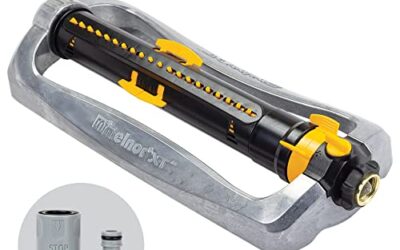
The Melnor 9536H is an all-metal pulsating sprinkler built around a die-cast zinc step spike with a step ledge for your foot. Pressing the spike in with body weight seats it firmly, and the metal head throws a coarse pulsating stream up to 100 feet in diameter. Metal construction runs through the whole unit, which suits exposed, windy sites where plastic heads can flex and chatter in gusts.
Pattern adjustment runs from a narrow 30-degree wedge to a full 360-degree circle, and a double connection lets the sprinkler serve as part of a series. A brass swivel nut eases hose hookup without twisting the hose, and a screen filter washer at the inlet helps keep debris out. The listing describes a limited warranty. The unit measures about 6 by 13 by 3 inches at 12.8 ounces, so it moves easily between beds and lawn sections.
Listing features
- All-metal pulsating sprinkler head and step spike
- Die-cast zinc spike with a step ledge for foot pressure
- Coverage up to 100 feet in diameter
- Pattern adjustment from 30 degrees to a full 360-degree circle
- Double connection for use in a series
- Brass swivel nut for hose hookup
- Screen filter washer to help prevent clogging
Considerations
The step spike is the anchor, so soil condition decides how steady this sprinkler is. In soft, wet soil it seats deeply and holds well; in dry, compacted ground it may need a pre-wetted spot or a few firm presses to seat fully. The all-metal head carries more weight at the top than a plastic head, and a shallow spike lets it lean under a side gust. Set the pattern with the diffuser and deflector before you walk away, and confirm the arm sweeps evenly on the first run. Like other pulsating heads, it needs enough pressure to drive the arm, so keep the hose run short and avoid extra fittings between the tap and the head.
How to Choose a Hose End Sprinkler for High Wind
In wind, droplet size and trajectory decide where the water lands. Impact and pulsating heads throw a single coarse stream that breaks into large droplets, and those droplets fall fast and drift little. Oscillating bars and fan nozzles throw a thin curtain of fine spray high into the air, which is exactly the water wind steals. If your yard is regularly windy, choose an impact or pulsating head first.
A sprinkler that tips in a gust waters the fence instead of the lawn. Step spikes anchor into soil and hold well on flat ground, sled bases spread weight over a wide footprint and suit soft or uneven turf, and ring or wheel bases stay put on flat lawns but can roll or shift on slopes. Match the base to your ground: spikes for firm soil and sleds for soft soil.
Two controls matter most in wind: a deflector that shortens the throw and a diffuser screw that fattens the droplets. With both, you can pull the pattern in on the windward side and keep the sheltered side covered. A pattern that adjusts from a narrow wedge to a full circle also lets you water up to a boundary without throwing water past it.
Size coverage to your pressure, not the listing maximum. Maximum diameters are measured under strong pressure on a calm day, and wind shortens the effective reach. If the listing claims a 90-foot diameter, plan on useful coverage well inside that figure and overlap each placement by about a third. For large lawns, a flow-through outlet linking two heads in series can help, but a second head divides the water supply and shortens both throws.
Finally, water in the early morning, when wind is usually lightest, and move the head more often instead of running one long session from a single spot.
Fit and Installation Considerations
Every sprinkler in this guide connects to a standard garden hose, but a few installation details make the difference between a steady pattern and a wandering one. Connect the hose with slack so it does not pull the base sideways, and lay the hose on the ground rather than letting it hang from the tap, which drags the head off line. Tighten the coupling by hand, then snug it with a quarter turn.
Seat the base before turning the water on. For a step spike, press it straight down with your foot until the ledge meets the soil, and confirm the head stands upright rather than leaning. For a sled base, set it flat on the turf and press the frame down to settle it. For the Rain Bird head, which ships without a base, thread it onto a spike or riser and confirm the connection is firm; a loose head wobbles and throws an uneven pattern.
Set the pattern with the water running. Start at full circle and full distance, watch where the stream lands, then pull in the arc and shorten the throw on the windward side. Turn the diffuser screw until the droplets look coarse rather than misty. Walk the edge of the pattern and confirm water lands on grass, not paths or fences. If the head stalls or the arm moves slowly, the cause is usually low pressure: shorten the hose, remove extra fittings, or run one head at a time.
At the end of the season, drain the head, wipe off soil, and store the sprinkler under cover. Rinse the screen washer so debris does not harden inside the inlet, and check washers and couplings each spring.
Frequently Asked Questions
Why do impact sprinklers work better in wind than oscillating sprinklers?
Impact and pulsating heads throw coarse, heavy droplets on a low arc, and those droplets fall quickly and resist being carried sideways. Oscillating sprinklers throw a fine curtain of small droplets high into the air, where wind catches them easily. On a breezy day the difference is visible: an impact head keeps its pattern recognisable, while an oscillating bar drifts and leaves dry stripes.
Should I water at a different time of day when it is windy?
Yes. Wind is usually calmest in the early morning, so watering then gives the stream the best chance of landing where it should. If wind picks up during the day, shorten the throw with the deflector, fatten the droplets with the diffuser screw, and move the head more often.
Can I connect two hose-end sprinklers together?
Several models in this guide have a flow-through outlet for exactly that. Linking two heads extends coverage across a large lawn, but the pair shares one water supply, so each head throws a shorter distance than it would alone. Confirm your household pressure can support two heads, and place them so their patterns overlap by about a third.
Do I need a spike base, a sled base, or a tripod for windy conditions?
It depends on your ground. A step spike anchors well in firm soil and keeps the head low, which is good in wind. A sled base spreads weight over a wide footprint and suits soft or uneven turf where a spike works loose. A tripod lifts the head above tall grass but also lifts the spray into the wind, so use it only where the extra height is needed and the legs stand firmly. For most windy yards, a low spike or sled base is the steadier choice.
Conclusion
Wind does not have to mean a patchy lawn. The sprinklers in this guide share the traits that matter when gusts pick up: coarse droplets, low trajectories, adjustable deflectors and diffuser screws, and bases that anchor instead of tipping. The Rain Bird 25PJDAC is a heavy brass head for gardeners who already own a spike or riser. The Orbit 58214N is a complete spike-mounted unit with broad coverage and series connection. The Gilmour 196SPB Pattern Master uses a wide sled base and a shapeable pattern ring for irregular yards. The Melnor 9536H pairs an all-metal head with a foot-driven step spike for firm, exposed ground.
Pick the base that suits your soil, set the pattern with the water running, and water in the calmest part of the day. With those habits, an impact or pulsating sprinkler will keep water on the grass even when the wind is working against it.
As an Amazon Associate, we earn from qualifying purchases.