Key takeaways
- Compare five sprinklers by the spray spread each one lays across your planting beds, from adjustable pop-up spray heads and rotors to micro-stream stakes.
As an Amazon Associate, we earn from qualifying purchases made through links on this page.


The phrase behind this guide is a garbled one, so here is the reading used throughout: “iridium” is taken to be a typing slip for “irrigation”, and “planting spread” is taken to mean the spread of water a sprinkler lays over a planted area — the width, radius, or diameter the manufacturer states for its pattern. Read that way, the question becomes practical: which sprinklers publish a spread you can match to the shape of a planting bed, so water lands on the rows and not on the path beside them. One honest note: a well-known farming game also uses the words “iridium sprinkler” for an in-game item, and this site carries layout guides for that game. This page is about real irrigation hardware for real beds, not the game item.
The five picks below were chosen because each one publishes a concrete spread figure and a way to shape it: an in-ground pop-up spray head with an adjustable arc, a gear-drive rotor for long beds, a hose-end gear-drive sprinkler you can move from bed to bed, micro-stream drip stakes that put a small adjustable spread around individual plants, and a simple stationary sprinkler whose fixed circular spread suits a single round bed. Every figure quoted is the manufacturer’s own stated figure, and each section names the limit that figure hides, because a maximum reached at strong pressure is not the spread you will see on a weak supply line.
What to look for in a sprinkler for planting beds
Begin with the shape of the spread, not the size. A bed is usually a rectangle, a narrow strip, or a rough circle, and each shape wants a different pattern. An adjustable-arc spray head or rotor can be narrowed into a wedge that follows a corner bed. A fixed circular sprinkler throws water in every direction at once, which suits a round bed and wastes water beside a straight one. Micro-stream stakes skip the question by giving each plant its own small spread, which is why they work in mixed beds where no single pattern fits.
Read the stated spread as a radius or a diameter, and check which one it is. Spray heads and rotors are usually rated by spray distance — how far water travels from the head. Stationary and hose-end sprinklers are usually rated by diameter — the full width of the circle. A head rated at a 15-foot spray distance and a sprinkler rated at a 30-foot diameter cover roughly the same circle, and confusing the two leads to beds watered twice as wide as planned, or half as wide.
Check how the spread can be narrowed. Published figures are maximums. What matters in a bed is the adjustment range underneath: an arc you can close down from a full circle to a quarter wedge, a spray distance you can shorten with a screw or collar, or a flow knob that shrinks a micro-stream from a wide fan to a narrow one.
Match the connection to the system you actually have. Two picks below are in-ground heads on a half-inch threaded inlet, one is a hose-end sprinkler on a spike, one is a drip component on a quarter-inch barb, and the last is a hose-end stationary sprinkler. None substitutes for another, so the connection check comes before the spread check.
Mind pop-up height and pressure. A four-inch pop-up can sit below tall bed foliage and lose its spread to leaves. Running below a head’s stated pressure range shrinks the spread and breaks the pattern into a doughnut with a dry ring near the head.
Plan for overlap. Manufacturers space heads head-to-head: each head’s spread should reach the next head along the bed, or the far corners stay dry.
The best sprinklers for planting beds
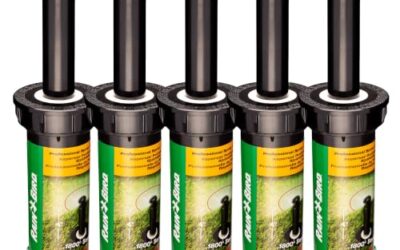
Rain Bird 1804VAN Professional Pop-Up Spray Head
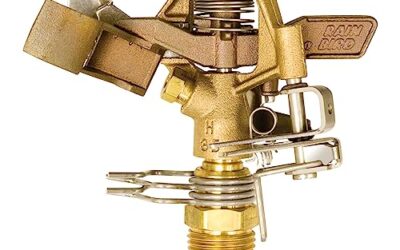
The 1804VAN is the bed specialist in this lineup: a four-inch pop-up spray body from Rain Bird’s 1800 Series fitted with a variable-arc nozzle. The nozzle adjusts by hand from a closed position through a full 360-degree circle, so the same head can throw a narrow wedge into a corner bed, a half circle along a fence line, or a full circle in the middle of a round bed. Rain Bird rates the spray distance at up to 15 feet, and a stainless screw on top shortens it when the bed is smaller than the full throw. The body connects to a standard half-inch threaded inlet, a direct fit for the risers and laterals most residential systems already use.
For planting beds, the appeal is control at small scale. Beds are rarely wider than the 15-foot maximum throw, and the adjustable arc means one zone of identical heads can serve a strip bed, an L-shaped border, and a square herb patch simply by setting each head’s arc and distance to its own patch of ground.
The limits are the usual spray-head limits. Four inches of pop-up is not much against tall perennials or dense shrubs, and foliage growing over the head blocks the spread and leaves dry shadows. The head also needs an in-ground line to feed it; it does nothing without a valve, pipe, and a water source. Spray heads apply water quickly, so on sloped or compacted beds much of it can run off instead of soaking in.
Best for: in-ground beds of mixed shapes on an existing system, where each head’s arc and distance need to be set bed by bed.
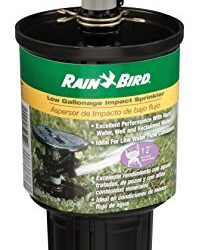
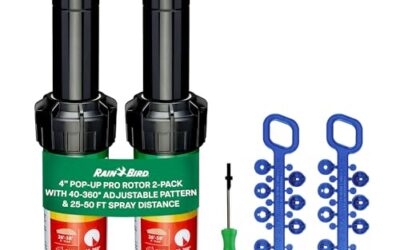
Rain Bird 32SA Gear-Drive Rotor
Where a bed is long — a deep border, a vegetable plot, a row of shrubs along a drive — a small rotor covers it with fewer heads than a spray zone would need. The Rain Bird 32SA is a closed-case gear-drive rotor with a four-inch pop-up, a spray distance Rain Bird states at 19 to 32 feet, and an arc adjustable from 40 degrees to a full 360-degree reversing circle, set at the top of the head. The preinstalled nozzle is rated at 3.0 gallons per minute, and Rain Bird’s Rain Curtain nozzle design produces larger droplets that hold their line in wind, with micro ramps directing some water close to the head so the area at its base is not left dry.
The working pressure range is 25 to 55 psi on a half-inch female NPT inlet, the same connection as the spray head above, so a 32SA can replace a spray head on an existing riser when a bed outgrows its original zone — although the two head types should not be mixed on one valve, because rotors and sprays apply water at very different rates. One 32SA set to a wide part-circle can sweep a long rectangular bed from one corner, with fewer heads to bury.
The limits follow from the throw. A rotor whose shortest stated distance is 19 feet cannot be turned down for a narrow strip bed; it overshoots a small bed no matter how the arc is set. Rotors also need the upper part of their pressure range to reach the stated spread, and they apply water slowly, so run times are long.
Best for: long beds, deep borders, and vegetable plots on an in-ground system, where one head must sweep a wide part-circle from a corner.
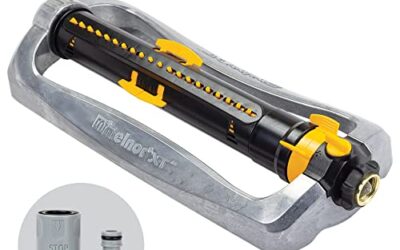
Orbit H2O-Six Gear-Drive Sprinkler on a Metal T Spike (58573)
Not every bed has an in-ground system behind it. The Orbit H2O-Six is a hose-end gear-drive sprinkler on a metal T spike: push the spike into the soil, connect a garden hose, and choose from six spray patterns with the rotating head and adjustable collar tabs. Orbit rates the full-circle spread at up to 80 feet in diameter, the watering arc can be set from a 25-degree partial circle through a full 360 degrees, and a four-position flow control adds a second layer of adjustment, shortening or softening the throw without moving the spike.
For planting beds, the draw is mobility plus pattern choice. The same sprinkler can water a newly planted bed at a gentle setting in the morning, move to a shrub border with a part-circle pattern in the afternoon, and come out of the ground when the bed is dug over. The six patterns include narrower shapes that suit rectangular beds better than a plain circular throw, and the metal spike anchors firmly in worked bed soil.
The limits are those of any hose-end tool. The 80-foot diameter is a maximum at full circle with a strong supply; most beds will use a fraction of it, dialled down through the pattern and flow controls. There is no timer in the box, so watering runs only while someone turns the tap on and off, or through a separate hose timer. The spike also needs soil it can bite into — a paved courtyard or a bed under heavy stone mulch gives it nothing to hold.
Best for: beds without an in-ground system, new plantings that change shape from season to season, and gardeners who would rather move one sprinkler than bury a zone.
Orbit 67105 Adjustable Multi-Stream Stake Emitters
At the small end of the spread scale, the Orbit 67105 is a drip component rather than a sprinkler head: a multi-stream emitter on a six-inch stake, connected by a quarter-inch barb into drip tubing. A flow-control knob adjusts both output and reach. Orbit rates the flow at 1 to 16 gallons per hour at 25 psi, and the spray distance as adjustable from 2 to 6 feet, so one emitter can open up over a small grouping of plants or close down to a gentle stream at the base of a single shrub.
This is the pick that treats “planting spread” most literally. Instead of one pattern thrown over a whole bed, each plant gets its own small spread, sized to its root zone. Mixed beds — vegetables beside perennials beside a young tree — stop being a compromise, because each emitter is set independently. The low application rate also suits beds on slopes and in containers, where a spray head’s faster output would run off before soaking in.
The limits are structural. The 67105 does nothing alone: it needs a drip mainline, quarter-inch tubing, a filter, and pressure regulation, so it is an addition to a drip layout, not a substitute for a sprinkler. Its six-foot maximum reach is the smallest spread in this lineup, so covering a whole bed takes many emitters, each a small part that can clog or be buried by mulch. Flow figures are quoted at 25 psi, and output falls as pressure drops along a long line.
Best for: mixed beds, rows, containers, and individual shrubs on an existing or planned drip layout, where each plant needs its own sized spread.
Orbit 58021N Small-Area Metal Sprinkler

The simplest tool in the lineup is a stationary zinc sprinkler that sits on the ground, connects to a garden hose, and throws an even, rain-like circular spray. Orbit rates its coverage at up to 30 feet in diameter and describes it as working with both low- and high-pressure water systems, which makes it forgiving about the supply it is given. There is nothing to adjust and nothing to program: the spread is the circle, and you size the watering by where you place it and how long it runs.
That simplicity suits a particular kind of planting: a round bed, a circular herb patch, a small island of flowers in a lawn, or a newly planted tree ring. Placed in the centre, the gentle circular spray wets the whole patch evenly without the hard jets that can flatten seedlings or wash mulch off a bed. The zinc body is built to be left outside season after season, with very little to break, clog, or mis-set.
The limits are the flip side of the simplicity. The circle cannot be narrowed, wedged, or aimed, so beside a path or wall half the spread lands outside the bed unless the sprinkler sits at the bed’s edge and the overshoot is accepted. Orbit publishes no finer pressure or flow figures for it, so its real diameter on a given hose is judged by eye on the first run.
Best for: one round bed or patch watered from a hose, especially new plantings that need a gentle, even soak and no setup.
Comparison table
| Product | Type | Stated spread | Pattern control | Connection |
|---|---|---|---|---|
| Rain Bird 1804VAN | Pop-up spray head | Up to 15 ft spray distance | Arc adjustable 0–360 degrees, distance screw | 1/2 in. threaded inlet, in-ground |
| Rain Bird 32SA | Gear-drive rotor | 19–32 ft spray distance | Arc adjustable 40–360 degrees | 1/2 in. NPT inlet, in-ground |
| Orbit H2O-Six 58573 | Hose-end gear-drive sprinkler | Up to 80 ft diameter at full circle | Six patterns, arc from 25 to 360 degrees, flow control | Garden hose, metal T spike |
| Orbit 67105 | Multi-stream drip emitter on stake | 2–6 ft spray distance | Flow knob adjusts output and reach | 1/4 in. barb, drip tubing |
| Orbit 58021N | Stationary small-area sprinkler | Up to 30 ft diameter | Fixed circular spray, no adjustment | Garden hose |
Frequently asked questions
How do I match a sprinkler’s spread to a bed?
Measure the bed, then compare its width with the stated spread, remembering that spray heads are rated by distance from the head while stationary sprinklers are rated by full diameter. Pick a head whose maximum spread slightly exceeds the bed, then use its arc and distance controls to pull the pattern back onto the planting.
Can one sprinkler water a whole raised bed?
A short bed, yes: a spray head at one end or a small stationary sprinkler in the middle can cover it. A long bed usually needs a rotor sweeping from a corner, a line of spray heads spaced so each spread reaches the next head, or drip emitters along the row. One head in the middle of a long rectangle leaves the corners dry.
Is a spray head or a rotor better for planting beds?
Spray heads suit most beds: their shorter throw and adjustable arcs fit bed shapes, and they water quickly. Rotors earn their place on long beds and deep borders where one head must throw 19 feet or more. Keep the two types on separate valves, since they apply water at very different rates.
Do drip emitters count as sprinklers for a bed?
For coverage planning, yes. A multi-stream emitter puts down a small adjustable spread of water, just at plant scale instead of bed scale. In mixed beds, emitters often give the most even result because each plant’s spread is set on its own.
Why is the spread in my garden smaller than the stated figure?
Stated spreads are maximums reached at the maker’s stated pressure with a clean nozzle. Low pressure, a long hose, a partly clogged filter, wind, and foliage in the way all shrink the pattern. Judge the real spread by where water lands on the first run.
Conclusion
Choosing a sprinkler by its planting spread means matching three things: the shape of the pattern, the size of the stated spread, and the connection your beds can feed. The Rain Bird 1804VAN is the most flexible in-ground choice for mixed bed shapes, the Rain Bird 32SA covers long beds from a corner, the Orbit H2O-Six brings pattern control to beds with no buried system, the Orbit 67105 shrinks the spread down to individual plants on drip lines, and the Orbit 58021N keeps a single round bed simple. Measure the bed, read the spread figure as the maximum it is, and pick the head whose adjustments pull that spread back onto the plants.