Key takeaways
- Compare the best UV water purifiers for whole-house, well, and under-sink use, with five verified picks, flow rates, lamp life, and sizing help.
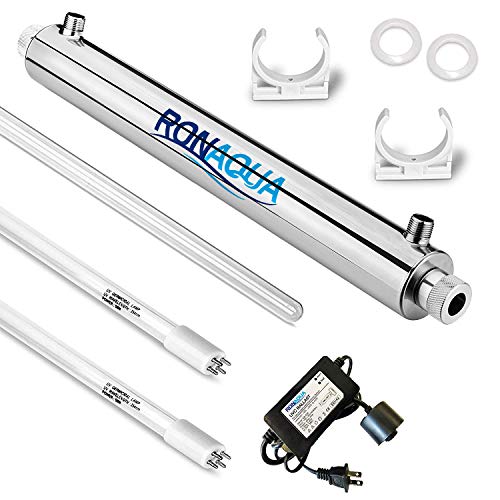
Quick answer: For most homes on well water or untreated supply, the Bluonics Whole House UV Water Filter System is the best starting point: it treats up to 12 gallons per minute with a 55 watt lamp in a stainless steel chamber, adds an LED indicator and an audible alarm, and arrives as a complete kit with the chamber, ballast, lamp, sleeve, gloves, and mounting hardware. If your home is smaller or your peak demand is lower, the Ronaqua 25 watt sterilizer covers up to 6 gallons per minute through half inch connections and includes a spare lamp. For a compact whole-house unit with a spare lamp and spare quartz sleeve in the box, the HQUA-TWS-12 is the practical mid-range pick. Under the sink, the iSpring UVF11A adds a final ultraviolet stage to a reverse osmosis setup at up to 1 gallon per minute, switching itself on and off with water flow. And for the most controlled whole-house setup, the iSpring UVF55FS pairs a 55 watt lamp with a flow sensor that only powers the lamp once flow reaches 0.66 gallons per minute, protecting lamp life between uses.

As an Amazon Associate, we earn from qualifying purchases.
Table of Contents
- How Ultraviolet Purification Works
- How to Choose a UV Water Purifier
- Quick Comparison
- 1. Bluonics Whole House UV Water Filter System, 12 GPM, 55W
- 2. Ronaqua Whole House UV Sterilizer, 25W, 6 GPM
- 3. HQUA-TWS-12 Ultraviolet Water Purifier Filter, 12 GPM
- 4. iSpring UVF11A UV Water Filter for Under Sink Systems, 1 GPM, 11W
- 5. iSpring UVF55FS Whole House UV Water Filter, 12 GPM, 55W
- Installation and Maintenance Basics
- Who Should Skip a UV Purifier
- Frequently Asked Questions
- Conclusion
- Product and ASIN Reference
How Ultraviolet Purification Works
An ultraviolet water purifier does not filter water in the usual sense. It passes water through a chamber around a UV lamp, and the ultraviolet light damages the genetic material of bacteria, viruses, and protozoa such as Giardia so they can no longer reproduce and cause illness. The water comes out with nothing added and nothing removed: no chemicals, no change in taste, no change in odor, and no change in mineral content. That is the central strength of the method and also its central limit, and understanding both halves is what separates a good purchase from a disappointing one.
The strength is simplicity. A UV stage has no cartridge that clogs with sediment in the way a carbon block does, no membrane that needs backwashing, and no holding tank or contact time for a chemical to work. Water flows through, light does the work, and treated water reaches the tap. For well water, lake water, and other untreated sources where the main concern is biological contamination, ultraviolet treatment is a proven, chemical-free approach that whole-house systems have used for decades. Municipal water can also benefit, since a UV stage guards against organisms that survive or bypass city treatment, but the case is strongest where the source is untreated.
The limit is that ultraviolet light treats only what it can reach. It does not remove sediment, dissolved solids, iron, hardness, lead, or other chemicals, and it does not improve color or taste. Cloudy or silty water is a real problem, because particles can shield organisms from the light, which is why almost every whole-house UV installation sits downstream of a sediment pre-filter, and often downstream of a carbon stage as well. A UV purifier is the final biological barrier in a treatment chain, not a complete treatment system on its own, and buyers who expect it to fix brown water or a sulfur smell will be disappointed no matter which model they choose.
Dose is the other concept that matters. A UV system delivers a certain amount of ultraviolet energy to each liter of water, and that dose falls as flow rises. Every system in this roundup publishes a maximum flow rate, and that figure is a ceiling, not a suggestion: push water through faster than the rated flow and the dose drops below the level the design was built to deliver. Sizing a UV purifier therefore starts with your peak demand, the moment when two showers, a dishwasher, and a washing machine may all draw at once, and works backward to a rated flow that covers it. A system rated for 12 gallons per minute suits a typical family home; a 6 gallon per minute unit suits a smaller home or a single-bathroom cabin; a 1 gallon per minute under-sink stage suits one drinking-water tap and nothing else.
Lamp life is the running cost. The ultraviolet lamps in these systems are rated by the manufacturers in thousands of hours, typically 8,000 to 9,000 hours, and they lose output gradually long before they stop glowing. A lamp that still lights can already be too weak to deliver its rated dose, which is why manufacturers recommend replacing the lamp once a year even when it appears to work. The quartz sleeve around the lamp needs attention too: mineral scale and biofilm cloud it over months, and a cloudy sleeve blocks light just as surely as a weak lamp. Cleaning the sleeve every six to twelve months is part of owning any of these systems, and the models with an alarm or indicator earn their keep by reminding you that something needs attention.
Power is a final practical point. Whole-house UV units run on household current, and when the power goes out the lamp goes out with it, which means untreated water can reach the taps during an outage. Some owners pair the system with a backup power source or simply avoid drinking tap water until power returns. Under-sink stages with a flow sensor switch solve a different power problem: they switch the lamp on only when water flows, so the lamp is not burning hours while nobody is using the tap, and the published lamp life stretches further in real use.
How to Choose a UV Water Purifier
Start with the water source and a test. A UV purifier is the right answer when a water test shows biological contamination or when the source is a private well, a spring, or surface water with no disinfection at all. If the test shows iron, manganese, hardness, or heavy sediment, those problems need their own stages first: a sediment filter for particles, an iron filter or softener where the chemistry demands it, and then the UV stage last. Buying the UV unit before the pre-treatment is putting the final barrier in front of the problems it cannot solve, and the sleeve will foul fast in dirty water.
Next, measure or estimate peak flow. Count the fixtures that can run at the same time and add up their draw. A standard shower uses roughly 2 to 2.5 gallons per minute, a dishwasher about 1.5, a washing machine about 2, and a kitchen tap about 1.5 to 2. A family home with two bathrooms can easily peak above 10 gallons per minute for short stretches, which is why 12 gallon per minute systems dominate the whole-house category. A single-bathroom home or a cabin peaks lower, and a 6 gallon per minute unit can be the right size there. Oversizing a UV system costs little except a slightly larger chamber and a stronger lamp, while undersizing it means the dose falls short exactly when the household needs the most water, so err toward the larger rating when the choice is close.
Then look at the chamber and the connections. Whole-house chambers in this roundup are stainless steel, which resists corrosion and handles household pressure, and they connect with threaded fittings in three quarter inch or one inch sizes. Match the fitting size to your main line, or plan on adapters, and check the chamber length against the space where it will mount: the HQUA-TWS-12 measures 21 inches long, the iSpring UVF55FS chamber is 37.5 inches, and the Ronaqua unit is 22 inches long. A long chamber needs a straight run of pipe and clearance to pull the lamp and sleeve out for service, so measure the service clearance, not just the wall space.
Lamp wattage follows flow. A 55 watt lamp serves a 12 gallon per minute system, a 25 watt lamp serves a 6 gallon per minute system, and an 11 watt lamp serves a 1 gallon per minute under-sink stage. Higher wattage is not a quality badge on its own; it is the power needed to deliver the dose at the rated flow. What does distinguish models is how the lamp is managed: a basic ballast runs the lamp continuously, a flow sensor switch turns it on only when water moves, and an alarm or LED indicator tells you when the lamp or the system needs attention. The flow sensor matters most in homes where the tap runs in short bursts all day, since it saves lamp hours, and the alarm matters most in homes where nobody will remember the annual lamp change without a reminder.
Consider what comes in the box. A whole-house kit should include the chamber, the ballast, the lamp, the quartz sleeve, and the mounting hardware, and the better kits add gloves for handling the lamp and sleeve, since skin oils on quartz can create hot spots and shorten lamp life. Spare parts in the box are worth real value: the HQUA-TWS-12 ships with an extra lamp and an extra quartz sleeve, and the Ronaqua unit ships with a spare lamp, which means the first annual service costs nothing in parts. Check also whether the manufacturer publishes replacement lamp and sleeve part numbers, because a system whose spares are hard to find becomes a disposable purchase after the first lamp dies.
Finally, think about who installs it. A UV stage is a plumbing job: cutting into the main line, mounting the chamber, wiring the ballast, and pressure-testing the joints. Confident homeowners with plumbing experience can do it, and the kits in this roundup include step-by-step instructions and mounting hardware, but anyone unsure should budget for a plumber. The under-sink UVF11A is the simplest install of the five, since it drops into an existing reverse osmosis line as a final stage, but even there the placement matters: with a storage tank in the system, the UV stage goes after the tank, where flow is high enough for the sensor to work.
Quick Comparison
| Product | Flow Rate | Lamp | Best For |
| Bluonics Whole House UV Water Filter System | 12 GPM | 55W | Whole-house well or city water |
| Ronaqua Whole House UV Sterilizer | 6 GPM | 25W | Smaller homes and cabins |
| HQUA-TWS-12 Ultraviolet Water Purifier Filter | 12 GPM | 55W | Whole-house with spares included |
| iSpring UVF11A UV Water Filter | 1 GPM | 11W | Under-sink reverse osmosis final stage |
| iSpring UVF55FS Whole House UV Water Filter | 12 GPM | 55W | Whole-house with flow sensor control |
1. Bluonics Whole House UV Water Filter System, 12 GPM, 55W
The Bluonics system is the straightforward whole-house pick in this roundup, and its appeal is that it covers the most common case with the fewest complications. It is a point-of-entry unit rated for 12 gallons per minute, built around a 55 watt lamp inside a stainless steel chamber, and it suits both well water and city water setups. Installation uses standard three quarter inch NPT connections, which match the main line in most homes, and the kit includes the chamber, ballast, lamp, sleeve, cotton gloves, and mounting hardware, so there is no separate shopping trip for the parts that make the install possible.
What sets it apart from the other 12 gallon per minute systems here is the built-in monitoring. An LED indicator and an audible alarm report system status, so a failed lamp or a power problem announces itself instead of sitting silent while untreated water flows. That matters because the most common failure of a UV system is an unnoticed one: the lamp weakens gradually, the household keeps drinking the water, and nobody knows the dose has fallen. An alarm does not replace the annual lamp change, but it catches the failures that a calendar cannot.
The treatment itself is chemical-free by design. Water flows through the stainless chamber past the lamp, and the ultraviolet light works without adding anything to the water or changing its taste or odor. The manufacturer publishes the system for whole-house coverage, meaning every faucet in the home draws treated water, not just the kitchen tap, and that is the right scope for a biological concern: if the source carries organisms, they can enter through any tap, including the shower and the bathroom sink.
Budget positioning is honest here. This is the least elaborate of the three whole-house 12 gallon per minute units in the roundup, with no flow sensor and no spare lamp in the box, and its value is in the complete kit and the alarm rather than in extra features. For a home that wants whole-house ultraviolet treatment with a clear warning when something goes wrong, and that is willing to handle the annual lamp change on a schedule, it is the pick that asks the least and covers the most.
Specs
- Type: Whole-house ultraviolet water purifier
- Flow rate: 12 GPM
- Lamp: 55W UV lamp in a stainless steel chamber
- Connections: 3/4 inch NPT inlet and outlet
- Indicators: LED indicator and audible alarm
- Water sources: Well water and city water
- Installation: Point-of-entry, for every faucet in the home
- Included in the box: UV chamber, ballast, lamp, sleeve, cotton gloves, mounting hardware
- Treatment: Chemical-free, no change to taste or odor
- Group: Budget
2. Ronaqua Whole House UV Sterilizer, 25W, 6 GPM
The Ronaqua sterilizer is the small-system pick, and it earns its place by matching a smaller job instead of overselling a large one. It is rated for 6 gallons per minute with a 25 watt lamp, which fits a single-bathroom home, a cabin, a small rental, or a point-of-use installation where one or two fixtures draw at a time. Its chamber measures 22 inches long by 3 inches wide by 5 inches high, and it connects through half inch NPT fittings, so it drops into smaller plumbing runs without the adapters a larger unit would need.
The published design is built around continuous operation. The manufacturer describes the system as running around the clock, treating water as it flows with no holding tank and no reaction time, and the 6 gallon per minute rating is presented as enough to sanitize drinking and cleaning water for the whole of a smaller home. The operating envelope is published as 10 to 100 PSI and 36 to 104 degrees Fahrenheit, which covers normal household pressure and cold-water lines, and the unit is listed as compatible with the HQUA-OWS-6 and several equivalent 25 watt sterilizer models, which helps when sourcing a replacement lamp later.
A spare lamp in the box is the practical highlight. Ultraviolet lamps are a yearly consumable, and the first replacement is usually the moment an owner discovers how much the part costs and how long it takes to arrive. Shipping a spare with the unit removes that first service from the equation entirely, and the published guidance is that only the lamp and the quartz sleeve need annual replacement, keeping the longer-term maintenance simple. The system is also presented as a small-business brand product, and its chamber is listed as containing recycled material.
For buyers, the trade-off is plain: 6 gallons per minute is a real ceiling, and a household that runs two showers at once will exceed it. But for the homes it fits, the Ronaqua unit is the most compact and the most economical whole-house ultraviolet option in this roundup, and the spare lamp makes the first year of ownership the cheapest as well.
Specs
- Type: Whole-house ultraviolet water sterilizer
- Flow rate: 6 GPM
- Lamp: 25W UV lamp
- Connections: 1/2 inch NPT inlet and outlet
- Dimensions: 22 x 3 x 5 inches
- Operating pressure: 10 to 100 PSI
- Operating temperature: 36 to 104 degrees Fahrenheit
- Included in the box: Stainless steel chamber, UV lamp, quartz sleeve, spare lamp
- Treatment: Chemical-free, no change to taste, smell, or color
- Compatible models listed: HQUA-OWS-6, Boeray SSE-006, KOOTANS SDE-025
- Group: Budget
3. HQUA-TWS-12 Ultraviolet Water Purifier Filter, 12 GPM

The HQUA-TWS-12 is the mid-range whole-house pick, and its case is built on what arrives in the box rather than on a single headline feature. It is a 12 gallon per minute, 55 watt system with a 21 inch long chamber, 3.5 inches in diameter, and three quarter inch MNPT inlet and outlet connections. The chamber follows a compact Big Blue style layout that the manufacturer presents as easier to fit into an existing pipe run than a longer reactor, and the kit includes a professional manual covering installation, maintenance, and troubleshooting.
The spares are the reason to choose it over the other 12 gallon per minute units. The box includes one extra UV lamp and one extra quartz sleeve, which are exactly the two parts that wear out, and that pairing means the first annual service is covered before the unit is even mounted. The lamp is rated for 9,000 hours, and the system is published as a no-secondary-pollution design: no change in taste, odor, pH, conductivity, or general water chemistry, since the treatment adds nothing to the water.
Installation is presented as a homeowner-friendly job for those comfortable with plumbing, with the compact size helping it integrate into the pipe system without a long straight run. The unit runs on 120 volt household current, and like every whole-house UV system it treats water only while powered, so a power outage means untreated water until power returns. For a well-water home that wants a full-size system with the first service already in the box, the HQUA-TWS-12 is the most complete mid-range package in this roundup.
Specs
- Type: Whole-house ultraviolet water purifier
- Flow rate: 12 GPM
- Lamp: 55W UV lamp, rated life 9,000 hours
- Chamber: 21 x 3.5 x 3.5 inches
- Connections: 3/4 inch MNPT inlet and outlet
- Power: 120V
- Included in the box: UV chamber, lamp, quartz sleeve, 1 extra UV lamp, 1 extra quartz sleeve, manual
- Treatment: No change in taste, odor, pH, or conductivity
- Group: Mid-range
4. iSpring UVF11A UV Water Filter for Under Sink Systems, 1 GPM, 11W
The iSpring UVF11A is the only point-of-use pick in this roundup, and it plays a different role from the whole-house units: it is a final ultraviolet stage that bolts onto an existing under-sink reverse osmosis system, treating the drinking water at one tap rather than every faucet in the home. It runs an 11 watt lamp in a stainless steel chamber with quarter inch quick-connect fittings, and it is rated for up to 1 gallon per minute, which matches the flow of a reverse osmosis faucet.
Its defining feature is the smart flow sensor switch. The lamp turns on and off automatically with water flow, so it is not burning lamp hours while the tap sits idle, and that extends the life of a lamp rated at 8,000 hours well beyond what continuous operation would allow. The lamp itself is published as made in Poland, and the unit is presented as a complete add-on kit compatible with most reverse osmosis systems as a final stage of protection.
Placement matters more with this unit than with the others. If the reverse osmosis system has a storage tank, the UVF11A installs after the tank, where water flow is high enough for the sensor to work, and the manufacturer publishes it as suitable for well water and other problem sources such as lake and stream water feeding a reverse osmosis setup. It is not a standalone purifier: on its own it treats only the water that passes through it at one tap, and it removes nothing, so the reverse osmosis stages ahead of it do the work of removing dissolved solids and chemicals while the ultraviolet stage handles the biological risk.
For a household that already owns a reverse osmosis system and wants to add virus and bacteria protection at the drinking tap without replumbing the whole house, the UVF11A is the smallest, simplest, and most economical way to do it.
Specs
- Type: Under-sink ultraviolet water filter, final stage for reverse osmosis systems
- Flow rate: 1.0 GPM
- Lamp: 11W UV lamp, rated life 8,000 hours
- Chamber: Stainless steel with 1/4 inch quick-connect inlet and outlet
- Control: Smart flow sensor switch, automatic on and off with water flow
- Installation: After the storage tank in a reverse osmosis setup
- Water sources: Well water, lake water, stream water feeding a reverse osmosis system
- Group: Budget
5. iSpring UVF55FS Whole House UV Water Filter, 12 GPM, 55W
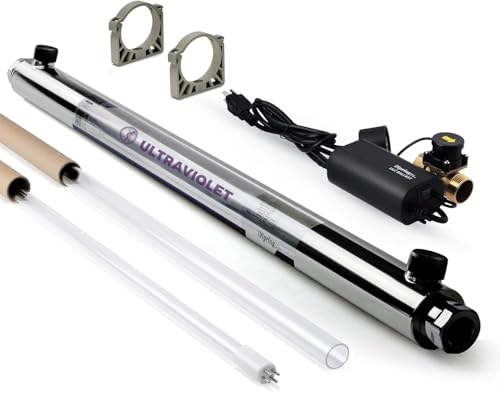
The iSpring UVF55FS is the premium pick, and the premium is in the control system rather than in raw flow: like the other full-size units here it is rated for 12 gallons per minute with a 55 watt lamp, but it manages that lamp with an upgraded ballast and a flow sensor switch that the simpler systems do not have. The sensor offers three modes, Auto, Move, and Stop, and Auto is the recommended setting, switching the lamp on only once flow reaches 0.66 gallons per minute. That protects the lamp from burning hours during the many small draws a household makes in a day, and it stretches the published 9,000 hour lamp life across more calendar time.
The chamber is the longest in this roundup at 37.5 inches, built from 304 stainless steel with a 1 inch MNPT inlet and outlet, and the long dwell time inside it is part of how the system holds its rated flow with minimum pressure loss. Mounting clips are included for do-it-yourself installation, and the published maintenance schedule is the standard one: replace the UV lamp once a year and clean the quartz sleeve every 6 to 12 months. The lamp and ballast carry their own published part designations, which makes ordering replacements straightforward.
Treatment is chemical-free, presented as a green alternative to chlorine with no chemical byproducts and low power consumption, and the system is positioned as the last step added to a whole-house filtration setup, treating all the water in the home at once. For a household that wants the most controlled whole-house ultraviolet system in this roundup, with lamp life managed by flow rather than by the clock, the UVF55FS is the pick that justifies its premium position.
Specs
- Type: Whole-house ultraviolet water purifier
- Flow rate: 12 GPM
- Lamp: 55W UV lamp, rated life up to 9,000 hours
- Chamber: 37.5 inch 304 stainless steel reactor chamber
- Connections: 1 inch MNPT inlet and outlet
- Control: Upgraded ballast with smart flow sensor switch, Auto, Move, and Stop modes
- Flow sensor trigger: 0.66 gallons per minute
- Included in the box: Mounting clips, quartz sleeve, UV lamp
- Maintenance: Annual lamp replacement, quartz sleeve cleaning every 6 to 12 months
- Treatment: Chemical-free, no chemical byproducts
- Group: Premium
Installation and Maintenance Basics
Every system in this roundup is installed in the same sequence, and getting the sequence right matters more than the brand on the chamber. The UV stage goes last in the treatment chain, downstream of the sediment filter and any carbon, iron, or softening stage, because cloudy water shields organisms from the light and fouls the quartz sleeve. It also goes downstream of the pressure tank on a well system, where flow is steady, and it needs a straight run of pipe with enough clearance to slide the lamp and sleeve out for service. The longest chamber here, the iSpring UVF55FS at 37.5 inches, needs the most room, while the HQUA-TWS-12 at 21 inches fits tighter spaces.
Shut the water off, cut into the line, and mount the chamber with the included clips or brackets before connecting the plumbing, so the weight of the chamber is carried by the mount rather than by the pipe joints. Threaded connections need sealant rated for potable water, and the joints should be pressure-tested before the ballast is wired. The ballast mounts nearby, away from direct water contact, and the lamp slides into the quartz sleeve with clean hands or the cotton gloves supplied in the Bluonics kit, since skin oils on quartz can create hot spots. Once the system is filled, check for leaks at every joint, confirm the indicator or alarm shows normal operation, and flush the line before drinking from it.
Maintenance is a calendar job, and the calendar is the part most owners neglect. Replace the UV lamp once a year even if it still glows, because output falls long before the lamp fails outright, and a lamp that looks alive can already be too weak to deliver its rated dose. Clean the quartz sleeve every 6 to 12 months, more often on hard or iron-bearing water, using a soft cloth and a mild descaling solution rather than anything abrasive. Check the O-rings and seals at the same visit, and keep a spare lamp and sleeve on hand so a service does not turn into a week of untreated water while parts ship. The HQUA-TWS-12 and Ronaqua kits both ship with spares, which is a genuine advantage here, and the other three systems need the owner to order spares ahead of the first service.
Pre-filtration deserves a final word. A UV purifier cannot fix water that is visibly cloudy, and installing one on an unfiltered well line is the most common reason these systems disappoint. A simple sediment filter ahead of the UV chamber, changed on its own schedule, protects the sleeve, keeps the dose where the design expects it, and is the cheapest insurance a UV installation can have. Homes with iron above trace levels or with heavy sediment should add the appropriate pre-treatment before the UV stage, and a fresh water test after installation confirms that the complete chain is doing its job.
Who Should Skip a UV Purifier
A UV purifier is the wrong purchase when the water problem is not biological. If the complaint is hard water, scale on fixtures, a sulfur smell, brown color, or a metallic taste, ultraviolet light will not help, because it removes nothing and changes no chemistry. Those homes need a softener, an iron filter, a carbon stage, or a reverse osmosis system, and a UV stage only earns its place after those problems are solved.
Renters should also think twice. A whole-house UV system is a permanent plumbing installation on a main line, and it stays with the property when the tenant leaves. A renter who wants safer drinking water is better served by a countertop filter or a portable treatment device that travels with them, not by a unit bolted to the landlord’s pipes.
Homes on reliable municipal water with no history of biological advisories may not need a UV stage at all. City water is already disinfected, and a UV unit in that setting is a second layer of protection rather than a necessity. The money may be better spent on a carbon stage for taste, or on a sediment filter, depending on what the local water actually needs.
Finally, anyone unwilling to maintain the system should skip it. A UV purifier with a dead or weakened lamp is worse than no purifier at all, because it creates the impression of treated water while delivering none. The annual lamp change and the sleeve cleaning are not optional extras, and a buyer who will not do them should choose a treatment method with no consumable that silently expires.
Frequently Asked Questions
Does a UV water purifier remove sediment, chemicals, or bad taste?
No. Ultraviolet light destroys bacteria, viruses, and protozoa, but it removes nothing from the water and changes no chemistry, so sediment, iron, hardness, chemicals, and taste all need their own treatment stages ahead of the UV chamber.
What flow rate do I need for a whole-house UV system?
Match the rated flow to your peak demand, when the most fixtures run at once. A typical family home peaks above 10 gallons per minute, which is why 12 gallon per minute systems are the common whole-house size, while a single-bathroom home or cabin can be served by a 6 gallon per minute unit.
How often should I replace the UV lamp?
Once a year, even if the lamp still glows. Lamp output falls gradually over its published life of 8,000 to 9,000 hours, and a lamp that looks alive can already be too weak to deliver its rated dose, so the annual change is the schedule every manufacturer in this roundup publishes.
Can I install a UV purifier myself?
A confident homeowner with plumbing experience can install the kits in this roundup, which include mounting hardware and step-by-step instructions, but cutting into the main line and wiring the ballast is a real plumbing job, and anyone unsure should have a plumber do it.
Conclusion
A UV water purifier is a focused tool: it does one job, destroying organisms in water with light, and it does that job without chemicals, taste changes, or a holding tank. The right pick depends on where the water goes and how much of it flows at once. The Bluonics 12 gallon per minute system is the best starting point for most homes, with its alarm and complete kit. The Ronaqua 6 gallon per minute unit fits smaller homes and cabins at the lowest commitment. The HQUA-TWS-12 adds spare parts to the same full-size job. The iSpring UVF11A brings ultraviolet protection to a single drinking-water tap as the final stage of a reverse osmosis system. And the iSpring UVF55FS manages its lamp with a flow sensor for the most controlled whole-house setup. Size the system to peak flow, put a sediment filter ahead of it, change the lamp once a year, and the water that reaches every tap will carry the protection the source requires.
Product and ASIN Reference
| Product | ASIN |
| Bluonics Whole House UV Water Filter System, 12 GPM, 55W | B0110LU81I |
| Ronaqua Whole House UV Sterilizer, 25W, 6 GPM | B06WD49NVL |
| HQUA-TWS-12 Ultraviolet Water Purifier Filter, 12 GPM | B07JLNYH49 |
| iSpring UVF11A UV Water Filter for Under Sink Systems, 1 GPM, 11W | B00FKC3ZT6 |
| iSpring UVF55FS Whole House UV Water Filter, 12 GPM, 55W | B08HW1VRJC |