Our Short List of 3

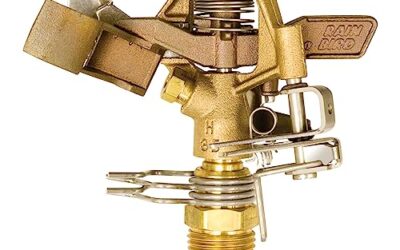
- Head: brass impact
- Series connection: flow-through outlet, supports single or series use
- Coverage: up to 90 ft diameter / 6,360 sq ft in full-circle mode
- Pattern: adjustable

- Head: all-metal pulsating (impact)
- Series connection: double connection, designed to be used as part of series
- Coverage: up to 100 ft diameter
- Pattern: adjustable 30–360 degrees
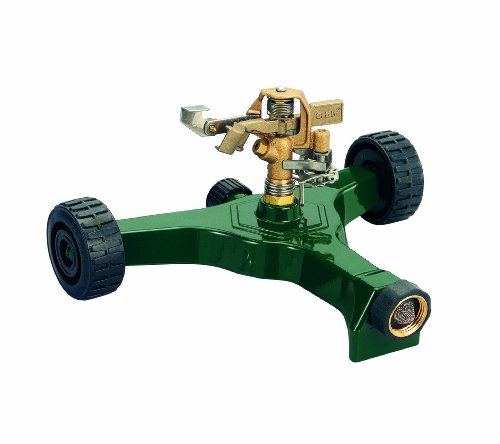
- Head: brass impact
- Series connection: flow-through outlet, supports series connection
- Base: metal wheel base
- Model: 56186N
All 5 Picks at a Glance
| Product | Specs | Action |
|---|---|---|
| 1. Orbit 58214N Brass Impact Sprinkler on Metal Step Spike — OUR TOP PICK |
| Check price on Amazon |
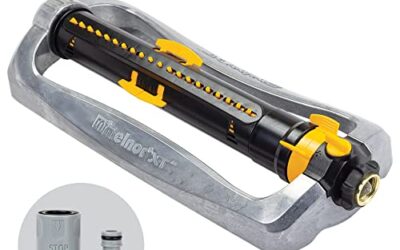
| 2. Melnor 9536H All Metal Pulsating Sprinkler with Step Spike |
| Check price on Amazon |
| 3. Orbit 56186N Brass Impact Sprinkler on Wheel Base |
| Check price on Amazon |
 4. STYDDI Deluxe Pulsating Impact Sprinkler with Heavy Duty Metal Base (HG119) |
| Check price on Amazon |
 5. Gilmour Pattern Master 196SPB |
| Check price on Amazon |
Key takeaways
- Five impact sprinklers that can run in series, compared on their flow-through outlets, throw, base type and pattern adjustment — plus how daisy chaining affects pressure along the chain.
Key takeaways
- Daisy chaining only works with sprinklers built for it: every pick here has a flow-through outlet or dual connection stated in its own listing, so water can pass through one unit to feed the next.
- Brass impact heads dominate this pool because the head has to survive season after season of pulsing; the bases vary — step spike, wheel base and weighted sled — to suit different soils and habits.
- Pressure falls along a chain. The sprinklers nearest the tap throw furthest, so plan the layout with the longest-throw unit where the chain needs it most.
- Two picks need a manual check before you rely on them: the STYDDI HG119 has a stock-risk flag, and the Gilmour 196SPB’s listing identity should be confirmed on the page itself.
Quick answer
If you want one chain-ready impact sprinkler to build around, start with the Orbit 58214N brass impact sprinkler on its metal step spike — its listing states a flow-through outlet for single or series use, and the brass head is the durable default. For the longest throw in the pool, the Melnor 9536H pairs an all-metal pulsating head with a stated double connection for series use. The other three picks solve specific problems: a wheel base for chains that move often, a weighted sled for hard ground where spikes will not go in, and a pattern ring for chains run along beds and borders.
As an Amazon Associate, we earn from qualifying purchases.
What daisy chaining actually requires
Running sprinklers in series sounds simple — hose to the first sprinkler, a short hose from the first sprinkler to the second, and so on — but an ordinary sprinkler cannot do it. A standard impact sprinkler has one inlet and no way out: water arrives, sprays, and stops there. A chainable sprinkler adds a second connection. Depending on the model, the listing describes it as a flow-through outlet, a double connection, or an extra hose connector, and that outlet is where the next length of hose attaches.
That is why every sprinkler in this roundup is here on evidence, not assumption. Each pick’s own listing or specification record states its series connection in its own words, and each product section below describes that connection exactly as its listing states it. If a sprinkler’s listing does not mention a flow-through or series connection, do not assume one is hidden in the base — the excluded models section of our research was full of good impact sprinklers that simply never claim the feature.
The second thing to understand is pressure. Each sprinkler in a chain takes its share of water and passes the rest along at reduced pressure, so throw shrinks as you move away from the tap. In practice that means short chains — two or three units — behave predictably, while long chains leave the last sprinkler dribbling a small circle. Layout matters too: the chain covers ground as a series of overlapping circles or arcs, and spacing the units so their patterns overlap slightly gives even coverage without dry seams.
How to Choose
Confirm the series connection in the listing
This is the whole game. Look for the listing’s own wording — flow-through outlet, double connection, daisy-chain capable — and treat anything vaguer as a no. The five picks here each carry that wording in their listing or specification record.
Match the base to your soil
Step spikes are fast to place and hold well in ordinary soil, and most chain layouts use them because each station is just pushed in. A wheel base rolls between stations, which suits chains that are repositioned for every session. A weighted sled sits on top of the ground — the answer for hard, dry or rocky soil where a spike will not seat, and for paved-adjacent strips where there is nothing to spike into.
Plan throw around falling pressure
Put the longest-throw sprinkler where the chain needs the most reach, and expect each subsequent unit to throw less than its headline figure. Headline coverage numbers are single-sprinkler figures at full pressure; in a chain they are ceilings, not per-station promises.
Decide how much pattern adjustment you need
A chain across an open lawn can run full circles. A chain along beds and borders needs partial-circle adjustment at each station, and one pick here adds a pattern ring that varies the throw as the head turns — the tool for shaped coverage rather than plain circles.
Quick Comparison
| Product | Series connection (as listed) | Coverage (up to) | Base | Best For |
|---|---|---|---|---|
| Orbit 58214N Brass Impact | Flow-through outlet | 6,360 sq ft / 90 ft diameter | Metal step spike | The default chain pick |
| Melnor 9536H Pulsating | Double connection | 100 ft diameter | Die-cast zinc step spike | Longest throw |
| Orbit 56186N Brass Impact | Flow-through outlet | — | Metal wheel base | Chains that move often |
| STYDDI HG119 Deluxe Pulsating | Flow-through outlet | 6,360 sq ft / 90 ft diameter | Weighted sled | Hard or rocky soil |
| Gilmour Pattern Master 196SPB | Daisy-chain capable, extra hose connector included | 5,800 sq ft | Polymer sled | Shaped coverage along beds |
The Picks
1. Orbit 58214N Brass Impact Sprinkler on Metal Step Spike — OUR TOP PICK
- Head: brass impact
- Series connection: flow-through outlet, supports single or series use
- Coverage: up to 90 ft diameter / 6,360 sq ft in full-circle mode
- Pattern: adjustable
The Orbit 58214N is the sprinkler to build a chain around. Its product information states a flow-through outlet that supports single or series use — run it alone, or connect the next hose at the outlet and keep going. The impact head is brass, the traditional material for this mechanism because it shrugs off the constant pulsing and the grit that garden water carries.
In full-circle mode the head covers up to 90 ft diameter, rated at 6,360 sq ft, and the pattern is adjustable for partial arcs. The metal step spike presses into the soil with a foot, which makes setting each station of a chain quick: spike, connect, move to the next.
2. Melnor 9536H All Metal Pulsating Sprinkler with Step Spike
- Head: all-metal pulsating (impact)
- Series connection: double connection, designed to be used as part of series
- Coverage: up to 100 ft diameter
- Pattern: adjustable 30–360 degrees
The Melnor 9536H brings the longest throw in this pool — up to 100 ft diameter — from an all-metal pulsating head. Its listing copy states the series feature directly: the sprinkler is “designed with a double connection so it can be used as part of series.” That wording is exactly what a daisy-chain buyer needs to see.
The pattern adjusts from 30 to 360 degrees, so the same unit can run a narrow wedge at the end of a chain or a full circle in the middle of one. The step spike is die-cast zinc, and the listing carries a 2-year limited warranty. Placed early in a chain where pressure is highest, its long throw covers the big rectangular stretches; placed last, expect less than the headline diameter.
3. Orbit 56186N Brass Impact Sprinkler on Wheel Base
- Head: brass impact
- Series connection: flow-through outlet, supports series connection
- Base: metal wheel base
- Model: 56186N
The Orbit 56186N answers a practical annoyance: chains that get set up, torn down and repositioned for every watering. Its product record states a flow-through outlet supporting series connection, and the brass impact head rides on a metal wheel base, so instead of pulling a spike and re-setting it at the next station, you roll the unit to where it goes.
The record for this model also lists a zinc step spike among its components, but the defining feature is the wheel base — it is the mobility pick in this pool. For a chain that lives permanently in one layout, a spike base is simpler; for a chain that follows the dry patches around a large yard, wheels win.
4. STYDDI Deluxe Pulsating Impact Sprinkler with Heavy Duty Metal Base (HG119)
- Head: pulsating impact, zinc-alloy and brass construction
- Series connection: flow-through outlet — single unit or connected in series
- Coverage: up to 6,360 sq ft / 90 ft diameter
- Base: weighted sled, 907 g / 2 lb
The STYDDI HG119 is the pick for ground a spike cannot handle. Its listing copy carries a “FLOW THROUGH OUTLET” bullet — usable as a single unit or connected in series — and the sprinkler sits on a weighted sled base of 907 g (2 lb) instead of a spike, so it works on hard, dry or rocky soil and on surfaces where nothing can be pushed in.
Coverage is rated up to 6,360 sq ft with a 90 ft diameter, matching the top pick’s reach, and the construction is zinc-alloy and brass. One caution, stated plainly: this listing carries a stock-risk flag from our research, so check the listing first before planning a chain around it — if it is unavailable, build the chain from the other picks rather than substituting a sprinkler whose listing never claims a flow-through outlet.
5. Gilmour Pattern Master 196SPB
- Head: impact, with pattern-master adjustment ring
- Series connection: daisy-chain capable; extra hose connector included
- Coverage: up to 5,800 sq ft
- Base: polymer sled base
The Gilmour Pattern Master 196SPB is the shaping pick. The specification record for this model (MPN 819603-1011) lists it as daisy-chain capable, with an extra hose connector included for the series connection — the connector is part of the package rather than an accessory to hunt down. Its pattern-master adjustment ring varies the pattern as the head rotates, which suits a chain run along beds and borders, where each station needs a shaped arc rather than a full circle sprayed over the planting.
Coverage is rated up to 5,800 sq ft, and the base is a polymer sled. Because the evidence behind this model’s listing identity is thinner than the other picks’, confirm the page you open is the 196SPB Pattern Master before ordering — model number and the pattern ring are the identifiers to match.
Care and Placement
Lay the chain out before you turn the water on. Connect every unit, set each pattern, then pressurise the line and walk the chain adjusting arcs so the circles overlap slightly. Adjusting a live chain station by station is far easier than re-laying hoses mid-session.
Mind the hose between stations. Each link in the chain is a short hose run; kinks and crushed sections cost pressure the last sprinkler cannot spare. Keep runs as short as the spacing allows and avoid driving or stepping on charged hoses.
Flush the heads at the start of the season. Impact heads pulse thousands of times per session and grit is their enemy. Run each sprinkler alone at full pressure for a minute before chaining, and check that the arm snaps back crisply — a lazy arm usually means debris, not a dead sprinkler.
Store the chain as a kit. Coil the short connector hoses with the sprinklers, and keep the Gilmour’s extra hose connector with its unit. Series hardware has a way of scattering across a garage over winter.
Frequently Asked Questions
How many impact sprinklers can I daisy chain?
There is no universal number — it depends on your water pressure and hose diameter. Each unit passes reduced pressure to the next, so throw shrinks along the chain. Two or three units behave predictably on typical household pressure; beyond that, test the last station’s throw before committing to a layout.
Does every impact sprinkler support daisy chaining?
No. Most impact sprinklers have a single inlet and no outlet. Only models whose listing states a flow-through outlet, a double connection or daisy-chain capability can run in series — all five picks here state it in their own listing or specification record, in the words quoted in their sections.
Which sprinkler should go first in the chain?
The one that needs the most reach. The first station sees full pressure, so give it the longest-throw job — the Melnor 9536H’s up-to-100 ft diameter, for example — and let later stations cover smaller arcs where reduced throw matters less.
Spike, wheel or sled base for a chain?
Spikes are the fastest to set and the default for ordinary soil. The wheel base suits a chain you reposition often. The weighted sled is for hard or rocky ground where a spike will not seat — that is the STYDDI HG119’s reason to exist.
Can I mix brands in one chain?
Yes — the connections are standard hose threads, and each unit’s flow-through outlet feeds the next hose regardless of brand. What matters is that every unit in the chain genuinely has a series connection, and that you plan throw around the pressure drop.
Conclusion
Daisy chaining is a feature, not a given: the chain only works when every sprinkler in it was built to pass water along. The Orbit 58214N is the safe foundation — brass head, flow-through outlet, step spike. The Melnor 9536H adds the pool’s longest throw, the Orbit 56186N adds wheels for chains that move, the STYDDI HG119 covers ground too hard for spikes (check its listing first), and the Gilmour 196SPB shapes coverage along beds with the series connector included in the box. Build the chain from listings that state the connection, and the layout will do the rest.
Product and ASIN Reference
| Product | ASIN |
|---|---|
| Orbit 58214N Brass Impact Sprinkler on Metal Step Spike | B0009H53D8 |
| Melnor 9536H All Metal Pulsating Sprinkler with Step Spike | B00004SE08 |
| Orbit 56186N Brass Impact Sprinkler on Wheel Base | B002EIVW44 |
| STYDDI Deluxe Pulsating Impact Sprinkler (HG119) | B0CPHW5LVP |
| Gilmour Pattern Master 196SPB | B00Y65SS8G |