Key takeaways
- Heavy duty shocks for towing compared: an adjustable Rancho RS9000XL set and Monroe Max-Air air-adjustable shocks, with fitment and load guidance for trucks.
Towing exposes every weakness in a truck’s rear suspension. Tongue weight compresses the rear springs, the nose rises, steering feel goes light, and on a rough road the trailer starts a slow porpoising bounce that the stock shocks were never valved to control. Heavy duty shocks for towing attack that problem in two different ways: firmer, fade-resistant damping that keeps the body composed, and, in the case of air-adjustable designs, actual load support that restores ride height. The two options below represent those two philosophies, and both are built for full-size American trucks that work with a trailer behind them.

One warning applies to every shock purchase and matters more than any brand choice: shocks are vehicle-specific parts. Length, mounting points and valving are matched to a particular truck, axle and drive configuration. Confirm the exact application for your year, model, cab and drivetrain with the maker’s fitment data before ordering, because a shock that is one inch wrong in extended or compressed length will either top out or bottom out in service.
Disclosure: As an Amazon Associate, this site may earn from qualifying purchases made through links in this article, at no additional cost to you.
The Picks at a Glance
- Rancho RS9000XL Adjustable Shocks Set (Ford F-350 Super Duty 4WD, 2005–2016) — nine-position adjustable damping you can firm up for towing and soften for daily driving.
- Monroe Max-Air MA830 Air Adjustable Shocks (pair) — air-inflatable rear shocks that add up to 1,200 lb of load-leveling support for GM full-size trucks and SUVs.
Rancho RS9000XL Adjustable Shocks Set
ASIN: B07RGYXFPJ
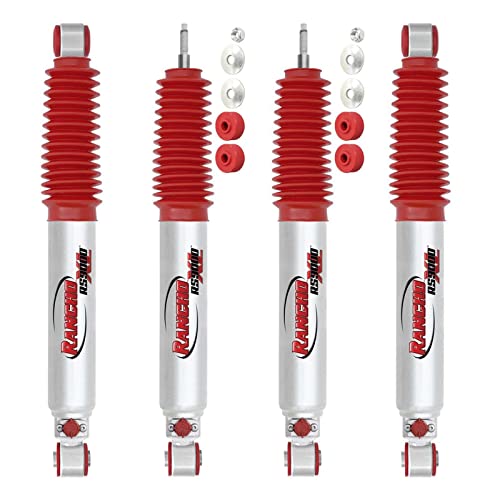
The RS9000XL line is Rancho’s answer to the truck that does two jobs. This set covers the 2005–2016 Ford F-350 Super Duty 4WD, pairing front shocks (part RS999042) with rears (part RS999254), and its defining feature is a nine-position adjustment knob on each shock body. Turn the dial toward the firm end and damping stiffens to control trailer sway and bounce; turn it back for an unloaded commute and the ride softens again. Rancho’s own guidance places settings 1–3 near original-equipment feel, 4–6 slightly firmer, and 7–9 for towing and heavy loads.
The hardware supports the brief. The reserve tube is a large 2.75-inch body that holds more oil and runs cooler than a standard twin-tube, which is what resists damping fade on long grades where the shocks work continuously. The piston rod is an 18 mm chromed unit, the shocks are nitrogen gas pressurized to reduce aeration and foaming, and the kit includes the washers, bushings and nuts needed to mount them on factory points. Rancho backs the line with a limited lifetime warranty and a 90-day ride guarantee.
Choose this set if your Super Duty alternates between empty daily driving and towing, and you want one suspension setup that adapts to both instead of a permanently stiff ride.
Monroe Max-Air MA830 Air Adjustable Shocks
ASIN: B004J2DIHM
The Max-Air takes the other route to towing control: instead of only damping motion, it helps carry the load. Each shock in this rear pair contains an air chamber that can be inflated up to 150 PSI, and Monroe rates the pair to maintain level ride height with up to 1,200 lb of additional weight — the tongue weight of a mid-size trailer is exactly the use case. Deflate the shocks and the truck returns to its unloaded stance; the air fitting is designed to resist leakage and can tie into a factory air system where fitted or be filled manually with a compressor, using Monroe’s AK air line kits where the application requires them.
Fitment covers the GM full-size family: Chevrolet Tahoe, Suburban and Avalanche, GMC Yukon and Yukon XL, and Cadillac Escalade of the relevant generations, in the rear position. Extended length is 23.94 inches. Because these are air shocks, installation includes routing an air line, and Monroe notes that vehicles without a factory rear air leveling system need the AK29 adapter kit to add air adjustability. The valving itself is full-displaced on both compression and extension strokes, so the shock still behaves as a damper, not just an air bag in a tube.
Choose the Max-Air pair if your GM truck or SUV squats visibly under tongue weight and restoring level ride height — with the steering geometry and headlight aim that come with it — is your main goal.
Damping Shocks Versus Load Support: Know What You Are Buying
Conventional heavy duty shocks, including adjustable ones like the RS9000XL, do not raise ride height and do not increase payload capacity. They control how fast the suspension moves, which is why they fix bounce, sway and wallow. Air-adjustable shocks and coil-over load carriers are the exception: they add a modest amount of spring support alongside damping. Neither type raises the truck’s legal gross vehicle weight figure, and neither substitutes for a weight-distributing hitch on a heavy trailer. Match the tool to the symptom: bounce and sway call for damping; visible sag calls for load support, and many working trucks benefit from the damping first.
Fitting and Setup Notes for Towing
Install shocks in axle pairs, never singly, and replace worn mounting bushings while the hardware is off. With adjustable shocks, start towing at a mid-firm setting and adjust one step at a time; the correct setting is the firmest one that does not make the unloaded ride harsh on your regular routes. With air shocks, inflate with the trailer hitched and the load in place, measure ride height at the fender, and aim to restore the unloaded height rather than exceed it — over-inflation lifts the rear, unloads the front tires and worsens steering. Recheck air pressure at fuel stops on long trips, because temperature changes move it.
What “Heavy Duty” Actually Means in a Shock
Heavy duty is not a regulated term, so it pays to know which construction details genuinely separate a towing shock from a standard replacement. The first is oil volume: a larger body or a reserve tube carries more fluid, and more fluid runs cooler, and cooler fluid keeps its damping character over a long grade instead of thinning and fading. The second is the piston rod and its seals; towing cycles the suspension constantly, so a thicker, hard-chromed rod and quality seals determine whether the shock is still dry at the rod in two years or weeping oil. The third is valving tuned for load: firmer low-speed compression control is what resists the slow, heavy motions of a trailer pushing the truck around, as distinct from the sharp, small motions of potholes. Gas pressurization, usually nitrogen, is the fourth marker — it keeps the oil from foaming under rapid cycling, and foam is compressible, so a foaming shock is a shock that has temporarily stopped working. When a listing like the Rancho’s states body diameter, rod diameter, pressurization and warranty terms, those are the numbers to compare; when a listing says only “heavy duty” in large type, treat it as a slogan rather than a specification.
Symptoms That Point at the Shocks — and Symptoms That Do Not
Porpoising, the rhythmic front-to-back pitching that builds on concrete-slab highways with a trailer attached, is the signature shock symptom, along with continued bouncing after a bump, trailer sway that arrives late and leaves late, and a truck that leans and wallows through ramps it used to take flat. Visible oil on the shock body and cupped, scalloped tire wear confirm the diagnosis. Just as important is what shocks will not fix: sag that is present the moment the trailer is coupled is a spring or load problem, not a damping problem; vibration at a steady highway speed is usually tire balance or driveline angle; and a trailer that sways violently at moderate speed is often loaded with too little tongue weight, which no shock can compensate for. Working through the symptom honestly saves the cost of replacing good parts — and when the symptom really is uncontrolled motion, fresh heavy duty damping is one of the most noticeable upgrades a tow vehicle can get.
Finally, a word on mixing old and new. Replacing only the rear shocks on a truck whose fronts are equally old leaves two different damping rates on one vehicle, and the mismatch shows up as a front end that still floats for a moment after the rear has settled. If budget forces you to stage the work, do the loaded axle first, as this guide advises — but plan the second axle soon after, and treat the interval between the two jobs as a compromise rather than a finished setup.
Frequently Asked Questions
Do heavy duty shocks increase my truck’s towing capacity?
No. Tow figures are set by the manufacturer from the whole vehicle. Shocks improve control and stability within those figures; they never raise them.
Should I replace front shocks too, or only the rears?
Towing loads the rear hardest, so a rear upgrade gives the biggest single improvement. A matched set on both axles, like the Rancho kit above, keeps damping balanced when the trailer pushes the truck around in crosswinds.
Are air shocks a substitute for air helper springs?
They overlap in purpose but helper springs carry more load and are the better tool for constant heavy payloads. Air shocks suit occasional towing where the support is needed only when the trailer is attached.
How long do towing shocks last?
Heat is the main killer, and towing generates it. Inspect for oil leaks, damaged bushings and loss of damping at every tire rotation, and expect a working truck to consume shocks faster than a commuter car does.
Can I install these myself?
On most trucks, yes, with a jack, stands and hand tools, because shocks are external bolt-on parts. Air shocks add line routing. Anything involving compressed springs, as on strut-equipped vehicles, is a different and more hazardous job.
Verdict
For the Ford Super Duty owner who tows one week and commutes the next, the Rancho RS9000XL set (B07RGYXFPJ) is the flexible answer: nine damping settings, a large oil capacity for fade resistance, and full front-and-rear coverage in one kit. For the GM truck or SUV owner whose problem is rear sag under tongue weight, the Monroe Max-Air MA830 pair (B004J2DIHM) adds genuine load leveling to its damping. Confirm the application for your exact truck before ordering either, and set them up with the trailer attached — that is where towing shocks earn their keep.