Our Short List of 3
All 5 Picks at a Glance
| Product | Specs | Action |
|---|---|---|
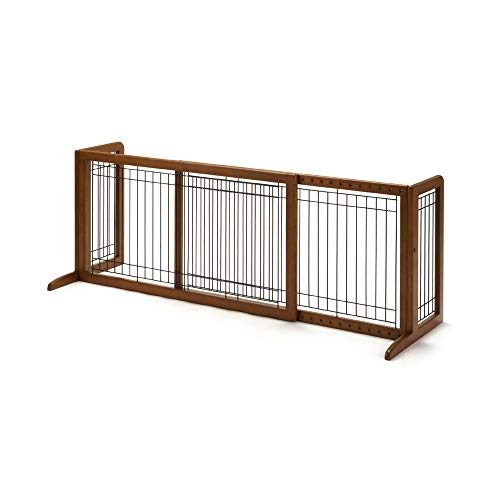 Richell Wood Freestanding Pet Gate, Large | Check price on Amazon | |
 PAWLAND Wooden Freestanding Foldable Pet Gate, 4 Panels, 24 Inches | Check price on Amazon | |
 Primetime Petz 360 Configurable Gate with Door, 24 Inches, Walnut | Check price on Amazon | |
 Arf Pets Freestanding Dog Gate with Door, 4 Panels | Check price on Amazon | |
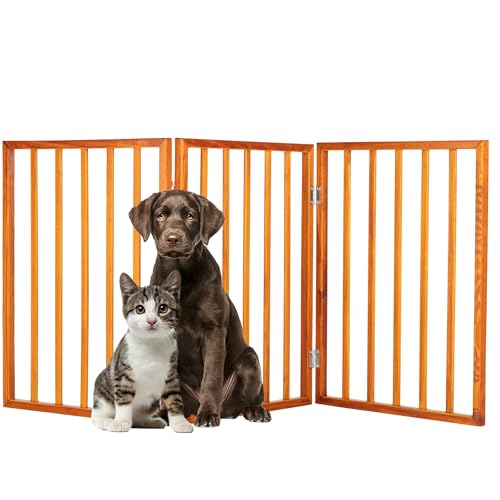 PETMAKER 3-Panel Freestanding Pet Gate, Mahogany | Check price on Amazon |
Key takeaways
- Freestanding pet gates that divide a hallway with no drilling and no pressure mounts. Compare five gates by usable width, height, doors and stability aids.
As an Amazon Associate, we earn from qualifying purchases made through links on this page.
A hallway is the natural choke point of a house, which makes it the easiest place to separate a dog from bedrooms, a home office, or a front door it likes to charge. The problem is that most gates want something from the hallway itself: screws in the trim, or pressure pads wedged against both walls. A freestanding pet gate asks for nothing. It stands on its own feet or side panels, can be lifted away when guests arrive, and leaves rental walls and painted woodwork untouched.
Every gate in this roundup meets two conditions taken from the manufacturers’ own documentation. First, it is genuinely freestanding: no drilling, no tension mounting, and no wall cups required to keep it upright. Second, its published width and height suit hallway use, meaning it can cover a typical corridor opening of roughly three to six feet while leaving enough panel length to angle for stability. Pressure-mounted and hardware-mounted gates were left out on purpose, even when the same brand sells them, because they fail the first condition.
One honest limitation applies to the whole category. A freestanding gate is a visual and physical boundary for a dog that respects barriers, not a locked door. Manufacturers design these gates for calm to average dogs, and a determined jumper or a heavy dog that leans its full weight on a panel can move one. If that describes your dog, treat the taller and heavier picks here as the realistic shortlist, and read the height and weight figures more carefully than the width figures.
What to Look for in a Freestanding Hallway Gate
Usable span is not the same as flat length. Folding gates only stand securely when their panels are angled into a zigzag, and angling consumes length. A gate that measures 80 inches laid flat typically covers about 72 inches of opening. Compare your hallway measurement against the usable span the brand publishes, not the flat measurement, and leave a small margin rather than planning to stretch a gate to its absolute limit.
Height decides which dogs the gate can hold. Step-over models in this roundup stand between about 20 and 24 inches tall. That is plenty for small dogs, puppies, and older dogs, and it lets adults pass without opening anything. Dogs that jump, and medium or large dogs that can simply look over a two-foot barrier, need the taller end of the range, around 31 to 32 inches.
Stability comes from feet, side panels, and weight. Look for rubber feet or pads that grip hard floors, support feet that widen the footprint, or fixed side panels that stop the gate tipping forward or back. Heavier gates, roughly 20 to 30 pounds, resist being pushed better than very light ones, at the cost of being slower to move out of the way.
A walk-through door matters in a busy hall. If people cross the barrier all day carrying laundry, shopping, or a child, a hinged door with a latch is worth having. If the hall is crossed a few times a day, a step-over gate is simpler, has no latch to fail, and is usually lighter.
Materials set the maintenance and chewing picture. Most freestanding gates are wood, because wood gives the weight and furniture look this category is known for. Wood can be chewed by a committed chewer, so pair any wooden gate with supervision for puppies. Slat spacing matters for small dogs and cats: gaps around two inches keep small heads from poking through.
Measure before anything else. Note the hallway width at its narrowest point, check whether baseboards reduce the clear opening, and confirm the floor is level. A freestanding gate on an uneven floor rocks, and a rocking gate slides.
The Five Gates Compared
Richell Wood Freestanding Pet Gate, Large
Richell takes a different approach from the folding gates below. Instead of hinged panels, the Wood Freestanding Pet Gate slides to the width of the opening, adjusting from 39.8 to 71.3 inches, so it covers everything from a standard corridor to a wide hall entrance with one unit. It stands 20.1 inches tall and 17.7 inches deep, and the depth comes from the patented side panels at each end, which brace the gate so it cannot tip forward or backward. The frame is rubberwood with a steel wire interior, rubber feet keep it from sliding on hard floors, and it weighs just under 16 pounds, so moving it between rooms is easy.
Richell rates this gate for small dogs between 6.6 and 17.6 pounds, and that weight range defines both its audience and its ceiling. It suits small breeds, cats, and calm dogs in a hallway that adults cross often, because the low height is simple to step over. The limitations follow from the same numbers: at 20.1 inches it will not slow down a dog that jumps, the side panels claim floor space at both ends of the opening, and Richell does not sell extension panels for this model, noting that adding panels would compromise the design. There is no door, so every crossing is a step-over.
PAWLAND Wooden Freestanding Foldable Pet Gate, 4 Panels, 24 Inches
PAWLAND’s four-panel gate is the accordion pattern done carefully. Opened out it measures 80.3 inches wide and 24 inches tall, and folded into its working zigzag it covers openings up to 72 inches, which spans a double doorway or a wide hall. It arrives fully assembled, folds down to 20.5 inches wide and 3 inches deep for storage in a closet, and the slats are spaced 2 inches apart. The frame is FSC-certified wood with metal hinges and non-slip rubber feet, and at about 20 pounds it is heavy enough that a mid-size dog pushing at it meets real resistance.
This is the pick for renters and for anyone who expects to move the barrier often, because nothing about it touches a wall and setup is simply unfolding it. The limitations are the usual ones for the type, stated plainly: 24 inches of height suits small and medium dogs that respect a barrier, not jumpers; there is no walk-through door, so people step over it; and because it must sit angled to stand, a narrow hallway loses a few inches of its width to the fold. The wood frame can also be chewed by a puppy left alone with it.
Primetime Petz 360 Configurable Gate with Door, 24 Inches, Walnut
Primetime Petz builds the 360 around hinges that rotate a full 360 degrees, so the panels can be arranged in almost any shape a hallway demands, including angled runs where the corridor turns. The panels total 81.6 inches laid flat, and the manufacturer’s instruction manual rates the gate for spans up to 72 inches. What separates it from the other step-over-height gates here is the walk-through door built into one panel: it swings in both directions and locks with a one-handed, spring-loaded bolt, so people pass through instead of climbing over. Construction is solid wood with a walnut finish, rubber pads protect the floor, and the gate weighs about 20 pounds. Support feet and two-panel extension kits are available from the brand as separate accessories for wider or less stable placements.
Choose this one when the hallway is a through-route and a step-over gate would be climbed fifty times a day. The limitations: at 24 inches tall it is still a small-to-medium-dog barrier despite the door; stability depends on keeping the panels angled, since a freestanding run laid perfectly flat is easier to push; and the base package does not include the support feet, so budget the setup around the gate alone unless you add them. The manufacturer is also explicit that this is a pet gate and was not designed as a child safety gate.
Arf Pets Freestanding Dog Gate with Door, 4 Panels
The Arf Pets gate is the heavyweight of this group in both senses. Four wooden panels run 80 inches wide and stand 31.5 inches tall, the greatest height here, and the unit weighs 30.4 pounds. It includes a hinged walk-through door and, importantly for a hallway, a pair of stabilizing support feet in the box, which widen the footprint and help the freestanding frame resist being knocked down. The panels join on 360-degree hinges, so the gate can zigzag across a hall, fold flat against a wall, or connect into a free-standing pen, and the brand sells additional panels for owners who later want a longer run. The finish is a rich espresso with a carved bone detail along the top rail.
This is the realistic choice for medium and larger dogs that are not jumpers, and for wide halls where a 24-inch gate looks and performs like a suggestion. The limitations are the flip side of its strengths: 30 pounds is a lot to shift every time you want the hall fully open, an 80-inch flat length must be folded down significantly to fit a standard hallway, which uses floor depth, and the wooden panels can be chewed, so a determined chewer needs supervision around it.
PETMAKER 3-Panel Freestanding Pet Gate, Mahogany
PETMAKER’s three-panel gate is the compact option, built for the narrower openings the bigger gates handle awkwardly. It measures 54 inches laid flat and 24 inches tall, and the brand rates it for blocking openings from 33 to 46 inches wide once it is angled into its accordion fold, which is exactly the span of a standard interior hallway or doorway. The construction is MDF wood in a mahogany finish, it folds flat for storage or travel, and its light weight makes it the easiest gate here to pick up and relocate several times a day.
Pick it for a puppy, a cat, or a small dog in a standard-width hall, especially in a smaller home where an 80-inch gate would be mostly folded bulk. The limitations match its size: there is no door, the 24-inch height is a step-over barrier for small pets only, the light frame can be shifted by a heavier dog leaning on it, and MDF is less forgiving of chewing and knocks than the solid wood frames above it.
Comparison Table
| Gate | Walk-through door | Usable span | Height | How it stays upright |
|---|---|---|---|---|
| Richell Wood Freestanding Pet Gate, Large | No | Adjustable, 39.8 to 71.3 in | 20.1 in | Fixed side panels, rubber feet |
| PAWLAND Wooden Freestanding Foldable, 4 Panels | No | Up to 72 in | 24 in | Zigzag fold, non-slip rubber feet |
| Primetime Petz 360 Configurable with Door, 24 in | Yes | Up to 72 in | 24 in | Angled panels, rubber pads |
| Arf Pets Freestanding Dog Gate with Door, 4 Panels | Yes | Up to 80 in flat, angled in use | 31.5 in | Support feet included, angled panels |
| PETMAKER 3-Panel Freestanding, Mahogany | No | 33 to 46 in | 24 in | Accordion fold |
Frequently Asked Questions
Will a freestanding gate work in a hallway without touching the walls?
Yes. Freestanding gates stand on their own feet, side panels, or angled folds, so they can sit inside a hallway opening without pads pressing on the walls or screws in the trim. Leave the gate angled or braced as the manufacturer directs, because that geometry, not wall contact, is what keeps it upright.
How do I measure my hallway for one of these gates?
Measure the clear width at the narrowest point, accounting for baseboards, then compare it with the usable span rather than the flat length. Folding gates lose several inches to their zigzag, so a gate listed at 80 inches flat generally covers about 72 inches of opening. The Richell is the exception here, since its width adjusts directly to the opening between 39.8 and 71.3 inches.
Can a freestanding gate hold back a large dog?
Only within limits. These gates are boundaries, not restraints, and manufacturers rate them for dogs that respect a barrier. The Arf Pets gate, at 31.5 inches tall and 30.4 pounds with support feet included, is the sturdiest option in this roundup. A large dog that jumps barriers or leans hard on panels needs a mounted gate instead, which is a different product type than the ones covered here.
Should a hallway gate have a door or be step-over height?
It depends on traffic. In a hall that people cross constantly, a latched walk-through door, like the ones on the Primetime Petz and Arf Pets gates, saves real effort. In a hall crossed a few times a day, a step-over gate is simpler, lighter, and has no latch to wear out.
How do I stop a freestanding gate sliding on hard floors?
Use the rubber feet or pads the gate ships with, keep the panels angled rather than flat, and add support feet where the brand provides or sells them. Sliding usually means the gate is standing too straight, the floor is uneven, or the dog has learned to push at one end, where a wider footprint helps most.
Conclusion
For most hallways, the choice comes down to traffic and dog size. The PAWLAND four-panel gate is the balanced default: wide usable span, honest 24-inch height, no assembly, and nothing touching the walls. If people pass through all day, the Primetime Petz 360 adds a latched door at the same height, while the Arf Pets gate is the one to pick for taller dogs and wider halls, with support feet included. Small dogs in standard openings are well served by the adjustable Richell, and the PETMAKER covers the narrow-hall, light-duty end of the range. Measure the opening first, match the usable span and height to your dog, and any of the five will divide a hallway without leaving a mark on it.