Key takeaways
- Two verified Kahtoola INSTAgaiter trail running gaiters compared by height, closure, strap design and weight, for keeping grit and stones out of trail shoes.
Disclosure: As an Amazon Associate, we earn from qualifying purchases.
Our top pick: Kahtoola INSTAgaiter Low. Runner-up: Kahtoola INSTAgaiter Mid.
A trail running gaiter has one job: keep grit, sand, small stones and trail debris out of your shoes so a long run does not turn into a series of stops to empty them. This guide covers two gaiters from the same Kahtoola line, the INSTAgaiter Low and the INSTAgaiter Mid, because those are the two models whose Amazon US listings could be verified for this guide. Other well-known trail gaiters exist, but their listings could not be verified here, so rather than pad the list with unverified products, this guide compares the two verified heights of one proven design and explains how to choose between them.
The two models share the same basic construction: a stretch fabric body that wraps the ankle and the top of the shoe, a lace hook at the front, an adjustable underfoot strap, and a side zipper for putting the gaiter on and taking it off. The real difference is coverage. The Low stands about 4.5 inches tall, and the Mid stands about 7.5 inches tall, so the choice between them comes down to how much of your ankle and lower leg you want covered, and how rough and loose the surfaces you run on tend to be.
Quick Picks
- Kahtoola INSTAgaiter Low — Best for most trail runners: the lighter, lower cut at about 4.5 inches, with a lace hook, side zipper and replaceable underfoot strap.
- Kahtoola INSTAgaiter Mid — Best for loose, rough trails: the same design at about 7.5 inches, for more coverage against scree, sand and brush.
Kahtoola INSTAgaiter Low

OUR TOP PICK
The INSTAgaiter Low is the gaiter most trail runners will reach for, and it is the top pick here because its Amazon US listing is the one that could be verified directly for this guide. It is a low-cut debris gaiter, about 4.5 inches tall, designed for trail running and hiking, with part number KT07-Low as recorded on the listing. That height is enough to cover the collar of a typical trail shoe and the ankle bone, which is where grit and small stones actually get in, without wrapping so much of the leg that it feels hot or restrictive on a summer run.
The attachment system is the heart of the design. At the front, a lace hook clips onto the shoe laces, which anchors the gaiter so it cannot ride up as you run. Under the shoe, an adjustable strap runs beneath the arch and holds the lower edge down against the shoe. Kahtoola calls this strap system DuraLink, and the important practical point is that the strap is replaceable: the underfoot strap is the part of any gaiter that wears first, because it is ground against rock and trail surfaces with every stride, so being able to swap in a fresh strap extends the life of the gaiter instead of forcing you to replace the whole thing. The strap is also adjustable, which matters because the right tension differs between a low-volume racing shoe and a high-volume cushioned trainer.
Entry and exit are handled by a side zipper. Many simple gaiters are pull-on sleeves that have to go on before the shoe, which means planning ahead at the trailhead and struggling if you want to remove them mid-run. A side zipper lets you put the INSTAgaiter on over a shoe that is already laced up, and take it off at an aid station or a road crossing without untying anything. For runners who only need gaiters on the loose sections of a route, that convenience is worth having.
As recorded for this line, the pair weighs roughly 2.0 to 2.7 ounces depending on size, which is light enough that you will not notice it on the shoe. The fabric is water-resistant, which in practice means it sheds splashes, dew-soaked grass moisture and light drizzle rather than soaking through immediately; it is not a waterproof boot cover, and it is not meant to keep your feet dry in stream crossings. What it does is keep the debris out, and keep it out consistently, mile after mile, because the combination of lace hook, underfoot strap and close stretch fit leaves very few gaps for grit to work through.
Choose the Low if most of your running is on established trails, forest paths, gravel roads and moderate mountain routes, and if you want debris protection with the least possible bulk. It pairs well with the low-cut trail shoes most runners already own, and its height keeps it clear of the calf so it stays comfortable when the pace rises and your legs warm up.
It is also the easier of the two to live with across a full season. Because it covers less of the leg, it works with short socks as readily as with taller ones, and it packs down to almost nothing in a race vest pocket or a belt pouch when a route only needs gaiters for one loose descent. Runners who race will appreciate that the lace hook and strap can be set once, at home, and then largely forgotten: the gaiter goes on with the side zipper in seconds at the trailhead, and the strap tension rarely needs attention between runs on the same pair of shoes. That set-and-forget character is exactly what a piece of kit this simple should deliver, and it is why the Low, rather than the taller model, is the default recommendation for anyone buying their first pair of trail gaiters.
Specs
– Model: Kahtoola INSTAgaiter Low (part number KT07-Low, as recorded on the listing)
– Height: about 4.5 inches (low cut)
– Weight: roughly 2.0 to 2.7 ounces per pair, depending on size, as recorded for this line
– Closure: side zipper
– Attachment: front lace hook and adjustable, replaceable DuraLink underfoot strap
– Fabric: water-resistant
Pros
– Low 4.5-inch cut covers the shoe collar and ankle without wrapping the calf
– Lace hook plus adjustable underfoot strap keeps the gaiter seated while running
– Underfoot strap is replaceable, so the highest-wear part can be renewed on its own
– Side zipper allows fitting and removal over a laced shoe
– Very light, at roughly 2.0 to 2.7 ounces per pair
Cons
– Coverage ends at the ankle, so deep sand and high scree can still spill over the top
– Water-resistant fabric sheds splashes but is not waterproof
– Only one design in this guide, so there is no cross-brand alternative verified here
Kahtoola INSTAgaiter Mid
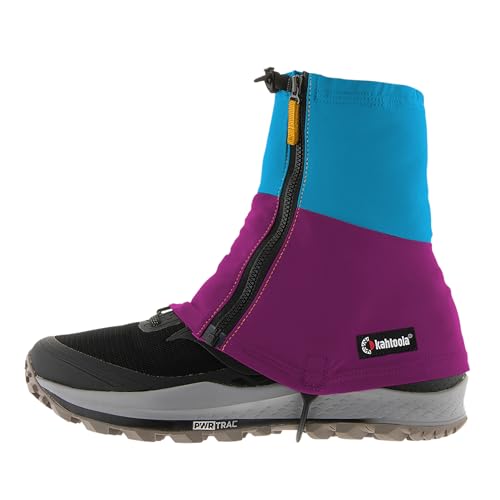
The INSTAgaiter Mid is the taller version of the same Kahtoola design, standing about 7.5 inches high instead of 4.5. Everything said about the Low’s attachment system applies here as well: the front lace hook, the adjustable and replaceable DuraLink underfoot strap, the side zipper, and the water-resistant fabric are shared across the line. What the extra three inches buy you is coverage up the lower leg, and whether that matters depends entirely on the terrain you run.
On loose surfaces, debris does not only arrive at shoe level. Running downhill through scree, sand or decomposed granite kicks material up behind you, and each stride throws grit against the back of the opposite leg. A low gaiter stops what enters at the shoe collar, but material kicked higher can land inside the top of a low gaiter or work down from above. The Mid’s extra height closes that gap. It is also the better choice for routes with brush, grass and low vegetation brushing the ankles, where a taller gaiter keeps seeds, twigs and thorns away from socks and skin, and for desert running, where fine sand gets everywhere and any extra seal helps.
The trade-offs are the obvious ones. More fabric means slightly more weight, though the line is recorded at roughly 2.0 to 2.7 ounces per pair, so the difference is small. More coverage also means a warmer lower leg, which some runners will notice on hot days, and a taller gaiter needs a sock height that works with it so the top edge sits comfortably. For runners whose trails are mostly smooth and firm, the Mid is more gaiter than they need; for runners who regularly descend loose slopes or cross sandy washes, it is the more secure option of the two.
One honesty note matters here. The Low’s listing was verified directly from its Amazon US product page for this guide. The Mid’s listing rests on thinner verification, drawn from a Kahtoola-branded mirror shop rather than a directly checked Amazon page, so confirm the exact model, size and strap details on the product page before ordering. The Mid is included because it is the same recorded product line and the natural taller alternative, but that difference in verification is stated plainly so you can weigh it.
Choose the Mid if your routes involve scree fields, sand, snow patches in shoulder seasons, overgrown singletrack, or long descents on loose ground, and if you would rather carry a little extra coverage than stop to empty a shoe. If your running is mostly on groomed trails and gravel, the Low covers the need with less fabric.
The Mid also suits runners who use gaiters as part of a layering habit rather than an occasional fix. On multi-day trips and long mountain outings, where the same shoes are worn for hours at a time and the terrain changes from forest track to open ridge to loose descent, the taller gaiter keeps working through all of it without needing to be swapped or adjusted. It guards the sock as well as the shoe, which matters when wet grass and mud would otherwise soak the ankle area long before the finish. None of that changes the fundamentals: the Mid still depends on the same lace hook, strap tension and close fit as the Low, and it should be fitted and checked the same way before a long day out.
Specs
– Model: Kahtoola INSTAgaiter Mid
– Height: about 7.5 inches (mid cut)
– Weight: roughly 2.0 to 2.7 ounces per pair, depending on size, as recorded for this line
– Closure: side zipper
– Attachment: front lace hook and adjustable, replaceable DuraLink underfoot strap
– Fabric: water-resistant
Pros
– Taller 7.5-inch cut guards against debris kicked up on loose descents
– Better coverage for sand, scree, brush and overgrown trails
– Same lace hook, side zipper and replaceable underfoot strap as the Low
– Still light, at roughly 2.0 to 2.7 ounces per pair
Cons
– Listing verification is thinner than the Low’s, so check the product page carefully before ordering
– Extra coverage can feel warm on hot days
– More gaiter than smooth, firm trails require
How to Choose
Start with height, because that is the real decision in this guide. A low gaiter at about 4.5 inches covers the shoe collar and ankle, which is where debris enters on most trails, and it does so with minimal weight and heat. A mid gaiter at about 7.5 inches adds protection up the lower leg for terrain that throws material higher: scree, sand, loose descents and brush. Honestly assess your usual routes. If you rarely stop to empty a shoe, a low gaiter is likely enough. If shaking out grit is a regular part of your long runs, the mid height earns its place.
Next, look at the attachment system, because a gaiter that migrates is a gaiter that leaks. A front lace hook anchors the gaiter to the shoe so the front edge cannot ride up, and an underfoot strap holds the bottom edge in place through the stride. Adjustability matters: the strap has to be tensioned to your shoe’s volume and sole shape, and a strap that can be replaced when it wears through is worth more than a slightly lighter fixed strap, because the underfoot strap is the part that takes the most punishment on rock.
Then consider how the gaiter goes on. A side zipper lets you fit the gaiter over a shoe that is already on your foot, and remove it mid-run without untying laces. Pull-on designs force you to dress your feet in the right order at the trailhead. If you think you will use gaiters only for certain sections, or you want to take them off when the route turns to road, a zipper design is the practical choice.
Fit and sizing come next. Gaiters are sized to shoe size and ankle circumference, and a gaiter that is too large will gap at the top and funnel debris in, while one that is too small will pull the strap out of position. Check the maker’s sizing guidance against your shoe size, and think about the shoes you will actually pair them with: a gaiter fitted to a slim racing shoe may sit differently on a wide, high-volume trainer.
Care and upkeep are worth a thought before buying, too. The underfoot strap should be rinsed and checked after muddy or sandy runs, because grit trapped against the strap accelerates wear, and a strap that is near the end of its life should be replaced before a big race or a long trip rather than during one. The fabric body benefits from a simple rinse and air drying; heavy detergents and high heat are not kind to stretch fabrics or water-resistant finishes. A gaiter that is easy to clean and has a replaceable strap, like the INSTAgaiter design in this guide, will usually outlast a sealed design that has to be discarded when one part fails.
Finally, be clear about what gaiters are not. A water-resistant trail gaiter keeps out grit, stones, sand and light moisture. It is not waterproof, it will not keep feet dry through stream crossings, and a low trail gaiter is not a mountaineering gaiter for snow travel with boots and crampons. Buying the right category matters more than buying the most features: for trail running, light weight, a secure strap and the right height are the whole game.
FAQs
Do trail running gaiters really keep stones out of shoes?
Yes, when they fit properly and stay seated. Most debris enters through the gap between the shoe collar and the ankle, and a gaiter bridges that gap. The combination of a lace hook at the front and an underfoot strap keeps the gaiter in position while running, which is what stops grit working in over the miles. A loose or oversized gaiter can gap at the top and let material in, so sizing matters as much as the design itself.
Should I choose the Low or the Mid height?
Choose the Low, at about 4.5 inches, for established trails, gravel and moderate routes where debris arrives at shoe level. Choose the Mid, at about 7.5 inches, for scree, sand, loose descents and overgrown trails where material is kicked higher or brushes the lower leg. Both share the same lace hook, side zipper and replaceable underfoot strap, so the decision is purely about coverage.
How long does the underfoot strap last?
It depends on the surfaces you run on, because the strap is ground against the trail with every stride and wears fastest on rock. The useful point with the INSTAgaiter design is that the DuraLink strap is replaceable: when it wears thin, you can fit a fresh strap and keep using the gaiter body, rather than replacing the whole gaiter. Check strap tension and condition before long runs, since a slack strap lets the gaiter shift.
Conclusion
For most trail runners, the Kahtoola INSTAgaiter Low is the top pick: a verified listing, a light 4.5-inch cut, a lace hook and side zipper, and a replaceable underfoot strap that extends the life of the gaiter. The INSTAgaiter Mid is the runner-up for runners whose routes throw debris higher, with the same attachment system and 7.5 inches of coverage, though its listing should be confirmed on the product page before ordering, as its verification is thinner. Either way, match the height to your terrain, size the gaiter to your shoes, and keep the strap tensioned, and the stops to empty your shoes should become rare.