Key takeaways
- Dust extractors that clean their own filters and carry HEPA filtration: compare the Makita VC4210L, Bosch VAC140AH and DeWalt DWV015 on airflow, tank size and cleaning cycles.
Fine construction dust defeats an ordinary vacuum in a predictable way: the filter loads up, suction fades, and the operator either stops to shake the filter clean or keeps working in a cloud. Automatic filter cleaning breaks that cycle by pulsing air through the filter during use, and HEPA filtration decides how much of the finest fraction stays captured instead of blowing back into the room. For renovation and silica-aware work, those two features together are the whole point of the machine.
This guide is for contractors, remodelers and serious workshop users connecting extractors to saws, sanders and grinders. Each pick below states both automatic filter cleaning and HEPA filtration on its Amazon listing, and certification language is used only where the listing itself uses it: one model here is described on its listing as carrying a certified-HEPA main filter, while the others state HEPA filtration without that word, and the difference is reported rather than smoothed over.
Quick Picks
As an Amazon Associate we earn from qualifying purchases.
| Product | Best for | Key spec from title |
|---|---|---|
| Makita VC4210L | Certified-HEPA wording and strong lift | 148 CFM, certified-HEPA main filter |
| Bosch VAC140AH | Frequent automatic cleaning cycles | Filter cleaning every 15 seconds, 150 CFM |
| DeWalt DWV015 | Highest airflow with tool-triggered use | 155 CFM, cleaning pulses every 30 seconds |
How to Choose
What automatic filter cleaning actually does
These systems reverse or pulse air through the filter at set intervals, knocking the dust cake loose so airflow stays near its clean-filter level. The interval is a real specification: one machine here cleans every 15 seconds, another pulses every 30 seconds, and Makita describes its system as an automatic filter-cleaning mechanism working during operation. Shorter intervals hold suction steadier under heavy dust loads such as drywall sanding, at the cost of more frequent pulses you can hear. Without the feature, the same jobs mean stopping to clean the filter by hand, repeatedly.
HEPA claims deserve exact reading
HEPA filtration is defined by capture efficiency at the hardest particle size, and the listings here quote capture of 99.97 percent of particles at 0.3 microns. Beyond the number, watch the wording. Makita’s listing describes a certified-HEPA main filter, which is the strongest claim in this guide and the reason it leads. The Bosch and DeWalt listings state HEPA filters with the same efficiency figure but do not use the word certified, so this guide does not apply it to them. For regulated work, the filter fitted on the day matters as much as the machine, since an extractor only meets HEPA-vacuum definitions with its specified HEPA filter installed.
Airflow and water lift pull in different directions
CFM describes how much air the extractor moves, which governs dust capture at a sander or saw hood. Water lift, or static pressure, describes pulling power against resistance, which matters for long hoses and fine filters. The spread here runs from 148 to 155 CFM and 90 to 97 inches of lift, all workable for tool extraction; the Bosch pairs its 150 CFM with the highest lift at 97 inches, suiting longer hose runs, while the DeWalt leads on raw airflow. Match the pair to your setup rather than chasing either number alone.
Tank size, bags and power draw
Tank capacities here run from 10 to 14 gallons, and bigger tanks mean fewer stops on demolition and floor work. Fleece filter bags, where supported, add a first filtration stage that protects the main filter and makes disposal cleaner, at a per-bag cost. Power draw spans 12 to 15 amps, which matters on shared site circuits: a 15-amp extractor plus a 15-amp saw on one breaker is a trip waiting to happen. Check the tool-actuation outlet rating on the listing if you plan to trigger the extractor from the tool, which is the normal way these machines are used.
The 3 Best Options
Makita VC4210L

The VC4210L leads this guide because its listing makes the strongest filtration claim of the three: a certified-HEPA main filter capturing 99.97 percent of particles 0.3 microns and larger, paired with an Automatic Filter-Cleaning System. Airflow is 148 CFM with 92 inches of water lift from a 12-amp motor, and the tank holds 11 gallons, a middle size that balances capacity against carrying weight. The lower amp draw also leaves more room on a shared circuit for the tool doing the cutting. For buyers whose work specifies HEPA in writing, this is the listing that answers in the same language.
Specs
- Tank: 11 gallons
- Motor: 12 amps
- Airflow: 148 CFM
- Water lift: 92 inches
- Filter cleaning: Automatic Filter-Cleaning System
- Filtration: Certified-HEPA main filter, 99.97 percent of particles 0.3 microns and larger, per the listing
Best for: Renovation and silica-aware work where the specification asks for certified HEPA filtration by name.
Watch out for: Keep the specified HEPA main filter fitted; swapping in a standard filter quietly removes the certified claim.
ASIN: B07ZMN75V2
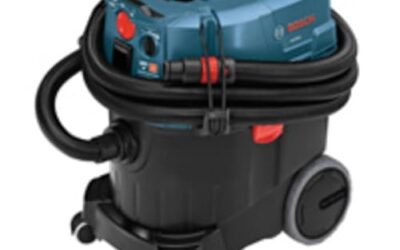
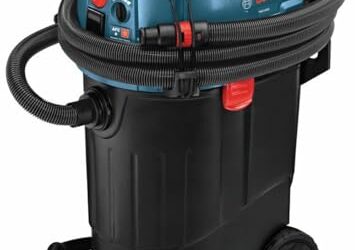
Bosch VAC140AH

Bosch’s extractor cleans its filter most often: the listing states automatic filter cleaning every 15 seconds, the shortest interval here, which suits dust-heavy tasks that load filters quickly. The HEPA filter is quoted at 99.97 percent capture at 0.3 microns, airflow is 150 CFM, and water lift reaches 97 inches, the strongest pull of the group for longer hoses. The tank is also the largest at 14 gallons. Note the wording difference, though: the listing claims HEPA filtration without calling the filter certified, so compliance-driven buyers should weigh that against the Makita before choosing.
Specs
- Tank: 14 gallons
- Airflow: 150 CFM
- Water lift: 97 inches
- Filter cleaning: Automatic, every 15 seconds
- Filtration: HEPA filter, 99.97 percent at 0.3 microns, per the listing
Best for: Drywall, concrete and long sanding sessions where filters load fast and hose runs are long.
Watch out for: The listing does not describe its HEPA filter as certified; check your job specification’s exact wording.
ASIN: B076CP3C9D
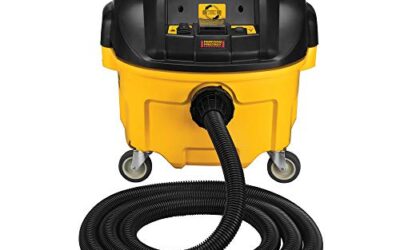
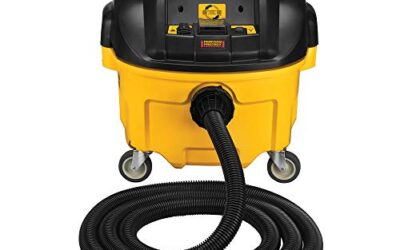
DeWalt DWV015

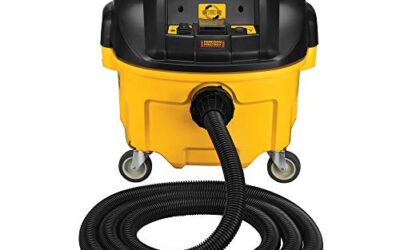
The DWV015 posts the highest airflow in this guide at 155 CFM, with 90 inches of water lift and a 15-amp motor, and its automatic filter cleaning pulses every 30 seconds to hold suction during use. The listing specifies HEPA filters capturing 99.97 percent at 0.3 microns. At 10 gallons the tank is the smallest here, which keeps the unit more manageable to move between floors and vehicles, in exchange for more frequent emptying on heavy debris work. DeWalt’s manual notes the machine meets the EPA’s HEPA-vacuum definition when fitted with its specified HEPA filters, a conditional worth honouring exactly as written.
Specs
- Tank: 10 gallons
- Motor: 15 amps
- Airflow: 155 CFM
- Water lift: 90 inches
- Filter cleaning: Automatic pulses every 30 seconds
- Filtration: HEPA filters, 99.97 percent at 0.3 microns, per the listing
Best for: Crews who want maximum airflow and tool-triggered extraction in a more portable size.
Watch out for: The 15-amp draw plus a big saw can trip a shared circuit; give it its own breaker where possible.
ASIN: B0C2BRWJ9K
Which One Fits Your Situation
The job specification names certified HEPA
Start and likely finish with the Makita VC4210L. It is the only listing here that uses the word certified for its HEPA main filter, and matching the specification’s language to the listing’s language is the safest way to buy. Keep the specified filter fitted and document the model and filter in your job paperwork.
All-day sanding that chokes filters
The Bosch VAC140AH is built for this, with cleaning every 15 seconds and the biggest tank of the three. Drywall and MDF dust load filters faster than any other common site dust, and the combination of frequent pulses, 150 CFM and 97 inches of lift is aimed squarely at keeping capture steady through a full shift.
A small crew moving between floors and jobs
Take the DeWalt DWV015. The 10-gallon tank and highest airflow make it the easiest to live with as a roving extractor, and tool-triggered operation means it runs only when the saw does. Watch the circuit loading, and empty the smaller tank before it becomes the reason suction drops. Keep a spare filter bag in the van and it is ready for the next call.
One extractor for the workshop bench
Any of the three will serve, so decide by hose length and circuit. Long runs to a mitre station favour the Bosch’s lift; a shared 20-amp bench circuit favours the Makita’s 12-amp draw; the DeWalt suits a dedicated outlet near the bench. In a fixed shop, add fleece bags where supported to stretch main-filter life.
Common Mistakes
- Reading HEPA on a headline and assuming certified, when the listing’s exact wording may claim less.
- Running the extractor with a standard filter fitted and believing the HEPA specification still applies.
- Judging by CFM alone while ignoring water lift, then finding capture weak at the end of a long hose.
- Putting a 15-amp extractor and a 15-amp saw on one circuit and blaming the machine for the trips.
- Emptying the tank without a mask because the dust is already captured; the finest fraction is exactly what is in there.
Frequently Asked Questions
Does automatic filter cleaning remove the need to change filters?
No. The pulses knock loose dust off the filter surface during work, which holds suction far longer, but filters still load internally over time and must be inspected, cleaned per the manual and eventually replaced. Treat the automatic system as what stretches the interval between interventions from hours to days, not as the end of filter maintenance.
What makes a filter certified HEPA rather than just HEPA?
Listings use the terms loosely, which is why this guide quotes each one exactly. A certified claim, as on the Makita listing, states the main filter itself meets the HEPA standard of 99.97 percent capture at 0.3 microns. Other listings state HEPA filters with the same efficiency figure without the certification wording. For regulated work, follow your specification’s language and the manufacturer’s documentation for the fitted filter.
Can these extractors pick up wet debris?
Dust extractors in this class are primarily dry machines, and wet pickup depends on the model’s stated design and filter fitted; a HEPA paper filter should not be used for wet work. Check the listing and manual for your model before introducing water, and expect to change the filtration setup if wet pickup is supported at all.
Is a bigger tank always better on site?
Only until you have to carry it. A 14-gallon tank empties less often but is heavy and awkward full of fine dust, while a 10-gallon unit moves between floors and vehicles more willingly. Match the tank to the job’s dust volume and your transport reality; for tool extraction with bags fitted, even the smallest tank here holds a long day’s fine dust.