Key takeaways
- Find the best HEPA dust extractors for construction cleanup, with certified HEPA filtration, strong CFM, and automatic filter cleaning for silica dust work.
Construction cleanup is not just about picking up debris. The fine dust left behind by cutting, grinding, drilling, and mixing concrete is the part that lingers in the air, settles into finished spaces, and creates the biggest compliance headaches on a jobsite. A standard shop vacuum can move bulk material, but it is not built to capture and contain the finest particles. That is where a dedicated HEPA dust extractor earns its place: certified HEPA filtration, sealed airflow, automatic filter cleaning, and tool-triggered operation designed around dust-producing work. The three extractors below were selected from their published listing specifications — not from detailed research — and each one is a purpose-built dust extractor rather than a general-purpose vacuum with a HEPA filter added as an afterthought.
As an Amazon Associate, we earn from qualifying purchases.
Quick answer
For most construction cleanup work, the Bosch VAC090AH is the most direct fit: it is a compact 9-gallon extractor with HEPA filtration, 150 CFM of airflow, automatic filter cleaning every 15 seconds, and power tool activation, and Bosch positions it specifically for OSHA silica Table 1 work. If you need more capacity and a quieter machine for longer days, the Makita VC4210L steps up to 11 gallons of wet/dry capacity with certified HEPA filtration, 148 CFM, and a published noise level of 60 dB(A). If your workflow already runs on a system platform and your work spans workshop and construction site use, the Festool CLEANTEC CT 36 EI HEPA offers 9.5 gallons of capacity, HEPA filtration, and Bluetooth capability in a corded 120V package.
Key takeaways
- Certified HEPA filtration is the dividing line: both the Bosch and the Makita publish 99.97% efficiency at 0.3 microns, which is the particle size range that matters most for fine construction dust.
- Automatic filter cleaning keeps suction consistent during long cleanup sessions, because fine dust blinds filters fast; all three picks address filter maintenance, and the Bosch and Makita publish automatic cleaning systems.
- Airflow (CFM) and water lift work together — CFM moves volume for cleanup, while water lift pulls dust through hoses and tool shrouds; the Bosch publishes 150 CFM with 97 inches of water lift, and the Makita publishes 148 CFM with 92 inches.
- Tool activation matters on real jobsites: an extractor that starts and stops with the power tool captures dust at the source instead of relying on the operator to remember a second switch.
The picks
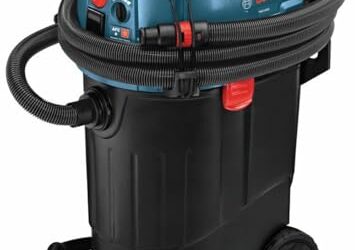
1. Bosch VAC090AH

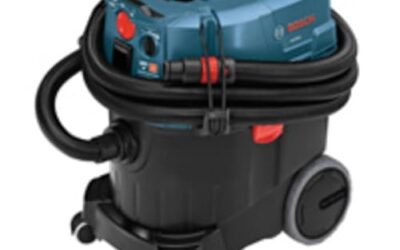
The Bosch VAC090AH is the most explicitly construction-focused machine in this group. It is a 9-gallon dust extractor with HEPA filtration — its description publishes 99.97% efficiency at 0.3 microns — paired with 150 CFM of airflow and 97 inches of static water lift. That combination is aimed at the two jobs a construction extractor actually does: capturing dust at a tool shroud under load, and moving enough air volume to clean up a work area afterward. Bosch positions this model for OSHA silica Table 1 work, which makes it the natural starting point for crews cutting or grinding concrete, masonry, or stone who need an extractor built around that compliance context.
The feature that keeps it working through a shift is its automatic filter cleaning, which cycles every 15 seconds to knock accumulated dust off the filter before suction falls off — a real issue with fine silica and drywall dust, which coat filter media quickly. Power tool activation lets the extractor switch on and off with the connected tool, so dust capture starts at the moment cutting starts. At 28 lbs, it is also the lightest pick here, which matters when the extractor moves between floors, rooms, and vehicles several times a day.
Specs
- Capacity: 9 gallons
- Filtration: HEPA, published at 99.97% efficiency at 0.3 microns
- Airflow: 150 CFM
- Water lift: 97 inches
- Filter cleaning: automatic, every 15 seconds
- Activation: power tool activation
- Positioning: OSHA silica Table 1 work
- Weight: 28 lbs
See the Bosch VAC090AH on Amazon
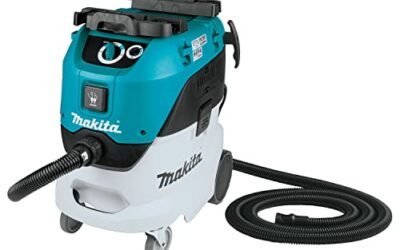
2. Makita VC4210L

The Makita VC4210L is the capacity pick. Its 11-gallon tank handles both wet and dry cleanup, which suits construction sites where the same machine might pick up slurry, washdown water, and dry dust in the same week. Its filtration is certified HEPA at 99.97% efficiency at 0.3 microns, and it publishes 148 CFM of airflow with 92 inches of water lift — figures in the same working range as the Bosch, delivered in a larger contractor-oriented package. Makita positions this extractor for contractor and concrete work, and the tool-activated outlet means a saw, grinder, or drill can switch the extractor automatically.
Two published details stand out for daily use. First, the noise level is listed at 60 dB(A), which is comparatively low for a machine in this class and relevant on occupied renovation sites or indoor work where a screaming vacuum wears on everyone nearby. Second, it includes automatic filter cleaning, so the filter is pulsed clean during operation rather than relying on the operator to stop and service it mid-task. At 35.3 lbs it is heavier than the Bosch, but that weight buys the larger tank and wet/dry flexibility, and for a crew that parks the extractor in one work zone for the day, capacity usually matters more than the last few pounds.
Specs
- Capacity: 11 gallons, wet/dry
- Filtration: Certified HEPA, 99.97% at 0.3 microns
- Airflow: 148 CFM
- Water lift: 92 inches
- Noise level: 60 dB(A)
- Filter cleaning: automatic
- Activation: tool-activated outlet
- Positioning: contractor and concrete work
- Weight: 35.3 lbs
See the Makita VC4210L on Amazon
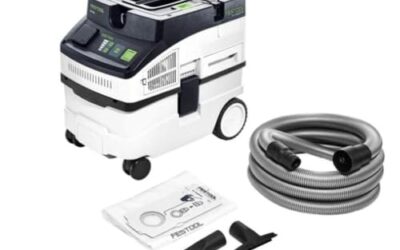
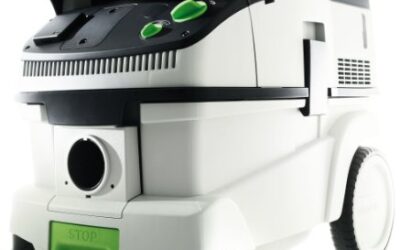
3. Festool CLEANTEC CT 36 EI HEPA

The Festool CLEANTEC CT 36 EI HEPA is the system-oriented pick. It holds 9.5 gallons and uses a HEPA filter, and its page’s published Recommended Uses list both Workshop and Construction Site — a fair reflection of where this machine fits: finish carpenters, remodelers, and tradespeople whose work moves between the shop and the site and who already work within the Festool ecosystem. It is a corded 120V machine rated at 800W, so it is built for sustained mains-powered operation rather than battery work.
The distinguishing published feature is Bluetooth capability, which in this class of extractor is about remote and tool-linked activation — starting extraction without walking back to the unit. At 39.3 lbs, it is the heaviest of the three picks, so it suits users who roll it into a work area and keep it there rather than carrying it between floors all day. For buyers whose cleanup work is mostly fine finishing dust — sanding, routing, and trim work alongside general construction cleanup — the CT 36 EI HEPA is the pick aligned with that workflow, while the Bosch and Makita lean harder into concrete and silica positioning.
Specs
- Capacity: 9.5 gallons
- Filtration: HEPA filter
- Recommended uses (as published): Workshop, Construction Site
- Power: corded, 120V, 800W
- Connectivity: Bluetooth capable
- Weight: 39.3 lbs
See the Festool CLEANTEC CT 36 EI HEPA on Amazon
How to choose
Start with the dust you actually produce. If your work involves concrete, masonry, mortar, or stone, silica dust is the governing concern, and you should prioritize an extractor whose published specifications include certified HEPA filtration and positioning for silica work — that is the Bosch VAC090AH’s stated territory, and the Makita VC4210L is published for contractor and concrete use as well. For general construction cleanup — drywall, wood, and mixed debris — HEPA filtration still matters because the fine fraction of any construction dust is what stays airborne longest, but tank capacity and wet/dry capability may drive the decision instead.
Next, read the airflow and water lift figures together rather than in isolation. CFM describes how much air the machine moves, which governs area cleanup and how well it keeps up with a tool producing dust across a wide shroud. Water lift describes suction pressure, which governs how effectively the extractor pulls dust through a hose and out of a tool’s dust port. The Bosch publishes 150 CFM and 97 inches of water lift; the Makita publishes 148 CFM and 92 inches. Those are close enough that either machine sits in the same working class — the choice between them turns more on capacity, weight, and wet/dry needs than on a meaningful airflow gap.
Filter cleaning deserves more weight than it usually gets. Fine construction dust loads a filter quickly, and as the filter blinds, suction drops and capture at the tool gets worse — often gradually enough that the operator does not notice. Automatic filter cleaning, published on both the Bosch (every 15 seconds) and the Makita, addresses this during operation. If you run long grinding or cutting sessions, treat automatic cleaning as a core requirement rather than a convenience.
Finally, match the machine to your work pattern. Tool activation — published on the Bosch as power tool activation and on the Makita as a tool-activated outlet — is close to essential for source capture, because dust is only captured if the extractor is actually running when the tool runs. Weight matters if the extractor travels: at 28 lbs the Bosch is the easiest to carry between floors, while the Makita (35.3 lbs) and Festool (39.3 lbs) make more sense as set-in-place machines. And if your day mixes wet and dry pickup, the Makita’s published wet/dry capacity is the deciding specification.
Who should skip
Skip this category entirely if your cleanup is only coarse debris — chunks of lumber, packaging, and swept rubble. A basic wet/dry shop vacuum handles bulk material fine, and a HEPA extractor’s filtration and filter-cleaning systems are wasted on work that never produces fine airborne dust. Likewise, if you only need occasional household or garage cleanup, these are professional machines built and specified for jobsite duty cycles, and they are more machine than the task calls for.
Skip the Festool if your work is primarily concrete and silica-driven and you want the extractor whose published positioning speaks directly to that work — the Bosch and Makita state that context more explicitly. Skip the Makita if the extractor has to be carried up stairs and between rooms constantly; its capacity is an advantage only when it stays put. And skip all three if your tools and workflow require a cordless extractor — every pick here is a corded machine designed for sustained mains-powered extraction.
FAQ
What makes a dust extractor different from a shop vacuum with a HEPA filter?
A dust extractor is designed as a sealed system around the filter: certified HEPA filtration, automatic filter cleaning to maintain suction under fine-dust load, and tool activation so extraction runs in step with the tool producing the dust. A shop vacuum with a HEPA filter can share the filter rating but typically lacks the sealed airflow path, the filter-cleaning system, and the tool-triggered operation that keep capture consistent during construction work.
Why does the 0.3-micron figure matter for construction dust?
HEPA efficiency is conventionally rated at 0.3 microns because particles around that size are among the hardest to capture — larger particles are intercepted more easily, and smaller ones are caught by diffusion. When the Bosch and Makita publish 99.97% efficiency at 0.3 microns, that is the benchmark figure for the finest fraction of dust, which includes the respirable particles produced when cutting or grinding concrete and masonry.
How do these extractors relate to OSHA silica requirements?
OSHA’s silica standard includes Table 1, which pairs specific construction tasks with specified dust controls, and vacuum dust collection with HEPA filtration is one of the control methods it references. Bosch positions the VAC090AH for OSHA silica Table 1 work. An extractor is one part of compliance — the tool shroud, hose connection, work practices, and the rest of your silica plan still matter — so treat the extractor’s published positioning as a starting point and confirm the full setup against the task you are performing.
Is automatic filter cleaning really necessary?
For fine construction dust, it is close to it. Silica, drywall, and concrete dust coat filter media quickly, and a loaded filter means falling suction and weaker capture at the tool — often without any obvious sign to the operator. The Bosch cleans its filter automatically every 15 seconds and the Makita publishes automatic filter cleaning as well, so suction stays consistent through long sessions instead of degrading until someone stops work to service the filter manually.
Final verdict
For construction cleanup centered on concrete, masonry, and silica-generating work, the Bosch VAC090AH is the clearest match: published HEPA filtration at 99.97% efficiency at 0.3 microns, 150 CFM, filter cleaning every 15 seconds, tool activation, explicit OSHA silica Table 1 positioning, and the lightest weight here at 28 lbs. For crews who need more capacity, wet/dry flexibility, and a quieter machine for occupied sites, the Makita VC4210L is the step-up pick, with certified HEPA filtration, 148 CFM, automatic filter cleaning, and a published 60 dB(A) noise level in an 11-gallon contractor package. For tradespeople working between workshop and construction site within a system platform, the Festool CLEANTEC CT 36 EI HEPA brings 9.5 gallons, HEPA filtration, and Bluetooth capability to that workflow. All three are genuine dust extractors rather than shop vacuums with upgraded filters — pick by the dust you produce, the capacity you need, and how the machine will move through your workday.
Product and ASIN Reference
| Product | ASIN |
|---|---|
| Bosch VAC090AH | B076CSZXY3 |
| Makita VC4210L | B07ZMN75V2 |
| Festool CLEANTEC CT 36 EI HEPA | B091J25T8S |