Key takeaways
- Compare HEPA dust extractors for small production shops on certified filtration, airflow, tank size and filter cleaning, with picks from Bosch, DEWALT and Fein.
The real decision when buying a dust extractor for a small production shop is not raw suction. It is whether the fine dust from sanding, routing, cutting and grinding stays inside the machine hour after hour, or slowly coats the shop and the crew’s lungs. A general-purpose shop vacuum moves plenty of air, but its filter is usually the weak point: it loads up with fine particles, suction fades, and the smallest dust passes straight through and back into the room.
This guide is for small production shops cutting and sanding wood, MDF, composites or similar materials every day, for shops that need documented HEPA filtration for compliance work, and for owners replacing a clogging shop vac with a machine built for tool-connected extraction. Every model below was picked from its Amazon product title and listing specifications, with filtration type, airflow and tank size taken from the listing itself.
Quick Picks
As an Amazon Associate we earn from qualifying purchases.
| Product | Best for | Key spec from title |
|---|---|---|
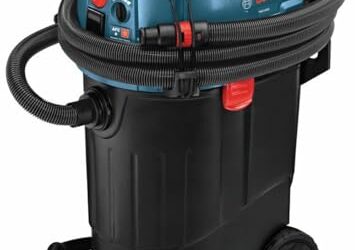
| Bosch VAC090AH 9 Gallon Dust Extractor | All-round extraction at one main workstation | Auto Filter Clean and HEPA Filter |
| Bosch VAC140AH 14 Gallon Dust Extractor | Long production runs between emptying | 14 Gallon with Auto Filter Clean and HEPA Filter |
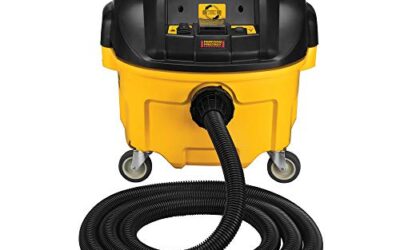
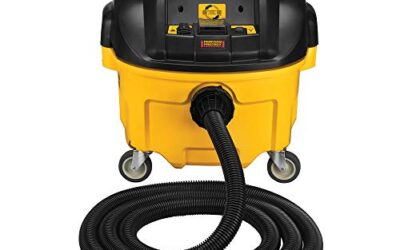
| DEWALT DWV010 8-Gallon Dust Extractor | Shops that need EPA RRP lead-safe capability | HEPA Dust Extractor with Automatic Filter Cleaning |
| Fein Turbo II HEPA Set | Noise-sensitive shops and indoor work | 151 CFM Suction, Quiet 66 dB Operation |
How to Choose
Filtration: certified HEPA versus HEPA-style filters
Start with the filter, because it decides whether fine dust stays captured. Look for a listing that names a HEPA filter outright and states its efficiency at 0.3 microns, the particle size that standard filters struggle with most. Some machines are only “HEPA ready,” meaning the filter that makes them compliant is a separate purchase, and some shop vacs accept a HEPA cartridge without sealing the rest of the housing. For a production shop, the safer pattern is a machine sold with the HEPA filter included, paired with a fleece filter bag that catches the bulk load before dust ever reaches the main filter.
Airflow and water lift for your tools
Airflow, listed in CFM, describes how much air the extractor moves, while static water lift describes how hard it pulls against resistance from long hoses and small tool ports. Sanders, routers and track saws in a small shop typically sit in the range covered by the extractors here, roughly 130 to 155 CFM on their listings. High lift matters when the dust port is small or the hose run is long, because suction at the tool drops as resistance rises. Match the machine to your dustiest tool rather than your cleanest one, and remember that a loaded filter quietly eats into both numbers.
Tank size and how often you stop to empty
Tank capacity decides how your day is interrupted. An 8 or 9 gallon drum under a busy sander can fill faster than expected, especially with fluffy MDF and sanding dust that takes up more room than its weight suggests. A 14 gallon tank stretches the interval between changes, which suits a shop running one extractor across a full shift. Keep in mind that the usable volume is the filter bag’s volume, not the drum’s: bags fill before the tank looks full, and a bag changed on schedule protects the HEPA filter and keeps suction consistent.
Filter cleaning, tool activation and running costs
Automatic filter cleaning pulses air through the filter at set intervals, 15 seconds on the Bosch models and 30 seconds on the DEWALT in this guide, so suction stays steadier through fine-dust work without stopping to knock the filter clean by hand. Tool activation is the other daily convenience: plug the tool into the extractor’s outlet and the vacuum starts and stops with the trigger. Finally, price out the consumables before choosing, in general terms: fleece bags and replacement HEPA filters are recurring costs, and a machine whose bags are easy to find will cost less attention over its life.
The 4 Best Options
Bosch VAC090AH 9 Gallon Dust Extractor

The VAC090AH is the balanced starting point for a small shop that wants one extractor living at its main sanding and cutting station. Its listing pairs a 150 CFM maximum airflow rating with a HEPA filter and an automatic cleaning cycle that fires every 15 seconds, which is exactly the combination that keeps suction from fading during long sanding sessions. Power tool activation lets a connected sander or saw switch the vacuum on and off, and the included fleece filter bag gives the main filter a first line of defense against fine dust.
Specs
- Tank capacity: 9 gallons
- Airflow: 150 CFM maximum
- Static water lift: 97 in. maximum
- Filtration: HEPA filter, captures 99.97 percent of particles at 0.3 microns and larger
- Filter cleaning: automatic, activates every 15 seconds
- Included: HEPA flat filter, fleece filter bag, 9.85 ft vacuum hose, bend nozzle, power tool adapter nozzle
- Weight: 28 pounds
- Power source: 120V corded
Best for: A small shop’s main workstation, where one extractor serves sanders and saws all day.
Watch out for: The 9 gallon bag fills quickly on high-volume sanding, so keep spare fleece bags on hand.
ASIN: B076CSZXY3
Bosch VAC140AH 14 Gallon Dust Extractor

The VAC140AH runs the same extraction package as its 9 gallon sibling, 150 CFM, the same HEPA filter rating and the same 15-second automatic filter cleaning, but wraps it around a 14 gallon tank. That extra capacity is the whole point: a production shop running an extractor across a full shift stops less often to swap bags, and the machine spends more of its day extracting instead of being serviced. It also carries Bosch’s Power Broker dial, which lets the operator dial suction down for delicate sanding or to manage the shared circuit when a tool is plugged into the extractor’s outlet.
Specs
- Tank capacity: 14 gallons
- Airflow: 150 CFM maximum
- Static water lift: 97 in. maximum
- Filtration: HEPA filter, captures 99.97 percent of particles at 0.3 microns and larger
- Filter cleaning: automatic, activates every 15 seconds
- Features: power tool activation, Power Broker suction dial
- Included: 14-gallon dust extractor with auto filter clean and HEPA filter
- Power source: 120V corded
Best for: Shops running long production sessions that want fewer bag changes per shift.
Watch out for: The larger drum is taller and heavier to move and store, so measure your space before choosing it over the 9 gallon model.
ASIN: B076CP3C9D
DEWALT DWV010 8-Gallon Dust Extractor
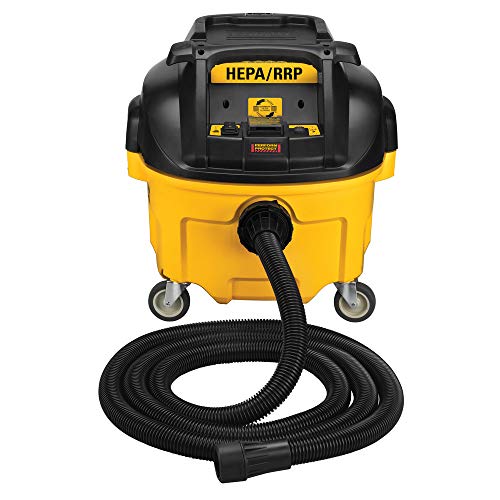
The DWV010 is the compact option here, an 8 gallon machine built around a 15 amp motor and an automatic filter cleaning system that pulses every 30 seconds to hold suction during fine-dust work. Its listing describes a HEPA dust extractor, and DEWALT positions it for lead renovation work: the listing notes it meets the EPA’s Renovation, Repair and Painting rule when fitted with the specified DWV9330 filters, which matters for shops doing refinishing or restoration work alongside production. At roughly 22 pounds with a 15 foot hose, it is also the easiest of these machines to carry between benches or rooms.
Specs
- Tank capacity: 8 gallons
- Motor: 15 amp
- Airflow: 150 CFM
- Filtration: HEPA filters; meets EPA RRP rule when used with DWV9330 filters, per the listing
- Filter cleaning: automatic, every 30 seconds
- Hose length: 15 feet
- Noise level: 80 decibels
- Weight: about 22 pounds
Best for: Shops that split time between production work and renovation or refinishing jobs needing documented HEPA capability.
Watch out for: The RRP capability depends on fitting the exact filters the listing names, so confirm which filters are in the box before relying on it for lead work.
ASIN: B00OA02TZ0
Fein Turbo II HEPA Set

The Turbo II HEPA Set is the pick when noise is a genuine constraint, because its listing leads with a 66 dB operating level alongside 151 CFM of suction, the strongest airflow figure in this group. Fein sells this version as a set with the HEPA filter and accessories included, which removes the guesswork of upgrading a base machine. The auto-start outlet switches the extractor on with the connected tool, the anti-static system reduces shocks and dust cling around the hose, and the long cord and hose combination gives it the widest working radius here for moving between stations in a small shop.
Specs
- Tank capacity: 8.5 gallons
- Airflow: 151 CFM
- Static water lift: 98 in.
- Filtration: HEPA filter included in the set
- Noise level: 66 decibels
- Power: 1,100 W maximum input
- Hose length: 13 feet
- Included: HEPA filter and accessory kit, per the listing title
Best for: Noise-sensitive shops, indoor installs and shared spaces where a loud extractor disrupts work.
Watch out for: Fein sells several Turbo II variants, and not all of them include the HEPA filter, so confirm the listing says HEPA Set before ordering.
ASIN: B00K74N8BC
Which One Fits Your Situation
One extractor at a busy sanding bench
Choose the Bosch VAC090AH. Sanding produces the finest, most filter-clogging dust in most small shops, and the 15-second automatic cleaning cycle plus the fleece bag keep its suction steadier through a full day of it. The 9 gallon tank is a reasonable match for a single station, and tool activation means the extractor is only running, and only wearing its filter, while the sander is actually cutting.
A full shift of mixed production work
Choose the Bosch VAC140AH. When several operators feed work to one extractor across a shift, bag changes become the bottleneck, and the 14 gallon tank stretches those intervals further than anything else here. The shared 150 CFM platform and HEPA rating carry over from the smaller Bosch, so you are trading footprint for uptime rather than giving up filtration or cleaning automation to get the capacity.
Refinishing and restoration alongside production
Choose the DEWALT DWV010. It is the only machine in this group whose listing ties it directly to the EPA’s lead renovation rule with a named filter set, which simplifies documentation when a job calls for it. It is also the lightest and most portable option here, so it can follow the work from the shop to a client’s space and back without becoming a two-person lift.
A shop where noise carries
Choose the Fein Turbo II HEPA Set. At a listed 66 dB it runs well below the level of a typical shop vacuum, which matters in small premises where the extractor shares air with a showroom, an office or neighboring tenants. You are not giving up extraction to get the quiet: its 151 CFM listing figure is the highest in this guide, and the HEPA filter is included in the set.
Common Mistakes
- Buying a “HEPA ready” extractor and never fitting the HEPA filter, which leaves the machine filtering like a standard shop vac.
- Running an extractor without filter bags to save on consumables, which loads the HEPA filter with bulk dust and shortens its life.
- Judging by CFM alone and ignoring water lift, then finding suction weak at the end of a long hose or a small tool port.
- Assuming every variant of a model line includes the same filter, when base versions often ship with a standard filter instead of HEPA.
- Ignoring the amp draw of the extractor plus a tool on its outlet, which can trip a shared shop circuit mid-cut.
Frequently Asked Questions
Does a small production shop really need a certified HEPA filter?
For fine dust from MDF, sanding and composites, yes, it is the filter class that captures the 0.3 micron particles most likely to stay airborne and be inhaled. Listings for the machines above state 99.97 percent capture at that size. If your work touches regulated material such as silica or lead paint, documented HEPA filtration is also the starting point for compliance.
What is the difference between a dust extractor and a shop vacuum?
A dust extractor is built around tool connection: it has an auto-start outlet, finer sealed filtration and usually automatic filter cleaning, and its airflow figures are published for extraction at a tool port. A shop vacuum is a general cleanup machine with a simpler filter and no activation outlet. The two overlap on floor cleanup, but only the extractor is designed to keep fine dust captured all day.
How often do filter bags and HEPA filters need changing?
The bag is the consumable you will change most: swap it when it is full rather than on a fixed calendar, because an overfilled bag strangles airflow before the tank looks full. The HEPA filter behind it lasts far longer when bags are used consistently, since the bag catches the bulk load. Follow the extractor’s manual for the filter interval, and treat a lasting drop in suction as the signal to inspect both.
Can one extractor serve several tools in a small shop?
Yes, within limits. An extractor in the 150 CFM class handles one tool at a time comfortably, so a small shop can move the hose between a sander, a track saw and a router as work flows. Running two dust ports at once splits the airflow and weakens capture at both tools, so shops with two operators producing dust simultaneously usually do better with a second extractor or a larger central collector.