Our Short List of 3

- Best for: A medium rectangular back lawn watered from one or two positions.
- Brand: Melnor
- Item model number: 65148AMZ
- Coverage stated on listing: 2,800 Sq. Ft.
- Nozzles: 16 Precision Nozzle

- Best for: A level front lawn where the sprinkler is moved often and needs to sit flat.
- Brand: Orbit
- Item model number: 56281Z
- Style: Oscillating
- Base: Metal base

- Best for: Corners, part-circle areas and mixed lawn shapes a fan pattern cannot follow.
- Brand: Orbit
- Item model number: 58573N
- Mounting: Metal T-Spike
- Spray patterns: Six spray patterns
All 4 Picks at a Glance
| Product | Specs | Action |
|---|---|---|
| Melnor 65148AMZ TurboTek Oscillating Sprinkler |
| Check price on Amazon |
| Orbit 56281 Oscillating Water Sprinkler |
| Check price on Amazon |
| Orbit H2O-Six Gear-Drive Sprinkler on Metal T-Spike |
| Check price on Amazon |
 Melnor XT Metal Turbo Oscillating Sprinkler |
| Check price on Amazon |
Key takeaways
- Four hose end lawn sprinklers compared by coverage pattern, base or spike mounting and adjustment, for rectangular lawns, wide areas and awkward corners.
A hose end sprinkler looks like the simplest purchase in the garden aisle, yet the wrong pattern wastes water every single run. An oscillator that overshoots a narrow side lawn soaks the driveway, a rotary head that throws too far drenches a fence, and a lightweight base that tips or drags across the grass leaves dry arcs behind the hose bend. The real decision is matching the shape of the spray to the shape of your lawn, then checking that the base or spike will stay put on your soil while the hose pulls against it.
This guide is for homeowners watering from an outdoor faucet with a standard garden hose, with no buried lines and no plans to dig any. Every model below was chosen from the product name and stated specifications on its own Amazon listing, so the coverage figures, nozzle counts and mounting styles quoted here come from the listing itself rather than from a brand brochure or a roundup written about a different model in the same range.
Quick Picks
As an Amazon Associate we earn from qualifying purchases
| Product | Best for | Key spec from title |
|---|---|---|
| Melnor 65148AMZ TurboTek Oscillating Sprinkler | A medium rectangular back lawn watered from one hose position | 2,800 sq. ft., 16 Precision Nozzle |
| Orbit 56281 Oscillating Water Sprinkler | A front lawn where a low metal base needs to stay flat and visible | Metal Base |
| Orbit H2O-Six Gear-Drive Sprinkler on Metal T-Spike | Odd corners and part-circle areas a rectangle pattern cannot reach | Six spray patterns, Metal T-Spike |
| Melnor XT Metal Turbo Oscillating Sprinkler | A larger open lawn that needs a wider sweep from a single spot | Waters up to 3600 sq. ft. |
How to Choose
Match the spray shape to the lawn shape first
Start with geometry, not with the biggest coverage number on the box. A rectangular or gently curved lawn suits an oscillating bar, because the fan of water travels back and forth in a shape that roughly mirrors the grass. A square patch, a corner bed or a strip beside a path suits a rotary or gear-drive head, where you can limit the arc instead of flooding the whole sweep. For example, a long side return that is far narrower than it is long will waste less water with a part-circle setting than with a full oscillating fan that keeps hitting the wall. Sketch the lawn, mark where the hose reaches, and only then compare models.
Read coverage figures as a maximum, not a promise
The square footage and diameter figures on a listing describe the widest setting under suitable water pressure, not the area every home will achieve. A long hose run, an older faucet or several bends in the line can shrink the throw noticeably, so a sprinkler that only just covers your lawn on paper may fall short in practice. As a working example, if your back lawn measures close to the stated limit of an oscillating model, choosing the next pattern type or planning two shorter positions is safer than assuming the maximum. Keep the stated figure as a ceiling, place the sprinkler, and be ready to move it once rather than buying on the headline number alone.
Choose a base or a spike for your ground
A flat sled base sits on top of the grass and moves quickly, which suits firm, level lawns and renters who reposition the sprinkler often. A spike pushes into the soil and resists the sideways pull of a charged hose, which suits softer ground, slopes and corners where a base would creep. The Orbit H2O-Six in this guide uses a metal T-spike, while the other three sit on bases, and that difference matters more in daily use than small gaps in coverage. If your lawn is freshly aerated or sandy, a spike usually holds its aim better; on hard, dry ground in midsummer, a base avoids the struggle of pushing a spike into baked soil.
Check how the pattern is adjusted
Adjustment decides whether you can trim the spray off paths, beds and parked cars without moving the whole unit. Sliding range adjusters on an oscillator shorten or lengthen the sweep, width controls narrow the fan, and a rotary head with selectable patterns changes the shape itself. The Melnor TurboTek below lists sliding range adjusters, while the H2O-Six lists six spray patterns, two very different answers to the same problem. Think about the obstacle you hit most often: a driveway along one side calls for range trimming, while a corner planting calls for a different arc. Pick the control that solves your obstacle, not the one with the longest feature list.
The 4 Best Options
Melnor 65148AMZ TurboTek Oscillating Sprinkler
- Best for: A medium rectangular back lawn watered from one or two positions.
- Brand: Melnor
- Item model number: 65148AMZ
- Coverage stated on listing: 2,800 Sq. Ft.
- Nozzles: 16 Precision Nozzle
A medium rectangular back lawn watered from one or two positions.
The rectangular fan still overshoots narrow side returns, so corner-heavy yards need a different pattern.
This is the straightforward pick for a medium rectangular lawn that gets watered from one or two hose positions. The listing describes a turbo oscillating design with sixteen precision nozzles and sliding range adjusters, so you can shorten the sweep when the far end reaches a patio or a bed instead of shutting the water off early. The QuickConnect bundle wording on the listing also suits households that swap the hose between a sprinkler, a hand nozzle and a pressure washer, because the adapter stays on the hose end. For a typical suburban back lawn with no sharp corners, this balanced pattern is the easiest one to live with.
Orbit 56281 Oscillating Water Sprinkler
- Best for: A level front lawn where the sprinkler is moved often and needs to sit flat.
- Brand: Orbit
- Item model number: 56281Z
- Style: Oscillating
- Base: Metal base
A level front lawn where the sprinkler is moved often and needs to sit flat.
The listing gives no headline coverage figure, so check your lawn size against the product page before ordering.
Choose this Orbit when you want an oscillating fan but prefer a metal base under it. The listing names a metal base for the 56281, model number 56281Z, and describes adjustable oscillation, which is the combination that suits a front lawn where the sprinkler sits in view and gets moved for mowing every week. A heavier-feeling base resists the small hops and shifts a charged hose can cause on short grass, helping the pattern stay where you aimed it. It covers the same general job as the Melnor above, so the choice between them comes down to base construction and how each one adjusts, rather than to a different kind of watering altogether.
Orbit H2O-Six Gear-Drive Sprinkler on Metal T-Spike
- Best for: Corners, part-circle areas and mixed lawn shapes a fan pattern cannot follow.
- Brand: Orbit
- Item model number: 58573N
- Mounting: Metal T-Spike
- Spray patterns: Six spray patterns
Corners, part-circle areas and mixed lawn shapes a fan pattern cannot follow.
The spike needs soil soft enough to push into, so rock-hard or very stony ground makes setup harder.
This gear-drive model solves a different problem from the two oscillators. Its listing states six spray patterns and an adjustable coverage range up to 80 feet in diameter, with a rotating head that can run from a partial arc to a full circle, so one unit can water a corner, a half-moon bed edge or a round patch of lawn. The metal T-spike anchors it against hose pull, and the listing notes a flow-through outlet for connecting additional sprinklers, plus whisper-quiet gear-drive operation. Pick it when your watering map has awkward shapes that a rectangular fan keeps missing or flooding, rather than one clean open rectangle.
Melnor XT Metal Turbo Oscillating Sprinkler
- Best for: A wide, open rectangular lawn that needs fewer sprinkler moves per session.
- Brand: Melnor
- Coverage stated on listing: Waters up to 3600 sq. ft.
- Style: Turbo Oscillating Sprinkler
- Construction: Metal, from the product name on the listing
A wide, open rectangular lawn that needs fewer sprinkler moves per session.
The listing copy available for this model is brief, so confirm the adjustment details on the product page before buying.
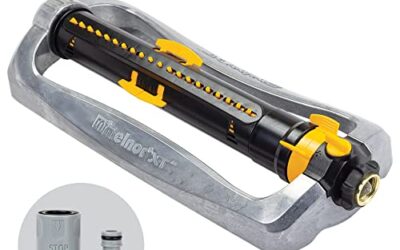
For a larger open lawn, this Melnor XT steps up the stated coverage while keeping the familiar oscillating layout. The listing headline says it waters up to 3600 sq. ft., and the metal construction in its name suits owners who have cracked a lightweight base before or who leave the sprinkler outdoors for long stretches of the season. The turbo oscillating action gives an even back-and-forth fan for big rectangles, playing fields and wide front lawns where the smaller TurboTek would need extra moves. If your lawn is one broad, simple shape and your main frustration is repositioning, this is the model aimed at you.
Which One Fits Your Situation
You water one plain rectangle behind the house
Stay with an oscillator and keep the routine simple. The Melnor TurboTek covers a medium lawn from one position, and its sliding range adjusters let you pull the far end of the sweep back from the patio without dragging the base around. Move it once for very long lawns rather than stretching the pattern until the far grass gets a thin share. This is the lowest-effort setup in the guide, and for a plain rectangle there is little reason to complicate it with spikes or multiple patterns.
Your lawn wraps around corners and beds
Pick the Orbit H2O-Six on its spike. A fan-shaped spray cannot bend around a corner, so it either misses the return strip or soaks the path beside it. The gear-drive head lets you set a partial arc and choose among six patterns, which means the water follows the grass you actually have. Push the spike in where the hose reaches comfortably, set the arc, and leave the oscillators for the open parts of the yard if you water those on a different day.
You keep repositioning a sprinkler on a big open lawn
Look at the Melnor XT Metal Turbo model first, because its stated coverage is the widest of the oscillating pair here. Fewer moves means fewer chances to leave a dry stripe between two positions, which is the most common flaw in large-lawn watering. Set it centrally, run it, and check the far corners before assuming one position is enough. If the edges still fall short, split the lawn into two halves rather than opening the pattern wider and watering the street.
The sprinkler lives on a front lawn in full view
Choose the Orbit 56281 with its metal base. It sits flat, moves quickly when you mow, and the adjustable oscillation lets you keep water off the sidewalk where people walk. Front lawns also tend to be watered in shorter, more frequent sessions, so a base you can grab and relocate in seconds beats a spike you have to work out of the soil each time. Aim the first run carefully, note where the fan lands, and repeat that placement.
Common Mistakes
- Buying the largest coverage figure for a small lawn, then spending every session trying to shrink a pattern that wants to throw far past the grass.
- Watering a corner or L-shaped yard with a rectangular fan, which guarantees either a dry return strip or a soaked path, and often both at once.
- Dragging a charged hose sideways across a lightweight base, pulling the sprinkler off aim a little more with every move until the pattern no longer matches the lawn.
- Leaving a spike sprinkler in hard, dry soil all season and then forcing it deeper, instead of watering first or choosing a base model for baked ground.
- Running one long session from a single position on a big lawn instead of two shorter placements, which leaves the overlap zone lush and the far edges thin.
Frequently Asked Questions
How do I stop an oscillating sprinkler watering the driveway?
Use the range adjustment before you move anything. On a model with sliding range adjusters, such as the Melnor TurboTek listed here, shortening the sweep pulls the fan back from hard surfaces at the far end. If only one side overshoots, recentre the sprinkler so the pattern sits squarely on the grass, then trim again. A part-circle rotary head is the better tool when the driveway runs along the side rather than at the end.
Is a spike sprinkler better than a base sprinkler?
Neither is better in general; they suit different ground. A spike, like the metal T-spike on the Orbit H2O-Six, holds its aim against hose pull on soft soil and slopes. A flat base is faster to place and kinder to hard or stony ground, and it moves easily for mowing. Match the mounting to your soil and to how often you relocate the sprinkler, and the pattern will stay where you set it.
Why does my sprinkler cover less than the figure on the listing?
The stated coverage is a maximum at the widest setting, and your water pressure, hose length and hose bends all reduce the throw. A sprinkler at the end of a long line rarely reaches its headline figure. Shorten the run, open the faucet fully, and check that the hose is not kinked where it leaves the tap. If the lawn still outgrows one position, water it in two placements instead of expecting the maximum every time.
Can I connect two hose end sprinklers together?
Only models whose listing states a flow-through outlet support that arrangement, and the Orbit H2O-Six in this guide lists one for connecting multiple sprinklers. Remember that each added unit shares the same supply, so the throw of both will drop. For most home lawns, running one sprinkler at full pressure and moving it once gives more even coverage than chaining two at reduced pressure, unless your faucet delivers a strong flow.